Most B2B companies have two teams quietly working on the same outcome from opposite sides of a wall.
Customer Success owns onboarding, QBRs, and renewal conversations. Customer Marketing owns adoption campaigns, expansion plays, advocacy programs, and lifecycle communications. Both teams are measured - directly or indirectly - on Net Revenue Retention. Both teams want the same thing: customers who activate fast, see value clearly, and grow over time.
But they operate in parallel, not together. CS holds the signal. Marketing holds the channels. Neither has the full picture, and the customer feels the seams.
QBRs surface usage shifts, new stakeholders, performance changes, and adoption gaps every quarter. Onboarding milestones tell you exactly when a customer is ready for the next message. Renewal indicators show you which accounts need a save play and which are ready for expansion.
These signals exist. They just don’t flow between the teams that need them.
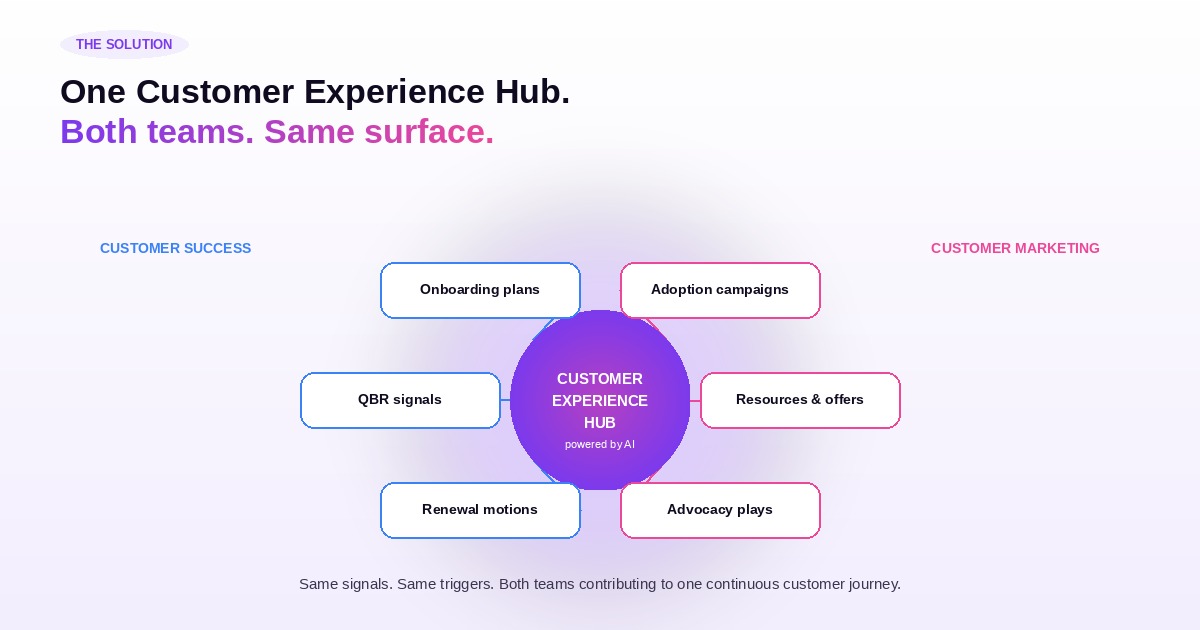
The fix isn’t another tool layered on top, and it isn’t a new RACI document. It’s a shared operating system - a customer experience hub that gives CS and customer marketing a common surface, common data, and a common set of triggers to act on.
This is the playbook for what that looks like and how to build it as a partnership.
The problem: two teams, one customer, zero shared system
Walk into most B2B companies and you’ll find CS and customer marketing running three motions in parallel - neither team with full visibility into the other’s work.
Onboarding is owned by CS. It lives in a CSM’s project plan or a generic LMS. Completion is tracked manually inside the CS tool. Customer marketing finds out a customer activated weeks after it happened, if at all - which means activation-triggered campaigns either don’t fire or fire late, missing the moment when the customer is most receptive to the next message.
QBRs are owned by CS. They live in slide decks. Each CSM builds their own. Quality varies. The customer sees the deck once, then it disappears. The signals inside - declining engagement, new stakeholders, expansion-ready usage patterns - never reach customer marketing in time to trigger anything. Marketing runs expansion campaigns based on segment, not based on the actual signals CS surfaced last week.
Renewal is technically a shared motion, but in practice it kicks in 90 days before contract end with CS leading the conversation. By then the customer’s experience over the prior 12 months has already determined the outcome. Customer marketing’s lifecycle programs were running the whole time - but they weren’t shaped by the QBR insights or onboarding patterns that would have made them relevant.
Three motions, one customer, zero shared system. That’s the gap.
What a customer experience hub actually is
A customer experience hub is a shared operating layer where CS and customer marketing both work - not a portal with a brand skin, not a marketing nurture program with a different login screen.
It does four things:
It centralizes the signals. Onboarding milestones, QBR notes, product usage, support themes, NPS, expansion intent - in one place where both teams can see them.
It hosts the journeys. Onboarding paths, QBR experiences, renewal preparation, expansion plays - built once, personalized at scale, surfaced inside the customer’s own hub.
It triggers the next action. When a customer hits an onboarding milestone, the customer marketing journey for that segment activates automatically. When a QBR surfaces an expansion signal, the right play is queued. When a renewal indicator fires, the lifecycle journey shifts.
It measures the joint outcome. Activation velocity, time-to-value, NRR contribution, expansion pipeline - attributed to the shared motion, not split between two teams’ dashboards.
For CS, a customer experience hub means three things shift.
Onboarding stops being a bottleneck. Instead of a CSM walking each customer through the same setup deck, the hub hosts the journey. The customer self-serves through milestones. The CSM gets time back for the conversations that actually need a human. And every milestone the customer hits is a signal that fires the next step in the customer marketing program.
QBRs become continuous and shared. The QBR isn’t a slide deck anymore - it’s a living surface inside the customer hub. The CSM updates it. The customer revisits it. Customer marketing builds on top of it. The QBR becomes the source of truth for the whole account journey, not a quarterly artifact.
Renewal becomes the output of the system. Renewals stop being a 90-day fire drill. The signals that predict renewal — adoption depth, executive engagement, value realization — are visible in the hub all year. Customer marketing’s programs reinforce them in real time. By the time the renewal conversation lands, the work is mostly done.
What changes for customer marketing
For customer marketing, a customer experience hub closes the loop on three things.
Activation campaigns get triggered by real signals. Instead of segmenting by tenure or industry, customer marketing triggers off onboarding milestones the CSM owns. The campaign fires the day the customer hits the milestone — not three weeks later when a batch job runs.
Expansion programs run on QBR insights. When a CSM logs an expansion signal in a QBR, the customer marketing journey for that play queues up. The customer sees the right message at the right moment, on a surface they already use, framed by the value story their CSM is telling.
Advocacy and references compound. Customers who hit milestones, renew, and expand are exactly the ones customer marketing wants in the advocacy program and reference program. The hub makes that pipeline visible — and routes the request at the moment of highest receptivity, not in a quarterly campaign.
What 8x faster onboarding actually looks like
Vidyard ran the playbook. Their onboarding used to take ~2 months — a CSM walking each customer through setup, training, and adoption. They moved onboarding into a shared customer experience hub. Same content, but now the customer self-served through the journey, milestones triggered the next step, and the CSM was freed to handle the conversations that actually needed a human.
Onboarding dropped from ~2 months to ~1 week. 8x faster.
The same shift happened with QBRs. Personalized QBRs used to be reserved for top accounts because the manual lift was too high. Once the QBR lived inside the hub — built once, personalized at scale — Vidyard ran personalized QBRs for 100% of their customer base. Every customer, every quarter.
What made it work wasn’t a tool. It was the decision to treat the customer hub as a shared CS and customer marketing surface — not a CS portal that marketing layered campaigns on top of, and not a marketing program with a CS login. One system, two teams, one motion. See how teams are running this play across their customer base.
The five-step playbook to build it together
If you’re leading CS or customer marketing and you want to move to this model, here’s the order that actually works.
1. Start with the signals. Sit down with the other team and list every signal that already exists - onboarding milestones, QBR notes, support themes, product usage, NPS, expansion intent. Decide which ones are actionable now. Don’t boil the ocean. Pick three.
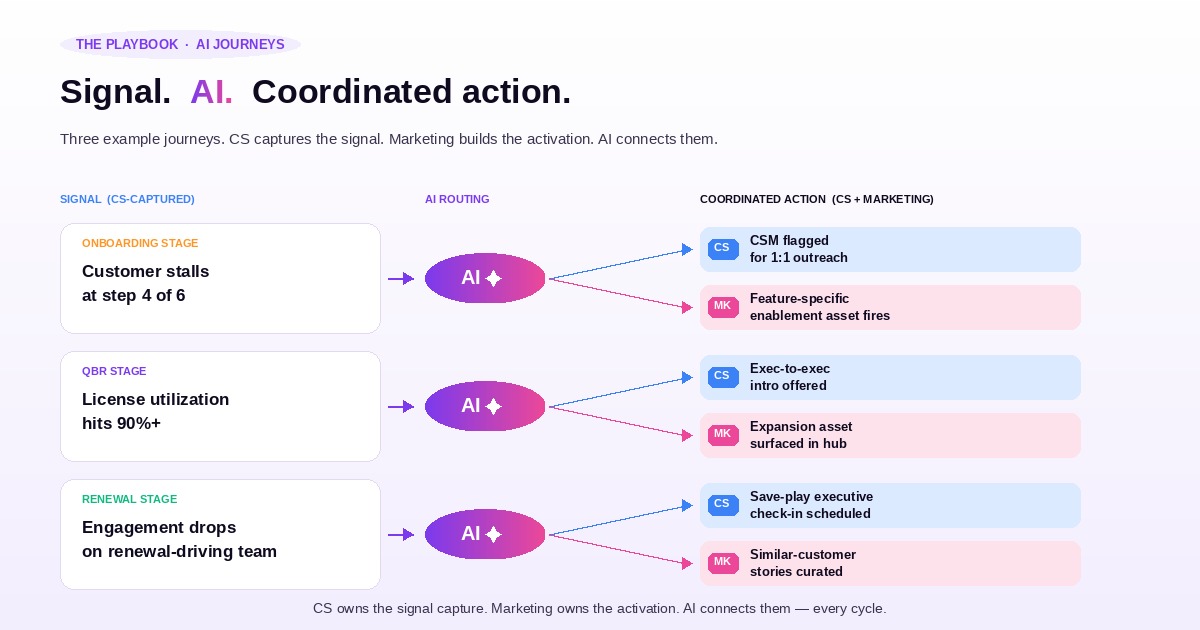
2. Map the journeys to the signals. For each signal, decide which journey activates. Onboarding milestone → activation campaign. QBR expansion note → upsell journey. Adoption decline → save play. Three signals, three journeys, one shared system.
3. Pick the surface. The customer hub has to be a single surface for both teams - not a CS portal with a marketing widget bolted on. CS owns the structure. Customer marketing owns the lifecycle layer. Both teams build on top.
4. Layer in agentic execution. Once the signals and journeys are connected, agentic execution takes over the routing. The hub watches signals, decides next-best action, and triggers the right journey - onboarding nudges, QBR follow-ups, expansion plays, renewal motions. CS and customer marketing review what the system did, not orchestrate every step.
5. Connect to renewal as a joint motion. A customer experience hub means the renewal motion starts at month 1, not month 9. CS and customer marketing’s job together is to make sure the journey from onboarding to renewal feels like one continuous experience for the customer —-and one continuous funnel for the business. That requires shared goals, not just shared tooling.
6. Measure as one motion. Stop measuring CS and customer marketing on different dashboards. NRR, activation velocity, expansion pipeline, advocacy participation — these are joint outcomes. Build the dashboard that shows them as one motion. That’s how the operating model holds.
Why this is the operating model that drives NRR
NRR is downstream of two things neither team owns alone:
How fast and how deeply customers activate. CS sets the milestones. Customer marketing reinforces them. If both teams aren’t operating on the same activation signals, you leave NRR on the table.
How clearly value is articulated and reinforced over the lifecycle. CS surfaces value in QBRs. Customer marketing amplifies it through journeys, content, and feature unlocks. Same hub, same customer view, both teams contributing. The customer experiences one connected journey, not a CS journey and a marketing journey running in parallel.
The mental model shift
If your customer marketing program is running on email opens and your CS team is running on quarterly decks, both teams are optimizing the wrong layer. The highest-value signals about your customers - the ones that predict expansion, churn, and advocacy - aren’t in your marketing automation platform and they aren’t in your CS tool. They live in the gap between them.
A customer experience hub closes the gap.
Onboarding is a CS motion that customer marketing should be triggering off. QBRs are a CS deliverable that customer marketing should be amplifying. Expansion is the outcome of both teams operating on the same signals, on the same surface, toward the same number.
Connect the systems. Turn the signals into shared triggers. Let AI route the next-best action based on what the customer is actually doing — not on whether CS remembered to flag the account or whether marketing’s campaign calendar happened to align.
That’s the operating model that drives customer-led growth. And it only works when CS and customer marketing build it together.
Key Takeaways
CS holds the signal, marketing holds the channels. Onboarding milestones, QBR insights, and renewal indicators live in CS systems. Customer marketing runs campaigns blind to them. The signals are there — the shared system isn’t.
NRR is downstream of two upstream things neither team owns alone: onboarding velocity and value articulation in QBRs. A customer experience hub fixes both for both teams.
The shift is structural, not tactical. Stop running two parallel programs on separate stacks. Start running one motion on a shared hub where CS surfaces signals and customer marketing builds the journeys that activate them.
AI routes next-best actions across onboarding, QBR, and renewal journeys — stalled customers, fast-movers, expansion signals, at-risk renewals — but only after both teams agree on what the plays are.
Vidyard cut onboarding from ~2 months to ~1 week (8x faster) and scaled personalized QBRs from top accounts to 100% of their customer base by treating the customer hub as a shared CS + customer marketing surface.
Frequently asked questions
What is net revenue retention?
Net revenue retention measures how much recurring revenue you keep and grow from existing customers over a period, counting expansion, contraction, and churn. Above 100% means your existing base grows on its own, without a single new logo. It is the number boards use to judge post-sale performance.
How do you calculate net revenue retention?
Take the starting recurring revenue for a cohort, add expansion, then subtract contraction and churn, and divide by the starting revenue. Start a cohort at $1M, add $200K of expansion, lose $100K to churn and downgrades, and NRR is 110%. New customers acquired during the period are excluded.
What is a good net revenue retention rate?
In B2B SaaS, 100% is the floor and 110% to 120% is strong. Enterprise-focused companies usually run higher, because expansion inside a large account is easier than winning a new one. The lever that moves it is activation speed and value articulation, not discounting.
How does customer success impact net revenue retention?
NRR is downstream of two things customer success owns: how fast and how deeply customers activate, and how clearly value gets articulated across the lifecycle. Onboarding milestones and QBR insights are the signals that should trigger expansion plays. When those signals never reach customer marketing, the plays fire late or never fire at all.
Give us a try, easy peasy.
Building and scaling your advocacy program is easy when you can manage campaigns, rewards, track, and report - all within one AI platform.