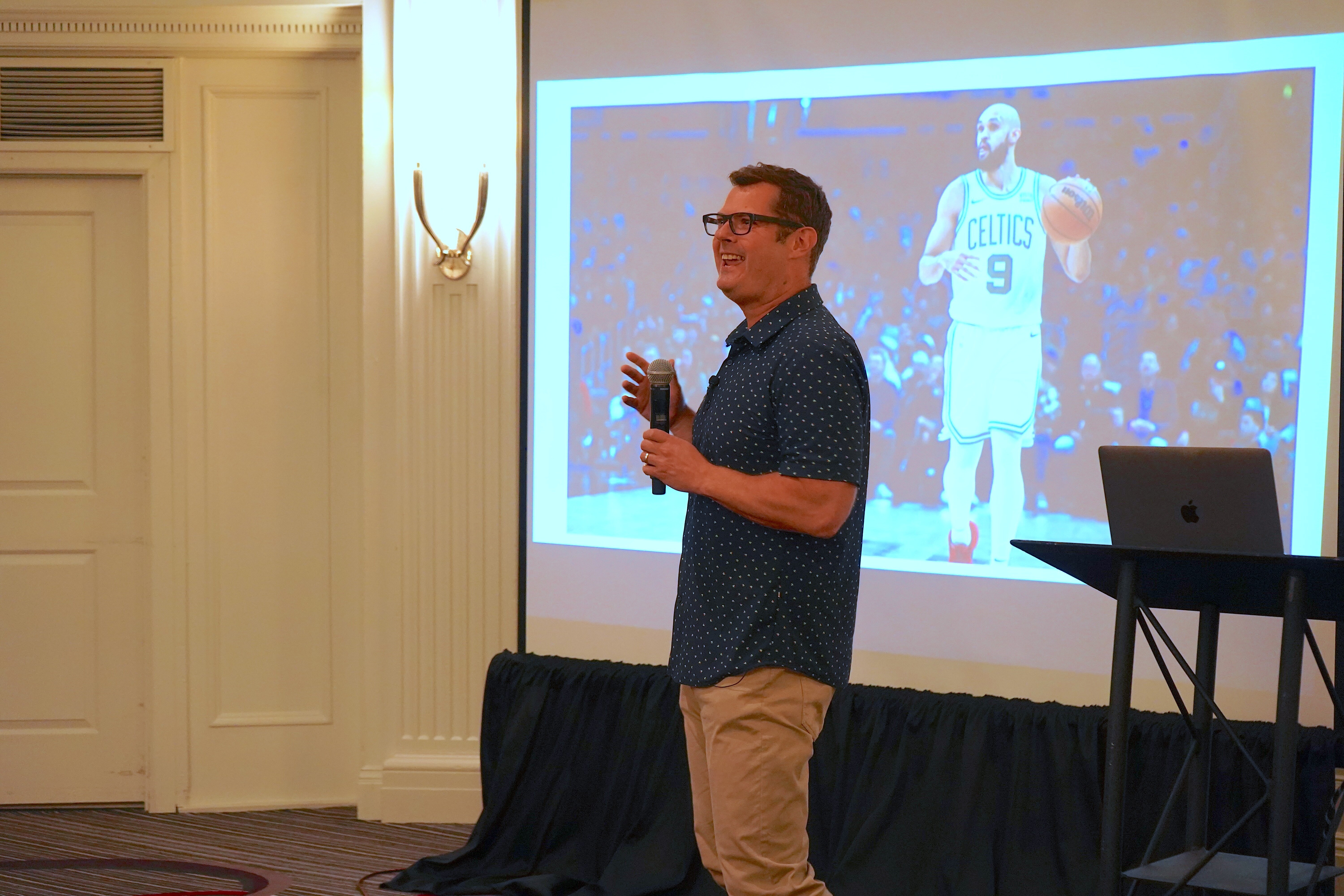
In a compelling session titled How to Apply Customer Marketing Against Different Key Moments in Time, David Coates, Senior Director of Customer-Led Growth at Forter, shared an insightful look into how Forter uses customer marketing to drive both revenue growth and product innovation. Drawing on his basketball analogy, Coates emphasized that customer marketers serve as the “point guard” for their organizations—facilitating collaboration and delivering impactful programs that align with the company’s goals.
Here’s how Coates’ team at Forter has crafted a playbook to leverage customer marketing during critical organizational milestones.
The Role of Customer Marketing: The Point Guard of the Organization
Coates likened customer marketing to a point guard in basketball:
“We’re not the stars on the poster; we’re the ones setting up the team for success.”
Customer marketers act as the glue between departments, ensuring programs like ABM (Account-Based Marketing), advisory boards, and design partner initiatives are aligned with broader business objectives. By assisting key players—whether sales, product, or demand generation—customer marketing drives value while ensuring the customer remains at the center of organizational strategies.
Laying the Foundation: Readiness is Key
Before diving into tactics, Coates stressed the importance of foundational readiness, drawing from the SiriusDecisions model. This approach ensures that workforce, systems, governance, and executive alignment are in place to support impactful programs.
For Forter, readiness also means connecting every initiative to business goals like the Rule of 40—a metric combining revenue growth and profitability. With this alignment, customer marketing initiatives are not only actionable but also measurable against top-line impact.
Customer Marketing in Action: Supporting Revenue Growth
Forter’s approach to revenue growth through customer marketing is centered on account-based experiences (ABX) and strategically deploying advocates during key moments:
Driving ABX Success: An 18-Month Playbook
Forter’s customer marketing team collaborates with sales and ABX teams to guide long-term, high-value deals through the pipeline. One standout example involved an 18-month engagement with a multi-million-dollar prospect:
- Tailored Engagements at Events: Advocates participated in workshops, networking events, and main-stage sessions tailored to the target account’s specific interests.
- Surround-Sound Strategy: By aligning advocate participation with major industry events, Forter provided multiple touchpoints for the buying center to engage with the brand.
- Results: The engagement progressed the account from stage two to stage five, showcasing the critical role customer marketing played in pipeline acceleration.
Champion Tracking for Advocacy Opportunities
Forter recently introduced a Champion Tracking Program using tools like UserGems to identify when advocates change roles or companies. Within just a few months, this initiative generated three high-value opportunities worth $1.5 million.
“Advocacy isn’t a moment in time; it’s a relationship over time,” Coates said.
This program exemplifies how customer marketing can unlock revenue potential by nurturing advocate relationships across their career journeys.
Driving Product Innovation Through Customer-Led Development
In addition to revenue growth, customer marketing plays a pivotal role in shaping Forter’s product development:
Advisory Boards as Strategic Drivers
Forter’s Customer Advisory Board (CAB) enables the product team to gain deep customer insights, driving innovations that address real-world challenges. For example, feedback from CAB members led to the development of a tool for tracking customer lifetime value.
- Discovery Phase: CAB discussions identified the need for this tool and helped scope the solution.
- Design Partner Program: Six CAB members became design partners, collaborating with the product team to refine the tool.
- Outcome: A beta version was showcased at Forter’s annual event, with a general release planned for mid-2025.
By aligning customer insights with product innovation, Forter ensures its solutions remain differentiated and relevant to evolving market needs.
Lessons for Building a Customer Marketing Playbook
Coates concluded with actionable advice for creating an effective customer marketing playbook:
- Tie Programs to Business Goals: Whether focused on new business acquisition, upsell, or retention, ensure your playbook aligns with organizational priorities.
- Collaborate Across Departments: Customer marketing thrives on partnerships with sales, product, and demand generation teams. Success comes from assisting, not owning, their objectives.
- Leverage Customer-Centric Insights: Use customer feedback to shape initiatives, keeping advocacy programs grounded in real needs.
- Measure What Matters: Connect metrics like pipeline acceleration, Net Promoter Score (NPS), or product impact directly to business outcomes to showcase the value of your efforts.
Final Thoughts: Be the Point Guard Your Organization Needs
At its core, customer marketing is about empowering others while keeping the customer front and center. By strategically aligning initiatives with key moments in time—whether for revenue or product growth—customer marketers can amplify their impact across the organization.
As Coates put it:
“We don’t own the ABX program or product development, but by assisting these teams, we ensure the customer’s voice is always heard. And that’s what makes customer marketing invaluable.”
Through data-driven strategies, collaborative execution, and a commitment to customer advocacy, Forter is proving that customer marketing is essential to long-term growth and innovation.