5 AI-Powered Customer Programs You Should Already Be Automating
Adi Gorelik
-
Base AI
7
min read
If your team is still running customer programs on spreadsheets, manual nominations, and CSV imports, you're already behind. The teams winning in 2026 aren't shipping more programs than you. They're running the same programs as a connected, AI-orchestrated system, the operating model behind customer-led growth.
Here are five every customer marketer should have automated by now.
1. Onboarding (the productized kind, not the deck-and-prayer kind)
Most onboarding lives in a CSM's project plan, a generic LMS, or a slide template that gets duplicated for each new account. The customer experience is a checklist someone is half-following.
The AI version: a self-service, guided journey customers run themselves. Multi-step, customizable, instrumented. When they complete a step, they earn badges or points that tie back into your loyalty program. When they stall, the system fires an enablement asset for the specific feature they're stuck on.
The reframe that matters: this isn't just product onboarding. The same engine runs any structured first-time experience.
Onboarding new advocates into your advocacy program
Onboarding executives into your CAB
Onboarding speakers to your annual event
Onboarding partners to a designated portal
Onboarding users to a beta program
If it has a starting point, a sequence, and a finish line, instrument it once and you get the same engagement signals across every flavor.
2. The customer help experience (AI-curated, not knowledge-base-shaped)
Every team has a knowledge base. Most customers can't find what they need in it. So they file tickets your team handles manually.
The AI version: a single help surface inside the customer hub that combines three things:
An AI expert agent connected to your knowledge sources. Customers ask questions in natural language and get curated, up-to-date answers. Every question answered here is a support ticket you didn't open.
Personalized recommendations based on persona, product mix, and lifecycle stage. No more dumping the same article list on every customer.
Embedded support cases synced bidirectionally with Salesforce Service Desk, Zendesk, or Freshdesk via native integrations. Customers see their open cases, file new ones, and get status updates without leaving the hub.
Stop sending customers to a separate help portal. The fewer surfaces they touch, the more usage data you collect, the smarter the AI gets, the fewer tickets you receive next quarter.
Most referral programs run on a Google Form and a Slack thread between Customer Marketing and the AE handling the deal.
The AI version: customers see exactly where they stand inside their hub. How many referrals they've submitted. How many were approved. What tier they've hit. What reward they've earned. And a calculator that shows them what they'd make on the next deal, based on your specific referral policy, with bonuses for company size or other rules you define.
When a customer submits a referral, it lands immediately in Salesforce as a lead, contact, or opportunity. When you mark it qualified or rejected, the customer's hub updates in real time and an email goes out automatically. No customer marketer chasing status.
The result: more referrals submitted (because customers can see what they're earning), faster turnaround (because the workflow is automatic), and zero manual reconciliation between your CRM and your customer-facing surface.
4. Year in Review (and every other data-driven engagement)
Your version of Spotify Wrapped: a personalized end-of-year experience surfacing milestones and value moments based on your customer's actual data. Pulled from Snowflake, Databricks, Gainsight, Salesforce, your product, wherever it lives.
But Year in Review is the least of what this engine does.
The same vibe-coding tool, built into the platform, lets you spin up any kind of dynamic, branded customer-facing widget. Monthly review. Quarterly review. Advocate retrospective. Beta program recap. CAB summary. Multi-year value report. Describe what you want, the platform builds it, you publish it inside the hub.
What used to be a once-a-year batch job is now an always-on engine. Engagement scales because the data is already there. You just decide what to surface and when.
5. Advocate identification and nomination (AI-driven, not manual)
The classic advocacy bottleneck: a customer marketer manually scanning CRM filters, health scores, and product usage to figure out who to invite into the reference pool, the advocacy program, the speaker bench, or the executive briefing.
The AI version: target audiences run automatically. Define a rule once ("contacts at accounts with health score above 80 AND product utilization above 70% AND no contract changes in the last 90 days") and the platform nominates matching contacts daily.
If you have automated handling enabled, qualifying customers go straight into the program with the right intro email. If not, they queue up for your approval. Either way, you stop scanning spreadsheets.
This connects upstream and downstream:
Upstream: it pulls signals from health scores, product usage, NPS responses, and the voice-of-customer loop.
Downstream: it routes nominated advocates into the right program: references for sales, advocacy for marketing, speakers for events, beta participants for product.
The outcome: more advocates identified, faster, with less work, and they're identified at the right moment in their lifecycle, not whenever someone happens to remember to check.
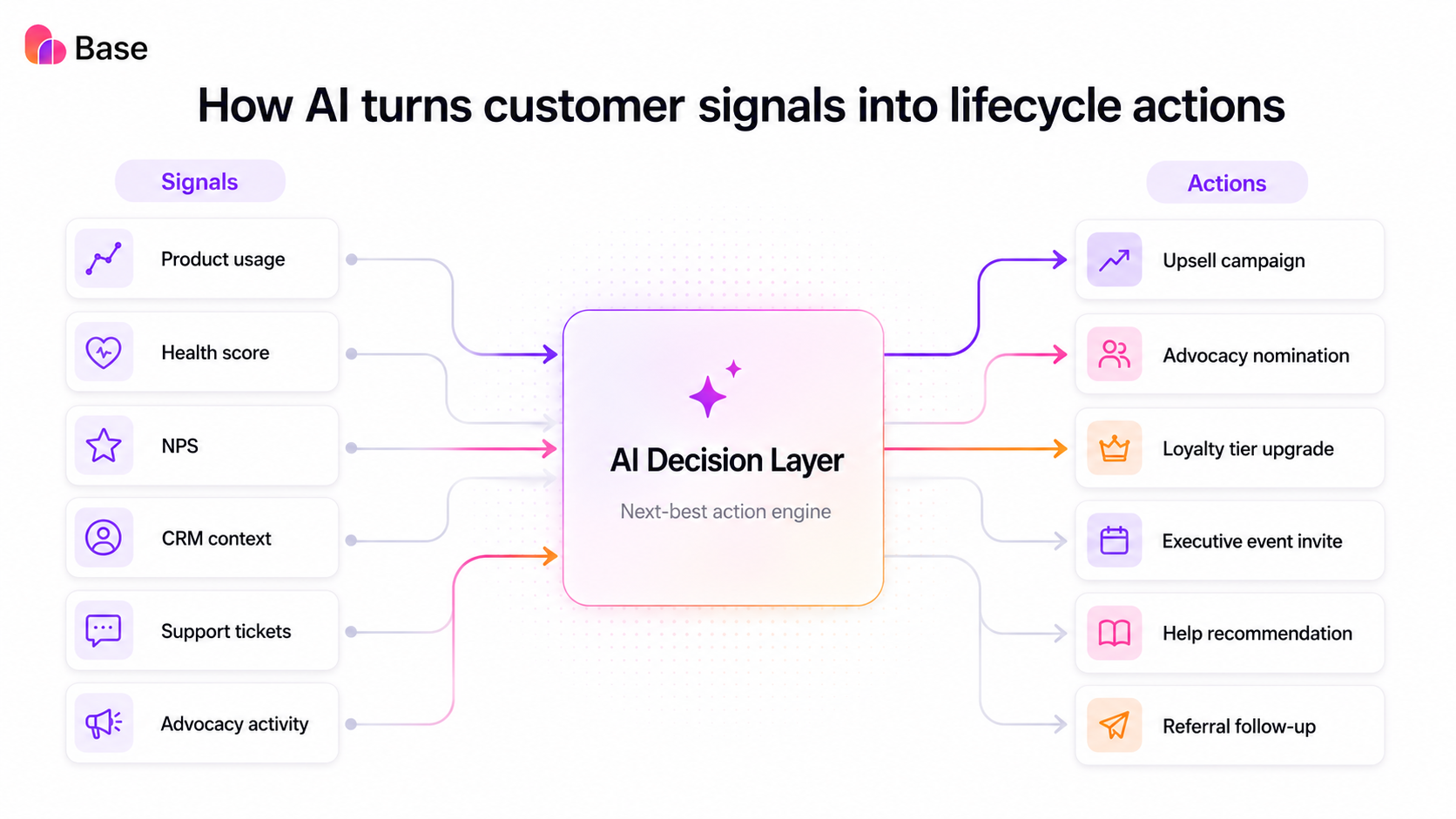
Signals to action
What ties them together
These five programs aren't separate initiatives. They're sides of the same operating model:
Onboarding generates the engagement signals.
The Help area answers customers and surfaces friction signals.
Referrals turn engagement into pipeline.
Year in Review (and its variants) re-engages customers between QBRs.
Advocate nominations route the right customer to the right program at the right moment.
Run them together on shared infrastructure and AI can do what it's been promising for two years: the move from automation to agentic execution. Connect product usage in Snowflake, health scores in Gainsight, advocacy and community signals in your hub, and CRM context in Salesforce, and let the system decide:
This customer just hit 90% utilization, has positive NPS, and a new exec sponsor, so fire the upsell campaign for product line 6.
This customer just completed onboarding ahead of schedule and gave a positive QBR signal, so route them to advocacy nomination.
This advocate just contributed three references, so auto-elevate their loyalty tier and unlock the executive event invite.
Customer programs as one connected system, AI as the layer underneath, your team focused on the strategy instead of the spreadsheet. (We wrote about the same shift from the CS angle in when CS and customer marketing operate as one system.)
What to do this week
Pick one of the five. Audit how you run it today:
How many manual handoffs?
How many CSV exports?
How many "let me check with Sales / CS / Ops" loops?
How many times has a customer fallen through the cracks because someone forgot to nominate them, follow up, or update the status?
That's your baseline. Now imagine the same program running with AI in the loop: signals captured automatically, nominations surfaced daily, status synced bidirectionally, customer experience always-on instead of campaign-driven.
That gap is the unlock.
The teams winning this year aren't running radically different programs from yours. They're just running them automated. Want a walkthrough on a specific program: onboarding, referrals, advocate nominations, or a multi-program rollout? We'd rather show you than tell you.
Key Takeaways
Five programs to automate now:onboarding (productized), customer help (AI agent + tickets), referrals (real-time CRM sync), Year in Review (dynamic widgets), and advocate nominations (rule-based, daily).
The reframe on onboarding: the same engine runs any structured first-time experience: advocates, CAB execs, speakers, partners, beta users. Instrument once, signal everywhere.
The help surface beats the help portal: AI agent + personalized recs + embedded tickets in one hub means fewer tickets opened and smarter AI over time.
Referrals run on signals, not Slack threads: customers see their tier, their reward, their next-deal calculator; CRM syncs the moment status changes.
Advocate nominations are a daily target audience job: define the rule once (health, utilization, lifecycle) and the platform nominates matching contacts into references, advocacy, speakers, or beta.
Frequently asked questions
Which customer programs benefit most from AI automation in 2026?
The five with the highest manual-effort-to-impact ratio: onboarding, customer help (AI agent + ticketing), referrals, dynamic engagement experiences like Year in Review, and advocate identification. Each is high-volume, signal-rich, and currently bottlenecked by manual handoffs. (See why the post-sale journey feels chaotic for the underlying pattern.)
What's the difference between automated and AI-orchestrated customer programs?
Traditional automation runs one program on a schedule. AI orchestration connects programs to shared signals (usage, health scores, advocacy intent, CRM context) and decides the next-best action across the lifecycle in real time.
How do I start automating advocate identification?
Define one target audience rule that combines health score, product utilization, and lifecycle stage. Run it daily. Pipe matching contacts into a nomination queue with optional auto-handling for the highest-confidence matches. The same rule feeds references, advocacy, and event programs.
Do I need to replace my CRM or CS tool to run these programs?
No. The point of a connected hub is that it sits on top of your existing stack (Salesforce, Gainsight, Snowflake, Zendesk) and orchestrates programs against the data already there. Integrations are the prerequisite, not a replatform.
What's the fastest program to automate first?
Referrals or advocate nominations. Both have clear signal inputs, clear outcomes (deals influenced, advocates routed), and the manual baseline is easy to measure. Book a demo if you want to scope a 30-day pilot.
Give us a try, easy peasy.
Building and scaling your advocacy program is easy when you can manage campaigns, rewards, track, and report - all within one AI platform.