How to Scale Customer Success with AI in 2026 (Without Hiring More CSMs)
-
10
min read
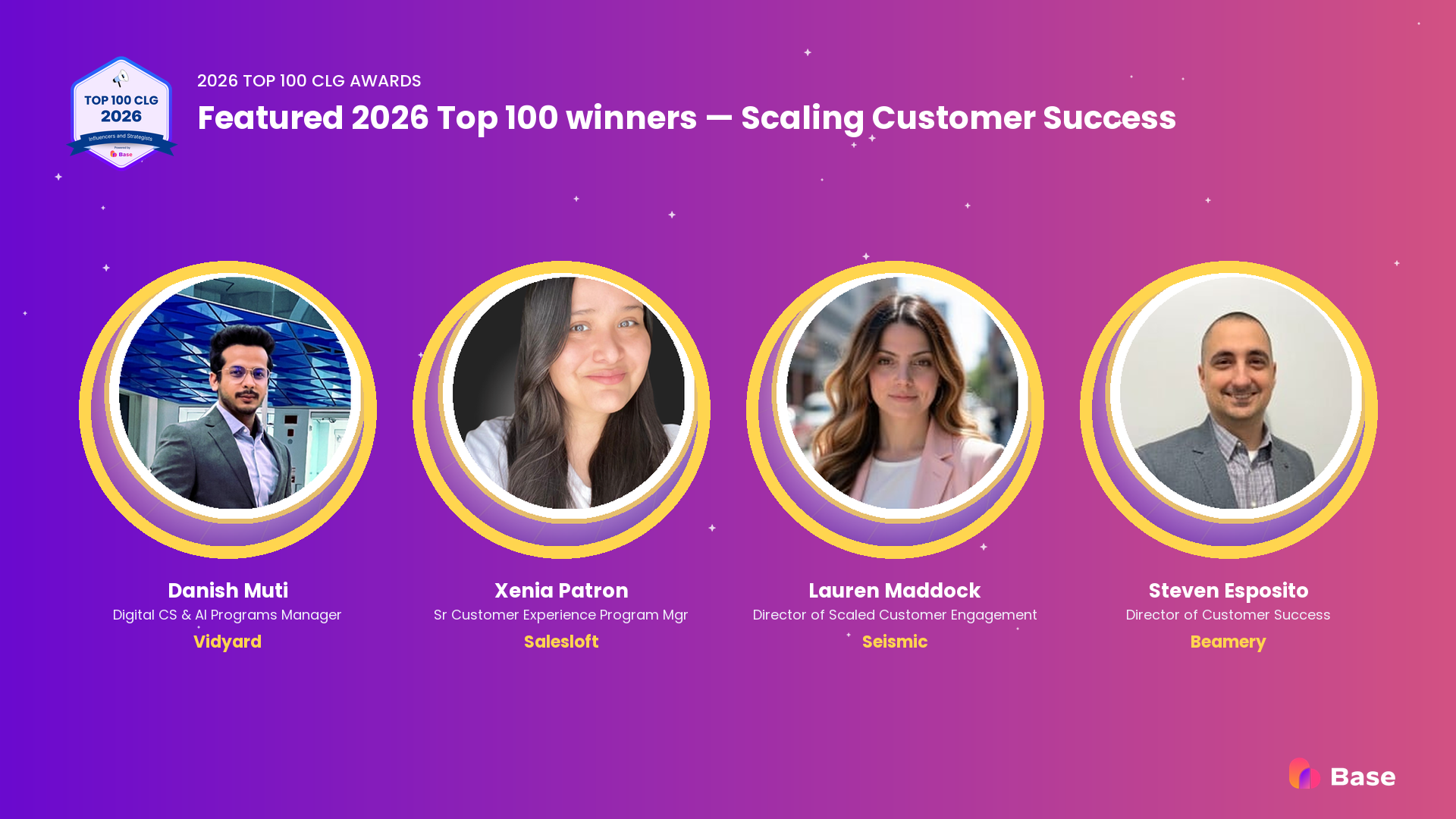
The 2026 Top 100 CLG Awards honored the leaders rewriting the playbook for scaled Customer Success. In the Digital CS programs category, four winners stood out. Danish Muti, Digital CS & AI Programs Manager at Vidyard, reframed onboarding and QBRs as productized, data-instrumented journeys. Xenia Patron, Senior Customer Experience Program Manager at Salesloft, turned Hub engagement into a population-level CLG signal across thousands of accounts. Lauren Maddock, Director of Scaled Customer Engagement at Seismic, proved that engaged customers drive 60% of renewed ARR while non-engaged customers drive 82% of churn. And Steven Esposito, Director of Customer Success at Beamery, designed a Digital CS tier that grew the digital base 10% in 12 months without added headcount. Four companies. One shared belief: the future of Customer Success is not 1:1.
2026 Top 100 CLG Awards winners featured in this blog — Danish Muti (Vidyard), Xenia Patron (Salesloft), Lauren Maddock (Seismic), Steven Esposito (Beamery)
What is happening in scaled Customer Success right now
The first is the gap between board expectation and CS budget. Most CS organizations were sized for 95% NRR. Boards now want 110% to 115%. The portfolio doubled. CS headcount did not. The math does not work without a different operating model.
The second is the rate at which customer signal is being generated. Product usage, support tickets, NPS responses, community posts, CSM call transcripts, in-app events. Most of it never reaches the dashboards CSMs actually use. A typical Scaled CS team is asked to act on the customer base while reading a tenth of what the customer base is telling them.
The third is the new ceiling on 1:1 CSM motion. Even the best CSMs cap out around 40 to 60 accounts of meaningful engagement. Above that, the CSM becomes a triage function, the QBR becomes a slide deck assembled from memory, and the renewal conversation restarts from zero. The accounts in the middle and tail produce most of the churn risk, most of the expansion ceiling, and most of the leading indicators a smart CS team should be acting on. They are also the accounts that get the thinnest experience.
The 2026 Top 100 winners in the Digital CS programs category have stopped trying to solve this with more humans. They are productizing what a great CSM does, instrumenting the system that surrounds it, and letting AI do the work that does not scale linearly with headcount.
Where Base AI sits in this shift
Base AI, the AI engagement OS, are built for exactly this operating shift. Scaled CS does not need another tool that runs alongside the CSM platform, the lifecycle platform, the community platform, and the survey platform. It needs a connective layer that makes onboarding, success plans, QBRs, adoption nudges, and renewal preparation feel like one continuous experience for the customer and like one orchestrated motion for the CS team.
That is the architecture the four winners below are building piece by piece at their own companies. Danish productized onboarding and QBRs as instrumented journeys. Steven productized the entire Digital CS tier with automated business reviews. Xenia turned the Hub into the operating layer where digital CX becomes measurable. Lauren built engagement as the leading indicator of retention across 1,800 accounts.
The pain every VP Scaled CS keeps hitting
The instinct most leaders default to is segmentation. Tier the accounts, give the top 100 white-glove treatment, give everyone else a digital newsletter and a help center. It is the path of least resistance, and it is the reason most "scaled CS" programs underperform. Digital CX gets built as a cost-saving exercise. It produces a worse experience for the customers most likely to churn and a thinner relationship with the customers most likely to expand. The CSMs get burned out. The CFO sees flat NRR. Nothing improves.
The 2026 Top 100 winners took the harder path. None of them said "we will hire more CSMs." Each said something closer to: we will productize what a great CSM does, instrument the system around it, and let AI carry the work that does not scale linearly with headcount. Here is what that looked like across four very different operating models.
1. Danish Muti, Vidyard: productizing the CSM motion into instrumented journeys
When Danish looked at Vidyard's Customer Success function, he saw the pattern most scaled CS leaders inherit. Onboarding was a checklist someone walked the customer through. QBRs were slide decks reassembled each quarter. Renewal conversations restarted from zero on every account. Each motion was high-effort, hard to scale, and impossible to compare across the customer base.
His move was to stop treating these as touchpoints and start treating them as journeys. Productized, data-instrumented, built to iterate. Onboarding became an insight-driven hub. QBRs became structured, repeatable engagement assets that surfaced the customer's own usage data alongside the next milestones they should reach. AI-enabled workflows were introduced where they removed real friction (pricing analysis, renewal decisioning) and not as novelty. The goal was to free the team from the work that did not need a human in the loop.
The discipline underneath the change was alignment. "I consistently look for ways to reduce bottlenecks, empower teams with better tools and ensure customer experience scales without losing personalization," Danish explains. "I partner closely with RevOps, Product, Support and Marketing to ensure customer feedback directly informs what we improve next. I don't just gather insights. I operationalize them."
The results he tracks reflect the system, not the activity: 5/5 onboarding satisfaction ratings, faster quote turnaround, decline in early-churn signals, feature-adoption uplift after QBRs, and higher self-serve renewal confirmations. The deeper takeaway for any VP Scaled CS: when the CSM motion is productized, growth stops feeling like a sprint and starts feeling like a natural outcome of consistent value delivery.
2. Xenia Patron, Salesloft: making the Hub the source of truth for digital CX
Xenia's lens on Scaled CS at Salesloft is different from most leaders her title would suggest. She does not measure success by tickets resolved or NPS movement. She measures it by whether engagement with the Hub is rising and whether that engagement is producing measurable customer outcomes downstream.
The Hub at Salesloft sits as the connective tissue between the CSM, the customer's internal champions, and the post-sale journey itself. Success Plans live there. Activation milestones live there. The escalation that would otherwise become a Slack fire lives there. "I have successfully scaled internal teams and programs by building repeatable processes, creating clarity around priorities, and aligning cross-functional stakeholders around customer value," Xenia explains. "I measure success by impact: customer adoption, and value realization."
The KPIs she runs the program on are unusually direct. Percentage and number of unique accounts that visited the Hub at least once. Unique accounts visiting 2 to 4 times and 5+ times. Total ARR of Hub-visiting accounts. Adoption of Success Plans (the share of accounts that have completed at least one task). No vanity counts. No aggregate session metrics. Just the population-level shape of customer engagement, sliced by ARR coverage so the program can be defended at the board.
What makes the model work is Xenia's combination of empathy and operational rigor. She invests in understanding each customer's business goals and constraints. She also leverages automation and "vibe coding" to streamline the workflows that surface insight, so the team can spend its time solving real problems instead of stitching reports. The lesson for VP Scaled CS: the Hub is not a content destination. It is the operating layer where digital CX becomes measurable.
3. Lauren Maddock, Seismic: proving that engagement is a leading indicator of retention
Most CS leaders treat engagement as a soft metric, something that lives next to NPS in the board appendix. Lauren did the work to make it the headline.
At Seismic, she rebuilt the community from a support-driven forum into the core pillar of a connected digital CS strategy. A scalable engagement engine spanning product-focused webinars, practitioner-led Power Plays, peer-driven Brain Dates, and partner sessions. The programs are repeatable systems, not one-off campaigns. The breakthrough was instrumenting the system across Seismic's ~1,800 customer accounts. "I measure success across ~1,800 customer accounts," Lauren explains, "tracking reach, engagement, repeat participation, and how customers move from attending to actively contributing."
That instrumentation produced the correlation every Scaled CS team suspects but few formally measure: 60% of renewed ARR comes from engaged accounts. 82% of churn comes from non-engaged accounts. Engagement became a predictive indicator of retention and churn risk, not a lagging report.
Reach matters as much as predictive power. 43% of customers actively participate in digital and community programs, 65% of total ARR is influenced by digital engagement, and 69% of the top 150 accounts are engaged. The operational story for the CS team is the part that finishes the case: 40,000+ hours returned to CSMs through digital education and scaled programs, freed up by reducing 1:1 reliance and routing customers through self-serve community and structured programs. That is the math that lets a VP Scaled CS reinvest CSM capacity into strategic, high-impact work instead of asking for headcount.
4. Steven Esposito, Beamery: building a Digital CS tier that expanded 10% without added headcount
Steven's case at Beamery is the cleanest existence proof in the 2026 Top 100 of the question every VP Scaled CS is being asked at the board. Can the Digital CS tier produce revenue, retention, and growth at the same time without growing the team?
His starting move was structural. "I personally drove the strategy and operating model for this initiative end to end," Steven explains. "We began by segmenting accounts based on annual spend to clearly define the Digital tier." Recognizing that a one-size-fits-all high-touch model wasn't sustainable as Beamery's customer base scaled, he led the end-to-end design and implementation of Beamery's Digital Customer Success tier. He mapped the full customer journey and partnered across teams to deliver automated touchpoints, automated business reviews that clearly demonstrated ROI, and strategically timed CSM-led strategy sessions. The design point he held to is the part most digital CS programs miss: keep the model consultative rather than transactional. Customers in the digital tier should feel like they have a partner, not a self-service portal.
The operational compression was the unlock. By automating QBR creation he cut CSM prep time 200%, freeing the team to focus on customer strategy instead of slide-deck assembly. The downstream results validated the architecture: 10% tier expansion in 12 months without added headcount, 15% YoY retention improvement in the Digital base, and the first successful upsell of a newly launched module within the Digital tier. Proof that digital CS can drive expansion, not just defend renewal. Steven's nomination is the blueprint for modern Digital CS. Scale and customer value are not in tension when the model is designed properly.
The pattern across the four
Four leaders, four companies, one architecture.
What this looks like when it is all in one place
If your Scaled CS function still depends on individual CSM motion to deliver renewal, expansion, and customer experience, the 2026 Top 100 pattern translates directly: productize the touchpoints, instrument engagement as the leading indicator, layer AI on the friction points, reinvest the returned hours into the strategic work that earns the next renewal.
Base AI productizes this pattern. The CSM motion becomes a customer-facing surface that runs onboarding, success plans, QBRs, expansion conversations, and renewal preparation as one continuous experience for the customer. AI inside the platform routes signals to interventions: a stalled milestone triggers a CSM nudge, a strong adoption pattern triggers an expansion play, a quiet account triggers a check-in. The CS team measures the function on the metrics the board already trusts: NRR, expansion pipeline, retention by tier, hours returned to strategic work.
The next blog in the series unpacks the mirror challenge on the marketing side. How the 2026 CLG winners are scaling Customer Marketing with AI without becoming a content factory.
How EverAfter by Base AI customers run this playbook
Key Takeaways
The CSM motion is being productized. Danish productized onboarding and QBRs; Steven productized the entire Digital CS tier; Xenia productized Hub-based CX; Lauren productized community.
Engagement became the leading indicator. Lauren's 60% of renewed ARR from engaged accounts, 82% of churn from non-engaged — engagement now predicts retention, not lags it.
AI and automation remove friction, they do not replace the team. Steven automated QBR creation and cut CSM prep time 200%. Danish uses AI for pricing and renewal decisioning.
The system makes the team strategic. Lauren returned 40,000+ hours to CSMs; Steven delivered 10% tier expansion in 12 months without added headcount.
The math: 60% of renewed ARR from engaged accounts; 82% of churn from non-engaged. Engagement is the metric VP Scaled CS leaders should be defending the function on.
Frequently asked questions
How do you scale customer success without hiring more CSMs?
Productize the motion. Danish Muti at Vidyard productized onboarding and QBRs; Steven Esposito at Beamery productized an entire Digital CS tier and expanded it 10% without adding headcount. The work becomes a system rather than a set of individual habits.
Is engagement a leading indicator of retention?
Lauren Maddock at Seismic proved it is. 60% of renewed ARR came from engaged accounts and 82% of churn came from non-engaged ones, which makes engagement a signal you can act on months before a renewal conversation.
Does AI replace customer success managers?
No. It removes friction from the work they already do. Steven Esposito automated QBR creation and cut CSM prep time by 200%, which bought the team hours rather than replacing it.
What does a digital customer success tier actually look like?
One source of truth the customer works in, with the routine motions instrumented. Xenia Patron at Salesloft made the Hub the source of truth for digital CX so customers and the team read from the same place.
Give us a try, easy peasy.
Building and scaling your advocacy program is easy when you can manage campaigns, rewards, track, and report - all within one AI platform.