Your Post-Sale AI Is Only as Smart as the Context Behind It
Adi Gorelik
-
Base AI
7
min read
Everyone is adding AI to post-sale right now. Few are asking the question that actually decides whether it works: what is the AI standing on?
Because an agent is only ever as good as the context it runs on. Point it at fragmented data. Product usage in one place, account notes in another, the last QBR buried in a slide deck nobody opens. It will do the wrong thing. Confidently. Quickly. At a scale you can’t manually catch. The demo looks magical. The reality drifts, because the model is guessing in the gaps.
This is the quiet problem under most “AI for customer success” announcements. The intelligence isn’t the hard part anymore. The grounding is. And grounding is exactly what post-sale has never had.
Post-sale has an AI problem, but it starts as a context problem
Think about where your customer truth actually lives. Usage signals sit in your product analytics. Sentiment lives in your CSMs’ heads and the occasional Slack message. Commercial context sits in the CRM. The onboarding plan is in one doc, the success plan in another, the renewal notes somewhere a quarter back. Each system is a partial, slightly-out-of-date version of the same customer.
Humans paper over this every day. A good CSM mentally reassembles the full picture before a call. But that doesn’t scale, and it doesn’t survive handoffs. When the CSM changes, the context walks out the door.
Now hand that same fragmented picture to an AI agent and ask it to recommend a next best action. It can’t. Or worse, it will, based on whatever slice of context it happened to see. The agent isn’t wrong because the model is weak. It’s wrong because it never had a single, trustworthy source of what’s true about the customer.
That single source is the thing post-sale has been missing. It has a name: the Customer Context Graph.
The Customer Context Graph. Every system in, one current view out. Continuously updated, RAG-backed.
What a Customer Context Graph actually is
A Customer Context Graph is one connected, accurate, continuously updated model of everything you know about a customer, and how it all relates.
Not a dashboard. Not a data lake you query when you remember to. A living truth layer that pulls from every system you already have and resolves it into a single, current view: who the customer is, what they’ve done, where they’re stuck, what they care about, what happened last, and what should happen next.
The critical word is truth. Most AI tooling in this category sits on top of whatever data it’s pointed at and hopes it’s right. A context graph inverts that. It builds the most accurate environment first. A grounded, retrieval-backed layer of real customer knowledge. Then it lets AI reason on top of something it can actually trust. That’s what retrieval-augmented generation (RAG) is for: the AI answers and acts from your real, sourced knowledge, not from a generic best guess.
Get this layer right and everything downstream changes. The AI stops hallucinating because it’s reading from a real record. The recommendations stop being generic because they’re built on this account, not accounts in general. And the context accumulates: every interaction makes the next one smarter, instead of resetting to zero.
This is why context graphs matter so much right now. In the AI era, your advantage isn’t access to a model. Everyone has that. Your advantage is the quality of the context you can feed it. The truth layer is the moat.
The three layers of the AI Engagement OS
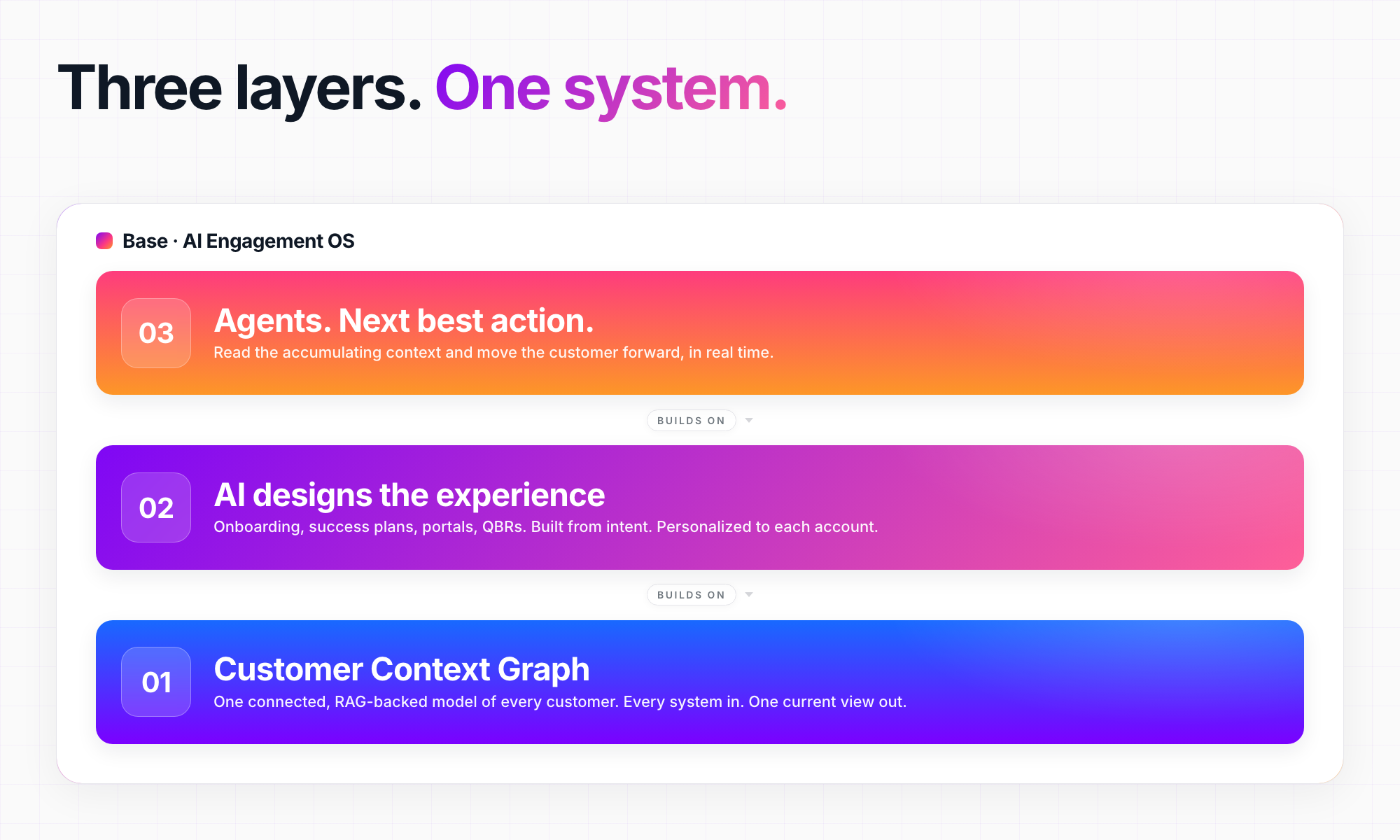
A truth layer is necessary, but on its own it’s just a smarter database. The point of grounded context is to act on it. That’s what makes Base an operating system rather than another view. It connects three layers in one system, each building on the one beneath it.
The AI Engagement OS. Truth, then experience, then action. One system.
1. The truth layer: one system connected to everything
This is the Customer Context Graph. One system, connected to the tools you already run, resolving fragmented data into the most accurate environment you have. RAG-backed, so the AI holds all your customer knowledge and reasons from what’s real. Everything above it inherits that accuracy.
2. The experience layer: AI that designs the experience
Grounded context is only useful if the customer feels it. The experience layer is AI that designs and builds the actual customer-facing experience. Onboarding flows, success plans, portals, QBRs. Built from intent rather than from a backlog. You describe what the moment should do; the system builds it, on-brand and personalized to that account’s real context. The work that used to take a designer, a developer, and three weeks happens in the flow of the conversation.
3. The agent layer: next best action in real time
On top of accurate context and a live experience, agents do the thing teams never have enough hours for. They read the accumulating context and drive the next best action. Not a static playbook that fires the same step for everyone. Agents that decide, in real time, what this customer needs next, and move it forward. Nudging a stalled onboarding. Surfacing an expansion signal. Prepping the renewal motion before it’s a fire drill.
Truth, then experience, then action. Each layer is only trustworthy because the one under it is. That’s the whole argument for one system instead of three bolted together.
Plenty of products touch pieces of this. Health-score platforms give you a dashboard. Point solutions give you a workflow for one stage. Horizontal AI gives you a clever assistant with no idea who your customer is.
That’s the gap Base was built to own. Most of the category is still a UI sitting on top of fragmentation. Base is the operating system underneath it. The place where accurate context, designed experience, and agentic next best actions live in one system, pointed entirely at post-sale revenue. When the foundation is a real context graph and not a prettier dashboard, the AI on top finally has something solid to stand on.
What it looks like when the foundation is right
Better grounding isn’t an abstract benefit. It shows up in the numbers teams care about.
When the context is accurate and the agents act on it, adoption climbs roughly 3×, because customers are guided to value instead of left to find it. Satisfaction lands at 10/10 in the moments that matter, because every touch is informed by the full picture rather than a partial one. And time to value drops by as much as 8×, because the experience builds itself around the customer instead of waiting on internal capacity.
Those outcomes share one root cause. None of them come from a smarter model. They come from a better-grounded one: context that’s accurate, connected, and compounding, with agents trusted to act on it. Teams running this pattern, including Vidyard, ZoomInfo, and Okta, are already seeing it in production.
The shift
The next phase of customer-led growth won’t be won by whoever bolts on the most AI. It’ll be won by whoever gives that AI the most trustworthy context to run on.
That’s the real reason a Customer Context Graph matters today, and why it can’t be an afterthought. It’s the layer that decides whether every agent above it is brilliant or just confidently wrong. Build the truth layer first, design the experience on top of it, and let agents drive the next best action. Then post-sale stops being a cost center you staff against churn, and starts compounding into NRR expansion.
That’s the AI Engagement OS. One system, agents on top, grounded in the truth of every customer you have.
Everyone is bolting AI onto post-sale. Almost no one is asking what that AI is standing on.
An agent is only as good as its context. Point it at fragmented data and it confidently does the wrong thing, fast, at scale.
A Customer Context Graph is the truth layer. One connected, accurate, always-current model of everything you know about every customer.
The AI Engagement OS puts three layers in one system: truth (the Context Graph, RAG-backed), experience (AI that designs the experience), and agents (next best action in real time).
The result for teams running it: ~3× adoption, 10/10 satisfaction, and up to 8× faster time to value.
Frequently asked questions
What is a Customer Context Graph?
A connected, continuously updated model of everything you know about a customer and how it relates. A single truth layer that resolves data from your existing systems into one accurate, current view that AI can reason and act on.
Why does context matter so much for AI in customer success?
Because an AI agent is only as good as the context it runs on. Without grounded, accurate, accumulating context, agents make confident but wrong recommendations. The context graph is what makes downstream AI trustworthy.
What is the AI Engagement OS?
One system that connects three layers for post-sale. A truth layer (the Customer Context Graph, RAG-backed), an experience layer (AI that designs customer-facing experiences), and an agent layer (agents that drive the next best action in real time).
How is this different from a customer health-score platform?
Health scores are a dashboard sitting on top of fragmented data. The AI Engagement OS builds the accurate context layer first, then designs experiences and drives actions on top of it, across the full post-sale lifecycle rather than a single stage.
What results does it drive?
Teams running it see roughly 3× adoption, 10/10 satisfaction scores, and up to 8× faster time to value. The pattern shows up in customer stories from Vidyard, ZoomInfo, and Okta.
Give us a try, easy peasy.
Building and scaling your advocacy program is easy when you can manage campaigns, rewards, track, and report - all within one AI platform.