How ZoomInfo Scaled Digital Onboarding to Half Its Customers with Base AI
How ZoomInfo Scaled Digital Onboarding to Half Its Customers with Base AI
SaaS
Vancouver, Washington
1,000+ employees
2x
Faster kickoff. Contract to completed kickoff dropped from 5 to 7 days to 1 to 3.
Days, not weeks
Customers now complete onboarding modules in days instead of weeks.
100%
Self-service start for SMB customers, on personalized digital paths with no scheduling.
We have trust from the business that this is working. It's producing results. We feel really good about it.
Mary Iapicca
Vice President of Customer Experience
ZoomInfo, a global leader in go-to-market intelligence, helps revenue teams connect with ideal buyers through actionable data. Mary Iapicca, Vice President of Customer Experience, oversees most of the post-sale org: onboarding, implementation, lifecycle marketing and community. Nate Alcorn, Director of Lifecycle Operations, runs the team that owns the programs and builds them. Mary brought in the platform and Nate builds on it. Their shared mission is to accelerate time to value while keeping every onboarding experience consistent and high quality.
The Challenge
ZoomInfo serves more than 35,000 customer companies and sees roughly 1,200 to 1,500 onboardings every month. Its sales team sells a lot. “A big part of digital for us was deflecting some of that volume because we have so many customers coming into onboarding,” Mary said. “Great problem to have.” The people on the receiving end felt it first. Onboarding managers are passionate about doing the job well, and at that volume they could not spend the time they wanted with every account.
It wasn't because they didn't want to, it was because they didn't have the time to spend with those customers.
For years, ZoomInfo onboarded every customer with the same proven 90-day framework covering implementation, adoption, and success planning. It still works well for mid-market and enterprise customers, where longer timelines and layered teams benefit from a guided cadence. For down-market SMBs, small teams running lean, the same time investment didn't fit.
“These customers move fast,” said Nate. “Their window for value is measured in hours and days, not weeks. When we asked them to schedule a kickoff, wait a few days, and then follow a 90-day nurture path, we were unintentionally slowing them down.”
Mary puts it from the buyer's side. “We close the deal. Someone reaches out with a kickoff call email and they say, hey, when can we get together? We're not getting together next week. Maybe the week after.”
What was breaking:
Multiple scheduling steps, kickoff calls, and email threads before customers could even start.
Contract to completed kickoff took 5 to 7 days on average.
Adoption and early usage showed no meaningful lift for the SMB segment, despite the quality of the experience.
Onboarding managers spent hours curating next steps, managing inboxes, and chasing updates for accounts that preferred to self-serve.
The goal became clear: keep the framework, modernize the delivery. ZoomInfo set out to build a digital experience with the same structure and quality, that let SMB customers start, and finish, at their own pace.
They don't have time to spend five hours with one of our onboarding managers. They want to do it on their own. They want to do it at 3 o'clock in the morning and get it done so when they wake up, they can actually just go prospect.
The Solution
ZoomInfo spent about a year and a half exploring the market. The hard requirement was its deeply customized Salesforce onboarding object, the backbone of the internal process. Most tools wanted ZoomInfo to move into their system and away from it. ZoomInfo needed the opposite: a no-code, customer-facing view of that data, synced both ways with Salesforce, that the team could maintain on its own.
It really felt like EverAfter by Base AI was the only one that was going to be complementary to what we have built internally.
The first plan was a shared working space for customers and their onboarding managers. “It actually wasn't to provide a digital experience,” Mary said. Today ZoomInfo uses it more in a digital-led motion: the ZoomInfo Journey Portal, powered by EverAfter by Base AI, a self-service onboarding hub built on the same framework ZoomInfo's onboarding managers run by hand.
Kickoff call, reframed: The live kickoff is replaced by a digital kickoff, so customers can start within hours of signing.
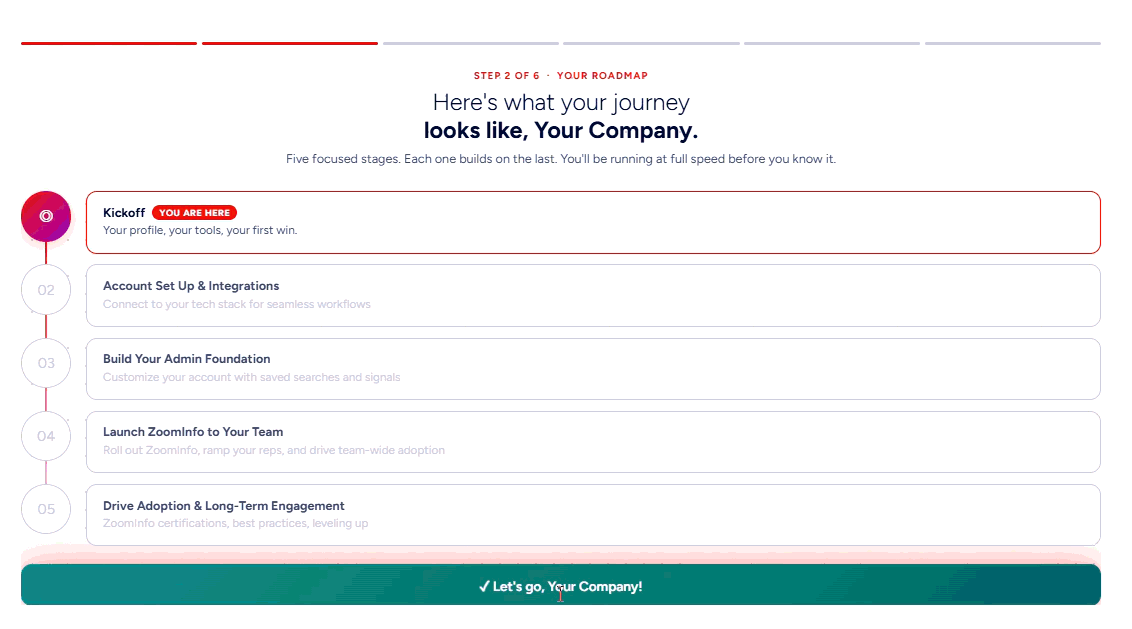
A welcome, then five stages: Kickoff, Account Setup and Integrations, Admin Foundation, Launch to Team, and Drive Adoption, the guidance an onboarding manager would give, delivered through a digital journey.
A relevant starting point: Business pain and use-case context from conversation intelligence shape the welcome and a suggested quick win, and the customer can always correct it. “We heard this in CI. We know this about you already. Does this sound right? Do you want to edit it?”
One journey, only the tasks that matter: Customer answers and product editions decide which tasks appear, and next steps reveal as customers progress, so one shared journey stays easy to maintain.
A quick win or full setup: One of Nate's additions asks customers at first login whether they want a quick win in the product right now or to continue with setup, and they can come back to the quick win later. Mary calls it a “brilliant idea.”
Humans at the right moments: When a customer stalls, the journey can offer a 15-minute call: “Hey, looks like you're not progressing. Do you want to talk to somebody?” In Mary's words, it is “digital led with human intervention at the right moments.”
Synced with Salesforce, both ways: Use case, tech stack, and timeline fields read and write to ZoomInfo's custom object, which auto-adjusts deadlines and progress and triggers personalized email nudges when a customer falls behind.
A ZoomInfo destination: A white-labeled portal admins reach through single sign-on, with Pendo guiding them into the product for setup and usage.
How They Built It with AI
A year ago, everything Nate's team did in the platform was out of the box. Then they got access to AI Studio. “I think it really became an unlock,” Nate said, because it let the team create the feeling they wanted customers to have, with HTML, React and custom widgets. “We want this to feel like ZoomInfo, not a separate tool.”
Idea to reality: “We can vibe code like a proof of concept. And then we can take AI Studio and make those things actual reality and make things feel gamified.”
Prompts that describe a feeling: “One of the prompts I've used on some of our widgets is like the button. And I said, make this button feel irresistible to press.”
Details people feel: A light shimmer, a subtly pulsing button, and a progress bar after a click. “There's no operational necessity, but it feels like, oh, I'm actually, I actually built my onboarding plan.”
Energy, not a checklist: Kinetic energy matters to Nate in every kit. The experience should feel alive, “not something that's just like a flat static checklist.”
The kit content itself has not changed that much in a year. What changed is how it feels.
I think it has a feeling of difference because of how we've built those custom widgets.
Nate sketches an idea, works with the team, and makes it real. His takeaway for any scaled program is “Feeling = function.” He describes the result as confidence: “Confident that we can come up with really cool ideas and not have to think about what the tool can or can't do.”
How the Strategy Fits Together
Mary's team is building two journeys across the whole lifecycle. A foundational journey covers the milestones everyone hits, such as a welcome, logging in, and a QBR. “Layered on top of that is where we build our signal-based journey,” Mary said, which responds to risk, alerts, and moments worth celebrating. Both journeys are then segmented by persona and by experience.
Every customer, the right delivery: “We have onboarding experiences from digital all the way up to a custom onboarding experience.” A digital customer gets those journeys in a digital-led way, and a custom customer gets the same events in a more human way.
Great for every tier: “The digital experience is a great experience for someone who is paying a little less.”
One feeling across channels: Programs including digital onboarding, lifecycle email and in-app messaging are channels. “All of those channels are working together,” Nate said, “to create one feeling.”
The stack underneath: EverAfter within Base for digital onboarding, Pendo as the main communications engine for dynamic journeys, SendGrid for email sends, and Salesforce as the system of record.
The Results
We were able to scale efficiently, to pull back human resources and let customers self-serve without watering down the experience.
ZoomInfo went live in September 2025 with a deliberately narrow cohort, about 10% of monthly onboarding logos. It expanded to about 20% in March 2026 and about half by May 2026, because, as Nate said, “we had gained so much confidence that this is a good model for customers.”
An estimated 1,250 onboarding-manager hours a month have been reclaimed and reinvested in customer-facing time, particularly upmarket. Product use held: ZoomInfo's internal utilization measure sits at 67.2% for Digital Touch, ahead of 63.5% for the historical low-touch model and in line with 67.5% for current mid touch. In the early program, fewer than 1% of customers needed live escalation.
Within 40 days of launch, time from contract signature to completed kickoff dropped from 5 to 7 days to 1 to 3, against an SLA of 10 days. Among customers who complete the portal, completion takes about four days. “They sign the contract, and within hours, if the customer is ready, they can start on their onboarding experience,” Nate said. Customers who complete the digital kickoff tend to stay engaged, and satisfaction lines up with use: “The customers that go through the kit, you know, are giving high CSAT at the end of onboarding. They feel good about the experience they have.”
The way ZoomInfo measures success has moved too. Calendar milestones drove “too much of a checklist mentality,” Nate said, so the team re-imagined health scores around utilization and consumption: connected tools, assigned seats, consistent logins, and consistent use of credits.
ZoomInfo kept the same engagement volume while removing the manual work of scheduling calls, managing inboxes, and pushing webinar attendance. Onboarding managers now spend that time on strategic accounts. “I feel really good for our team because we're giving them capacity back,” Mary said. Asked to sum up the impact in one word, Nate didn't hesitate: “Scalability.”
Knowing that we're creating a good experience, knowing that we're helping people get to their outcomes quickly, and we're not the bottleneck for people getting to those outcomes makes me feel really happy.
What's Next
ZoomInfo sees the Journey Portal as the first step in a company-wide move to digital-first success. “We see a world where all customers will get a version of the ZoomInfo Journey Portal, and they will get different journeys depending on what stage they're at,” Nate said.
Everboarding: “We really want to expand past onboarding,” Mary said. “Onboarding shouldn't be a one-time event. You're always finding new products, finding new use cases.” A signal from data or usage can open a new journey for the next use case.
Gen 3 onboarding: More choice in how customers navigate, with next actions shaped by their specific use case, built almost entirely with EverAfter Studio and AI widgets.
Testing the EverAfter MCP: Journey-data access to identify reporting gaps and explore targeted follow-up.
Expanded access to all customers: Project visibility alongside onboarding managers, closer connections to the product, and experiences for end users.
“Human-led experiences are great; digital-first experiences are great too,” said Nate. “This isn't less of an onboarding. It's just as legitimate.”
Ready to Scale Your Customer Programs?
See how Base helps you turn customers into your best growth channel.