AI Agents Are Reading Your Reviews. You're Probably Not Giving Them Anything Good to Read.
-
6
min read
Last week we watched a buyer evaluate three vendors in our category. She didn't open a single homepage. She typed "compare vendor A vs vendor B vs vendor C for customer marketing" into ChatGPT and read what came back. She had her shortlist before any of those companies' marketing teams knew she existed.
That is the new buying process. Not coming. Already here.
The marketing copy on your homepage is no longer the first version of your brand a buyer sees. The first version is whatever an AI agent stitches together from public mentions, reviews, podcast clips, community threads, and customer quotes pulled from surfaces you don't own. Your homepage might not even make the citation list. If it does, it shows up as one signal among twenty.
This is the part of the AI shift nobody is talking about clearly. It is not "AI will replace search." It is "AI will replace the homepage as the first impression." Two completely different problems.
The trust collapse is measurable now
Roughly 54% of Americans report AI fatigue in 2026. Only 19% are excited about AI, down from 50% two years ago. 59.9% of consumers doubt the authenticity of online content. 52% reduce engagement when they suspect content is AI-generated. Brand content perceived as AI-generated takes a 20 to 35 percent engagement penalty.
Gartner's number is the one we keep coming back to. 50% of US consumers would prefer to give their business to brands that don't use generative AI in customer-facing messages, ads, or content. Half the market is now actively allergic to the thing every marketing team is racing to industrialize.
In 2025, Macquarie, Merriam-Webster, and the American Dialect Society independently picked the same word of the year: slop. That is the market grading our work. We earned that grade.
What the agents actually trust
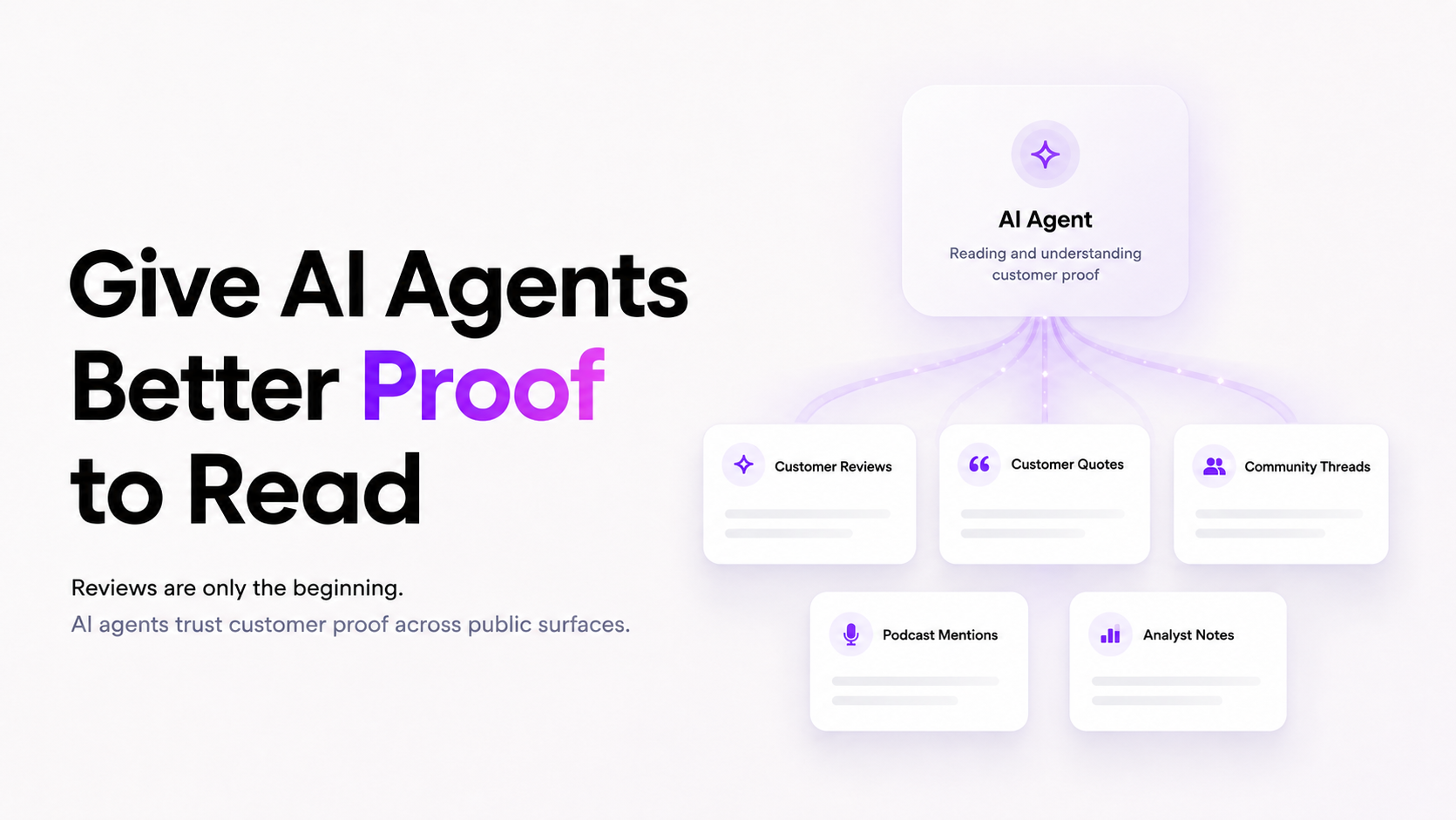
Here is the pattern we kept finding when we tested AI agents on our own category and our customers' categories. The agents do not fully trust homepages. They cite them, sometimes, and they discount them as marketing surfaces. They cluster around a different set of sources when buyers ask comparative or evaluative questions.
They quote G2 and TrustRadius reviews. They quote Reddit threads in the relevant subreddits. They quote LinkedIn posts written by real customers, not by company pages. They quote podcast transcripts and conference keynotes where a customer named a real outcome on the record. They quote analyst notes and Gartner reports. They quote case studies, but only the ones with named customers and verifiable numbers.
One vendor we spoke to measured this directly. ChatGPT systematically ranked brands with deep, recent, named customer reviews higher in comparison queries. The same CEO put it bluntly: customer reviews influence AI agent recommendations "one million percent."
Notice what the agents are doing. They are routing around marketing. They are treating the testimony of a real human customer, on a third-party surface, as the most credible data they can pull. The agent's trust heuristic is almost identical to a human buyer's trust heuristic. The only difference is that the agent reads everything, instantly, and never gets tired.
The proof economy is real and unevenly distributed
This is becoming a named pattern. The proof economy. Brands win when they can produce verifiable signals at the scale of their content output. Real video. Real names. Real numbers. Real locations. Brands lose when the proof-to-content ratio drops below whatever the agents are looking for.
Most B2B companies are catastrophically underweight on proof and catastrophically overweight on content. The marketing team ships eight pieces of branded thought leadership a week. The customer marketing team ships one new customer reference a month. The math was already bad in the SEO era. It is fatal in the AEO era.
Customer advocacy is now AEO infrastructure
This is the reframe we want every CMO and customer marketing leader to internalize.
Your advocacy program is not a feel-good function. It is not a "nice to have for the website." It is the substrate that AI agents will quote from for the next decade when buyers ask about you.
The customer keynote you didn't film. The G2 review you didn't ask for. The customer podcast you canceled because the team was busy. The Reddit thread you ignored because your community manager left. Those are not soft losses. They are missing data points in the corpus the agents will index, retrieve, and cite when somebody asks ChatGPT whether you are worth a demo.
Every customer marketing motion gets a new evaluation lens once you accept this. Does this artifact create a verifiable, citeable, named piece of customer truth that an agent can retrieve? If yes, ship it. If no, ask why the budget is going there.
Where the spend has to shift
The smart customer marketing teams are already reallocating. Less budget on glossy brand content that AI agents cannot distinguish from a competitor's glossy brand content. More budget on customer video, customer podcasts, customer keynotes, on-record references, and advocate enablement.
More importantly, they are tightening the loop. They are not just collecting customer proof. They are distributing it to the surfaces where agents actually look. Review platforms. Industry communities. Customer-authored LinkedIn posts. Third-party podcasts. Analyst briefings. The places where the agent's retrieval index is being built right now, today, whether you participate or not.
The honest part
None of this works if the underlying experience is not good. Authenticity is not a tactic. If the product underdelivers or the post-sale experience is broken, no AEO strategy fixes that. The agents will surface the bad reviews with the same fidelity they surface the good ones, and probably faster.
The companies that win the AEO era are the companies whose customers actually like them, and whose customer marketing teams are organized to capture and distribute that signal at scale. The strategy and the substance have to match. They always did. AI just made the gap visible.
The bet we are making
Base was built on the conviction that customer-led growth is the most sustainable growth model in B2B. That conviction is now load-bearing in a way it wasn't even twelve months ago. In an AI-mediated buying process, your customers are simultaneously your marketing, your sales pitch, your reviews, your brand layer, and your search results.
The companies that figure this out first will own the next decade of buying conversations. The companies that keep optimizing the homepage will not be in the conversation at all.
Your customers are reading your reviews. Now the agents are too.
Give them both something good to read.
Key Takeaways
The trust collapse is measurable. 54% of Americans report AI fatigue, 50% of US consumers prefer brands that don't use GenAI in customer-facing content (Gartner), and "slop" was 2025's word of the year across three major dictionaries.
AI agents route around marketing. When buyers ask comparative questions, the agents discount homepages and quote G2 reviews, Reddit threads, customer-authored LinkedIn posts, podcast transcripts, and named case studies.
Customer reviews directly influence AI agent recommendations. Vendors measuring this have found ChatGPT systematically ranks brands with deep, recent, named reviews higher in comparison queries.
The reframe: customer advocacy is no longer a feel-good function. It is AEO infrastructure. The corpus of real customer voices on third-party surfaces is the substrate AI agents will quote from for the next decade.
The spend has to shift: less budget on glossy brand content agents can't distinguish from a competitor's, more on customer video, on-record references, podcasts, and advocate enablement distributed to surfaces where agents actually look.
Frequently asked questions
Do AI agents use customer reviews to recommend vendors?
Yes. When buyers ask comparative questions, agents discount vendor homepages and quote what customers said instead. Your review corpus is now part of how you get shortlisted, whether or not anyone on your team is managing it.
What sources do AI agents actually trust?
G2 reviews, Reddit threads, customer-authored LinkedIn posts, podcast transcripts, and named case studies. The common thread is attribution to a real person who is not you.
Why is AI-generated marketing content losing trust?
Because buyers can now spot it. 54% of Americans report AI fatigue, 50% of US consumers prefer brands that do not use generative AI in customer-facing content (Gartner), and “slop” was named 2025's word of the year across three major dictionaries.
How does customer advocacy become AEO infrastructure?
Answer engine optimization depends on what third parties say about you, and advocacy is the function that produces that. Reviews, customer stories, and customer-authored posts are the raw material answer engines cite, which makes advocacy a distribution investment rather than a content one.
Give us a try, easy peasy.
Building and scaling your advocacy program is easy when you can manage campaigns, rewards, track, and report - all within one AI platform.