The TOP 100 Stopped Hiring. They Started Engineering.
Base AI Team
-
Base AI
6
min read
We have watched a lot of CS leaders walk into 2026 budget meetings asking for more CSMs. We get why. Renewals are tighter, expansion targets are higher, the book of business is growing, and the reflex move when the math gets harder is to add bodies. The reflex is not working. Most of the leaders we have talked to either did not get the bodies, or got fewer bodies than they asked for, or got them too late.
When the TOP 100 CLG '26 dataset came together, the pattern that separated the winners from everyone else was not team size. The list is full of teams smaller than you would expect, sitting on outcomes you would not expect those teams to be able to produce. They are not bigger CS teams. They are better-engineered CS teams. Three things show up across the list, and once you see them, the headcount conversation starts to look like it is asking the wrong question.
Productized journeys, not bespoke ones
The teams that scaled stopped trying to deliver more 1:1 CSM time and started turning the things every customer needs into products.
Radhika Narayanan at Freshworks is the cleanest case. Strong sales momentum was running into low post-purchase activation: under-configured licenses, inconsistent agent activation, plateauing adoption, rising churn risk. The 1:1 fix would have been doubling the CSM team. The fix she shipped was a system. A 21-day onboarding journey for time-to-first-value. A 45-day adoption journey for low-adopter reactivation. Cohort-based governance, entry/suppression rules, re-entry logic. Synchronized motion across email, in-app nudges, masterclass webinars, certifications, community pathways, and white-glove CSM touches, governed by a cross-functional Adoption Steering Committee. Six weeks in: 74.7% cohort engagement, 11x configuration lift, 9x activation lift, 133 new AI licenses expanded, and a 3.5-point NDR delta between engaged (107.1%) and non-engaged (103.6%) cohorts.
That is not a CS team working harder. It is a CS team running on infrastructure.
Danish Muti at Vidyard did the same to onboarding and QBRs. Where most teams treat them as one-off touchpoints with a CSM in the loop, he reframed them as productized, data-instrumented journeys, with AI-enabled workflows for pricing analysis and renewal decisioning, and feedback loops that pipe customer insight into RevOps, Product, Support, and Marketing. Onboarding completion rates went up. 5/5 satisfaction scores. Reduced early-churn signals. Higher self-serve renewal confirmations. Same team, more output, repeatable next quarter without rebuilding from scratch.
Mariah Urueta at Asana baked the philosophy into how the CS function works. In her first month she noticed customer calls kept surfacing the same handful of workflow, reporting, and validation questions, and she asked the sharper question: how do we solve this once, well, at scale, for thousands. Virtual Office Hours. Repeatable educational resources. Cross-functional alignment of customer-health signals with engagement strategy. Each initiative starts as a hypothesis, ships fast, gets measured against real behavior, and gets formalized into infrastructure when it works. The phrase her TOP 100 story uses is that she "operationalized scalable customer outcomes without adding CS overhead." That is the part the headcount-first reflex has been missing.
Lifecycle as revenue infrastructure, not nurture
The second move flipped lifecycle marketing from a nurture channel into a revenue surface that pays for itself.
Jillian Colon at Conductor is the receipt. Conductor had named retention and adoption as priorities and had no structured journeys behind them, so she built the customer email infrastructure from scratch. A comprehensive onboarding journey. A triggered new-user journey. A bi-monthly cadence called Workflow Wednesday that takes a real customer pain and walks through how Conductor solves it. The numbers, in order: 24% open rate. 12% click-to-open. 62.8% of openers convert to a platform login. 8% of clickers activate the highlighted feature in-product. The program has touched 235 qualified opportunities, influenced 25 closed-won deals, and contributed $10.7M in revenue. She is now layering Gong AI insights from real customer conversations into the program to make content planning real-time.
That is a lifecycle that pays for itself, and then some, and it does it without putting a CSM in the loop on every account. It puts the right content at the right point in the journey, instrumented end-to-end, and lets the CSM team work on the accounts where 1:1 actually moves something. The same instrumentation is what makes the program legible as expansion revenue rather than nurture activity.
AI as force multiplier, not staffing replacement
The third move is the one most teams still implement wrong.
The TOP 100 winners did not use AI to replace the CSMs they have. They used it to make the CSMs they have more effective than the CSMs they cannot hire.
Amber Frye at Alloy Labs runs Member Success for a community of innovation-driven banks. She built a custom AI assistant that cuts her strategy-session prep time by 40% while increasing personalization. Combined with her segmentation-by-innovation-maturity approach (Traditionalists, Explorers, Leaders), she lifted retention from 86% to 96% and grew program participation 70%. The framing her TOP 100 story articulates is the one to internalize: retention alone can be a ticking time bomb, and participation proves customers are actually getting value. AI gave her the bandwidth to chase both.
Kristi Faltorusso made the same move on the competitive front, with a custom GPT that ingests call transcripts, listens for competitive signals, scores each deal on competitive risk, and serves CSMs a tailored playbook by competitor and lifecycle stage. The result: an 18% retention lift on competitive deals inside the 180-day renewal window. Without adding a body.
Sneha Iyer at Observe.AI built upstream value infrastructure that turned AI into a force multiplier on the entire revenue motion. First Mile Intelligence: 300+ past deployments turned into reusable context, KPI logic, and data-readiness briefs. A Value Modeling Engine that builds CFO-credible ROI in 20 minutes instead of 6 to 8 analyst hours. The kind of attribution most CS orgs only aspire to: $20M+ influenced revenue, 73% upsell win rate, 80%+ renewal rates on Value-Modeling-backed deals.
Three different teams, three different categories, the same move. AI did not replace the CSM. It turned every CSM into the CSM the team wanted to hire and could not.
Why this only works on a connected layer
Productized journeys, lifecycle as revenue infrastructure, AI as force multiplier. These three things have something in common that is worth saying out loud, because it is the part that determines whether your team gets to do this work or watches other teams do it.
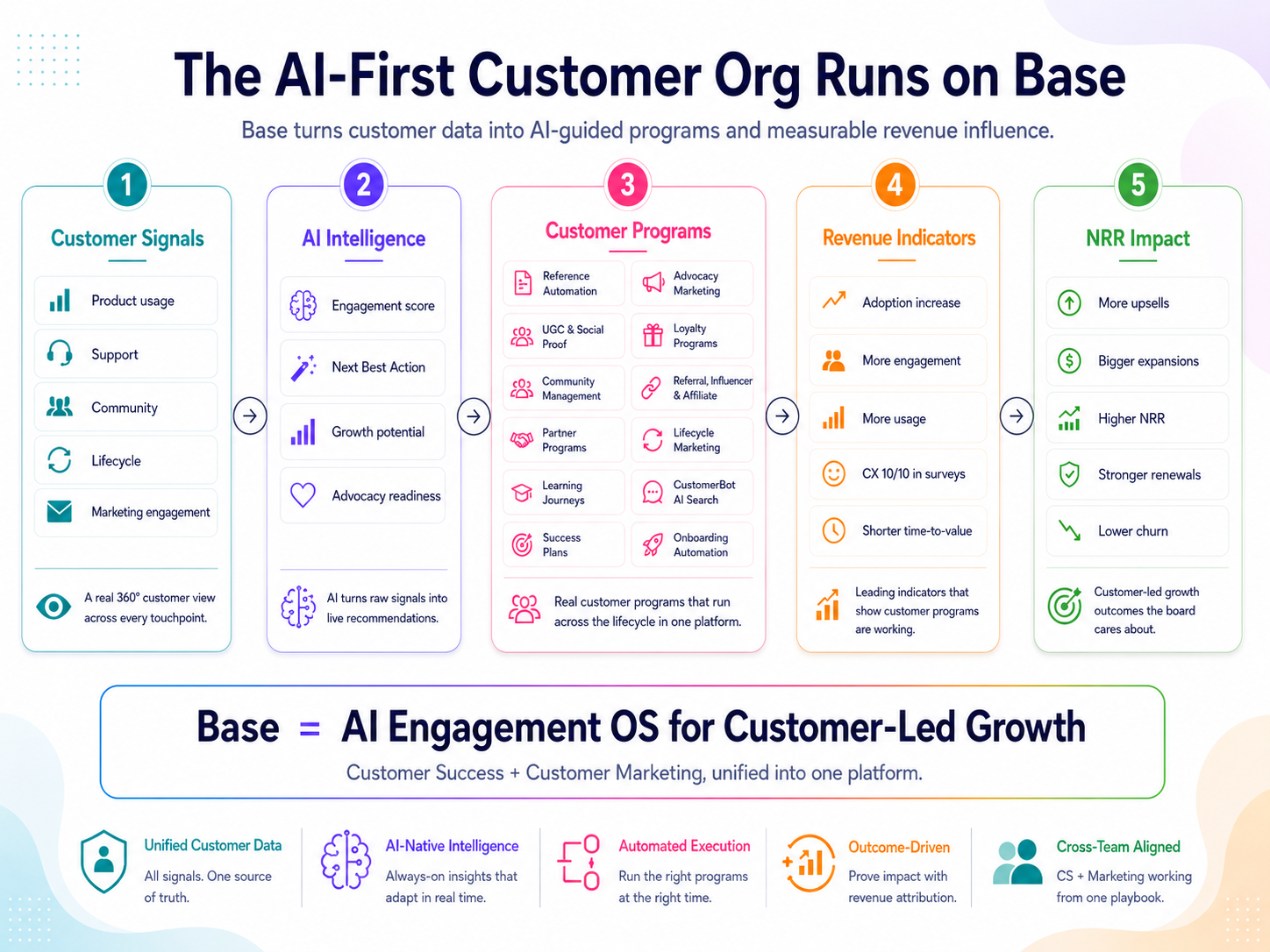
These programs do not run on stitched-together scripts and disconnected tools. They run on a connected engagement layer where the journey, the signal, the content, the AI, and the human-in-the-loop all share the same context. That is the architecture customer-led growth demands, and the architecture we built Base AI around.
The teams that tried to scale by hiring kept hiring. The teams that tried to scale by stitching tools together kept patching. The teams on this year's list out-engineered the problem.
If you walk into your next planning conversation arguing for more CSMs, the TOP 100 list is going to be in the room with you, and it is going to suggest a different argument. The leaders on this list scaled CS by productizing programs, instrumenting lifecycles, and turning AI into a force multiplier, not by adding bodies. Their numbers are public. Their playbooks are public. The full list, including the 100 winners and the 19 consultants who shaped this year's work, is at base.ai/top100-clg-2026.
If your 2026 plan still has a flat headcount line and a goal for higher NRR, this is the year to read it carefully.
Key Takeaways
The headcount-first reflex is not working in 2026. The TOP 100 winners scaled CS by system design, not team size.
Productized journeys outperform bespoke ones. Radhika Narayanan's 21+45-day lifecycle framework at Freshworks lifted activation 9x and configuration 11x.
Lifecycle email is now revenue infrastructure. Jillian Colon's program at Conductor influenced $10.7M in revenue.
AI is a force multiplier on the team you have, not a replacement for the team you cannot hire. Amber Frye lifted retention from 86% to 96%; Kristi Faltorusso added an 18% retention lift on competitive renewals; Sneha Iyer influenced $20M+ in revenue.
These three systems only work on a connected engagement layer. That is the architecture Base is built around.
Frequently asked questions
How do you scale customer success without hiring more CSMs?
By designing the system instead of growing the team. The TOP 100 winners productized their journeys, treated lifecycle communication as revenue infrastructure, and used AI to multiply the people they already had.
What is a productized customer journey?
A journey built once as a repeatable, instrumented product rather than assembled per account by whichever CSM owns it. Radhika Narayanan's 21-day and 45-day lifecycle framework at Freshworks lifted activation 9x and configuration 11x.
Does lifecycle email actually generate revenue?
When it is instrumented, yes. Jillian Colon's lifecycle program at Conductor influenced $10.7M in revenue, which puts it in the category of revenue infrastructure rather than nurture.
Why does this only work on a connected layer?
Because productized journeys, lifecycle triggers, and AI all read from the same customer signals. Run them on separate systems and each one operates on a partial view, which is how good programs produce wrong actions at scale.
Give us a try, easy peasy.
Building and scaling your advocacy program is easy when you can manage campaigns, rewards, track, and report - all within one AI platform.