Customer success automation is software that handles customer success work without a person doing each step. Most of it notices something and tells a person. For an AI agent to run a program instead, the playbook needs five fields: a trigger, a customer goal, allowed actions, a handoff rule and a proof metric.
Miss one and the agent can only send what a person already decided.
Most automation notices. It doesn't decide.
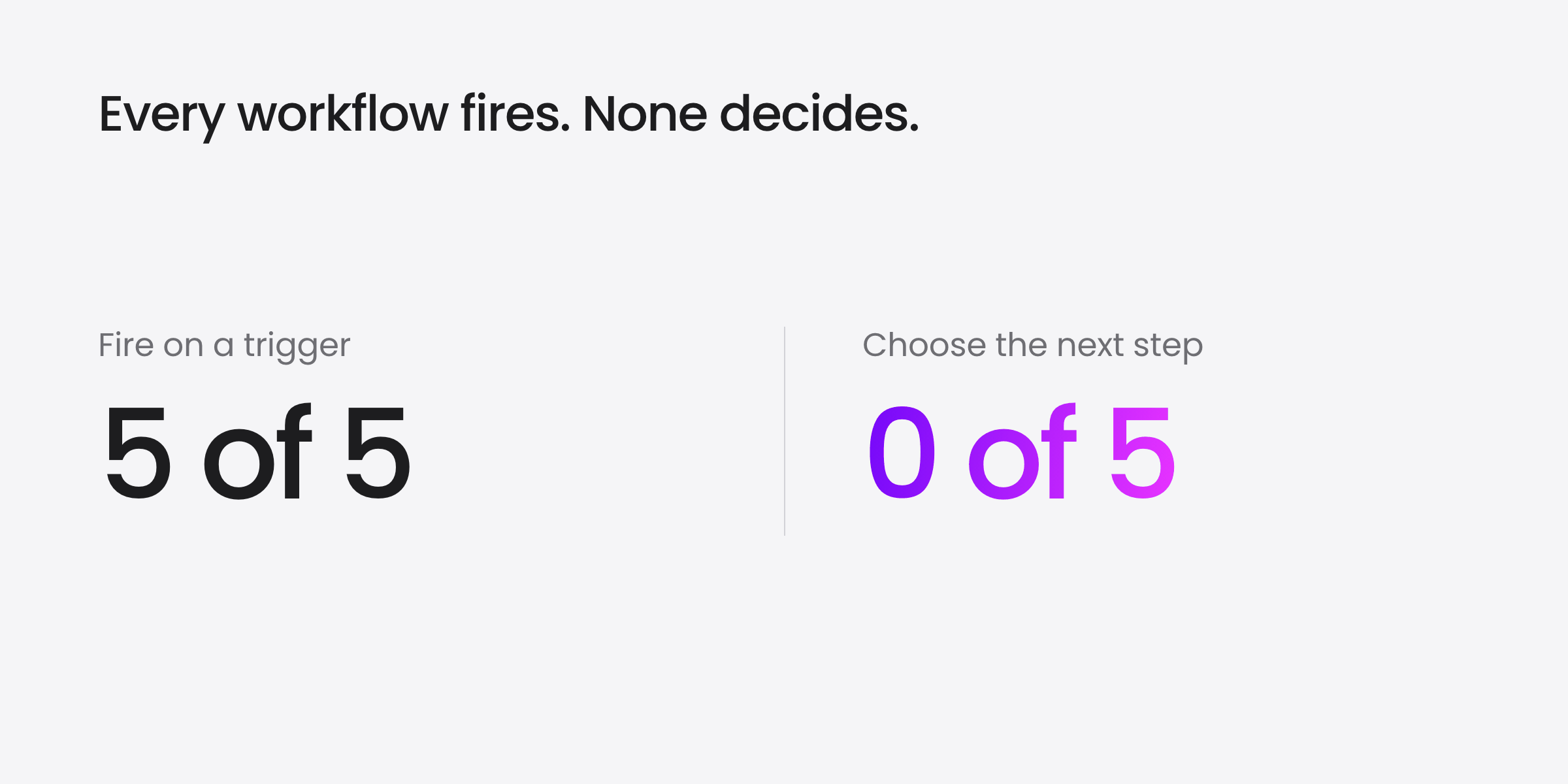
In February 2026, G2 surveyed four customer success and subscription platforms on AI for churn. All four reported automating workflows such as inactivity alerts, renewal reminders, onboarding sequences, upsell triggers and post-support follow-ups. The answers are vendor-reported.
Sort those five by what sets them off. This reading is ours, not G2's:
Inactivity alerts fire when usage drops below a threshold.
Renewal reminders fire when a date gets close.
Onboarding sequences fire on a start date.
Upsell triggers fire when usage crosses a threshold.
Post-support follow-ups fire when a ticket closes.
Each one answers "when should something happen?" None answers "what should happen for this account, given what it is trying to achieve?" That question still goes to a person, in an alert, a task or a Slack message.
Our reading of the five workflows named in G2's 2026 survey.
Open a customer success playbook and look at the verbs. You will find steps like these:
"CSM reaches out to understand the drop in usage."
"Schedule a check-in if the customer seems disengaged."
"Share relevant resources based on the customer's needs."
Each step hides a judgment. "Seems disengaged" according to what? "Relevant" to which goal? A CSM fills those gaps from memory. An agent can't, so it does nothing, or the same thing for every account.
A quick test: hand the playbook to a capable new hire with no one to ask. Every question they would need answered is a field the agent is missing.
What should a customer success playbook include?
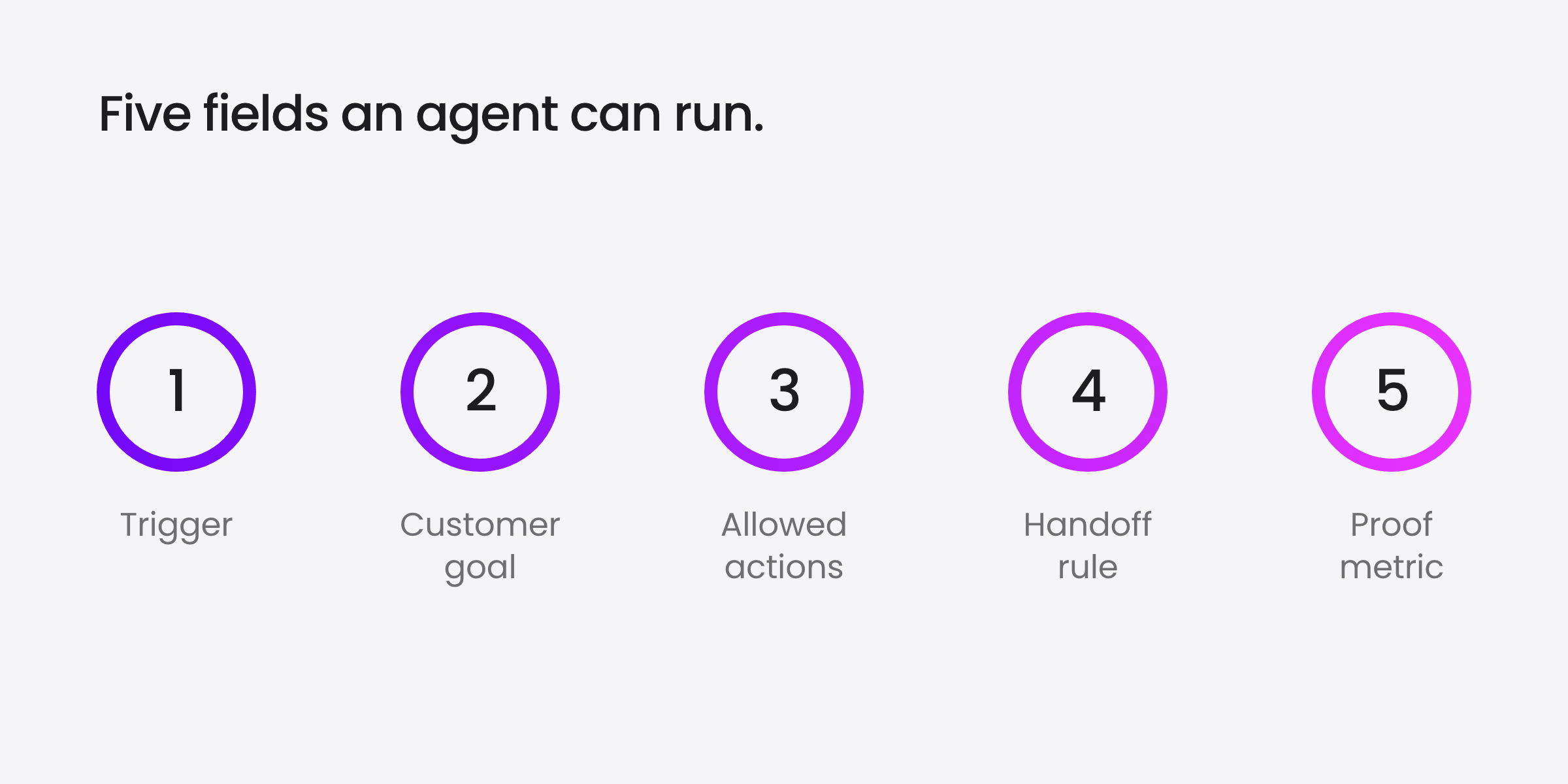
A customer success playbook needs five fields before an AI agent can run it: a trigger the agent can read in your systems, a customer goal it steers toward, allowed actions it may take alone, a handoff rule for when a person takes over, and a proof metric named before launch.
The five-field spec is our own. Each field is one line.
Each field is one line:
Trigger. The signal, where it lives, the threshold, and the cases that rule it out.
Customer goal. The outcome this customer named, stored as data the agent can read.
Allowed actions. The verbs, channels and limits the agent may use without asking.
Handoff rule. The conditions that pass the account to a named person, and the context that travels with it.
Proof metric. One number, with a baseline, a comparison group and a date to read it.
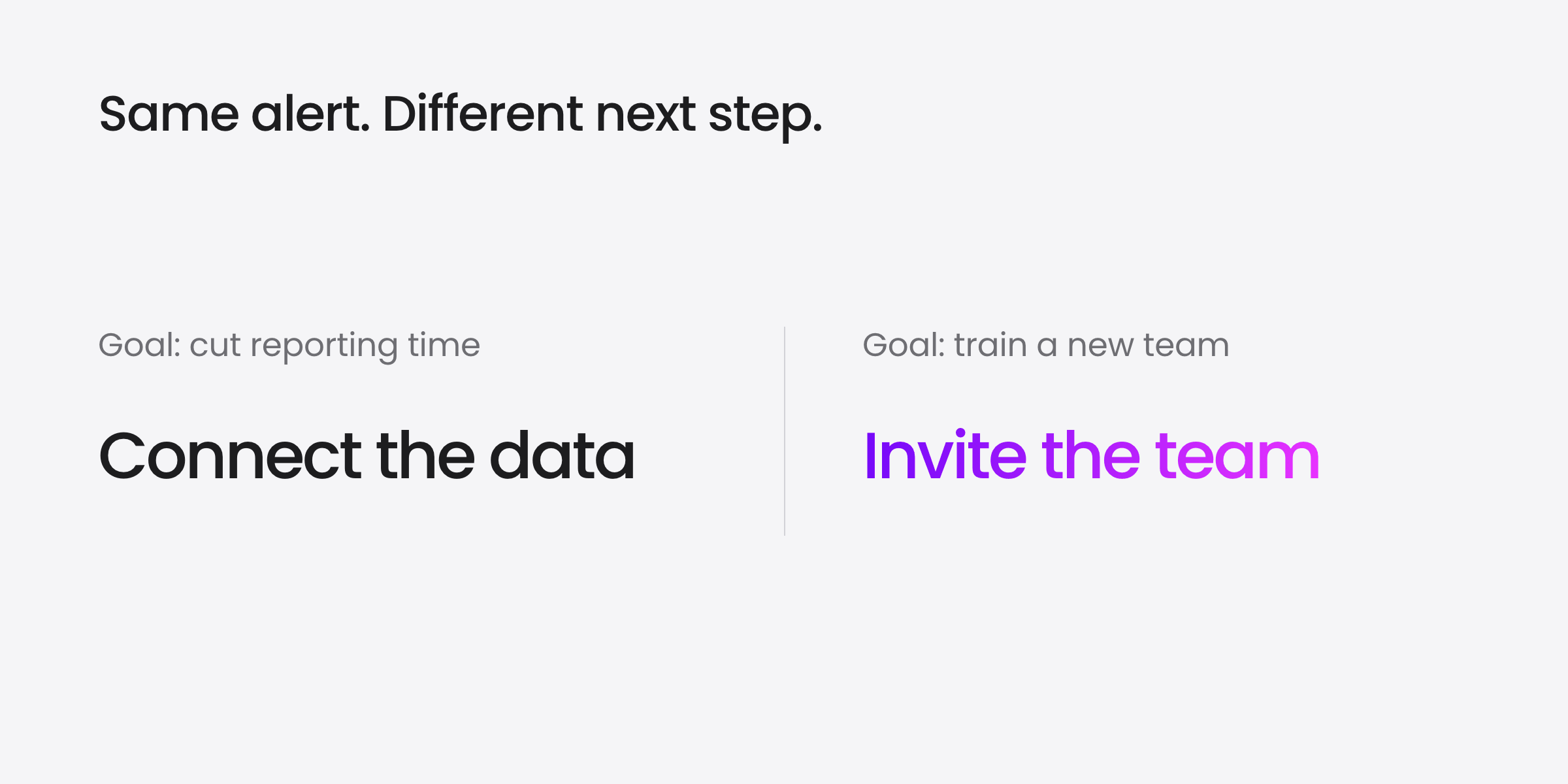
The goal is the field that turns a reminder into a decision. Two accounts can trip the same inactivity alert. One bought the product to cut reporting time and hasn't connected its data source. The other bought it to train a new team and hasn't invited them.
An illustrative pair of accounts.
Write a "never" line into the allowed actions as well: price, contract terms, roadmap promises. Legal, sales and support will ask for it first, and having it written is what gets the play approved.
One play, written in five fields
Here is an onboarding stall. The thresholds are illustrative, so set yours from your own data.
Trigger: a setup milestone, such as CRM sync, isn't complete 14 days after kickoff. Accounts with an open ticket on that step are excluded.
Customer goal: the go-live date and the first outcome the admin named at kickoff.
Allowed actions: send the guide for the missing step, move it to the top of the checklist, invite the integration owner to a how-to session.
Handoff rule: a second missed milestone, or a ticket on the same step, goes to the onboarding lead with the step history.
Proof metric: days from kickoff to first value event, against last quarter's cohort.
Write this play first, because the trigger data already exists. It is what AI-driven onboarding journeys are built to run.
Measure customer success automation with one proof metric, named before the play runs: an outcome tied to the customer's goal, such as days from kickoff to first value, read against a baseline and a holdout on a set date. Activity counts such as emails sent rise on launch day and prove nothing.
It also protects the program. When a CFO asks what the automation did, "Weekly use of the feature they pay for rose against the holdout" survives the meeting. "We sent thousands of nudges" doesn't.
What Salesloft's program shows
The clearest example we can point to is Salesloft's onboarding and digital success program. Salesloft built it on EverAfter, which Base AI acquired. The story doesn't say an AI agent runs the program, and neither do we.
It does show the first two fields at work. The guided implementation plan "tracks progress automatically and verifies completion using live product data." Scale customers define their goals, and the interface "automatically builds a tailored strategy."
Salesloft's story on base.ai reports:
10 hours saved per customer during onboarding
15% higher product adoption after guided onboarding
4 hours saved per consultant each week
The page doesn't show written limits, the conditions that move an account to a person, or a baseline or holdout behind the 15%. Add all three to yours.
Write the costliest play first
Buying a platform with agents doesn't give them a program to run. In an April 2026 post on Gainsight's MCP launch, Forrester's Shari Srebnick argued that redesigning customer success for this era is not a tooling decision but "an organizational one." The five fields are that decision written down.
Across all industries, Gartner predicted in June 2025 that at least 15% of day-to-day work decisions will be made autonomously through agentic AI by 2028, up from 0% in 2024. Each of those decisions needs written rules behind it.
This is the model Base AI is built on. As the Base AI homepage puts it, "Every program comes staffed." On the AI Customer Growth platform, regular touches run on schedule and judgment calls go to the AI teammate, while teams build plans, hubs and reviews in AI Studio.
Do one thing this week. Pick the play where a missed step costs you most, usually onboarding stalls or renewal prep, and write it in the five fields. If you can't fill the customer goal from data you already hold, that gap, not the AI, is your first project.
Most automation only notices. It fires on a date, threshold or event, then tells a person.
"CSM reaches out" can't run. Each step like it hides a judgment an agent lacks.
Five fields fix it. Trigger, customer goal, allowed actions, handoff rule and proof metric.
Start with the costliest play. If you can't fill its customer goal, fix that first.
Frequently asked questions
What is customer success automation?
Customer success automation is software that handles customer success work without a person doing each step, such as health scores, alerts, onboarding emails and renewal tasks. Done fully, it runs a program from signal to outcome: it reads account data, picks the next step toward the customer's goal, takes it within limits you set, and hands the account to a person when your rules say so.
What should a customer success playbook include before an AI agent runs it?
A customer success playbook needs five fields before an AI agent runs it: a Trigger the agent can read, with a threshold and exclusions; a Customer goal stored as data; Allowed actions it may take alone, plus a never list; a Handoff rule naming the conditions, the owner and the context that travels; and a Proof metric with a baseline, a comparison group and a read date.
Why can't an AI agent run a playbook step like "CSM reaches out"?
A step like "CSM reaches out" hides several judgments: which channel to use, which customer goal it serves, and what to do if nobody replies. A CSM fills those gaps from memory. An AI agent cannot, so it does nothing or sends the same thing to every account. A quick test: every question a new hire would need answered is a field the agent is missing.
How do you automate customer success with AI agents?
To automate customer success with AI agents, pick the play where a missed step costs you most and rewrite it in five fields: trigger, customer goal, allowed actions, handoff rule and proof metric. Onboarding stalls are often the easiest start, because the trigger data already sits in your product. If you cannot fill the customer goal from data you hold, close that gap first.
What is a handoff rule in customer success automation?
A handoff rule says when an AI agent stops and a person takes over an account. It has three parts: conditions that end the agent's turn, such as a second missed milestone or a seat reduction request; a named owner, by role, with a response time; and the context that travels, meaning what the agent saw, what it sent and what the customer did.
How do you measure whether a customer success automation play works?
Name the proof metric before the play runs, or you will end up measuring activity such as emails sent. A proof metric has one outcome number tied to the customer goal, such as days from kickoff to first value, plus a baseline from before the play, a comparison group or small holdout, a read date set in advance, and an owner who reports it.
Customer experiences that drive NRR.
Building and scaling your advocacy program is easy when you can manage campaigns, rewards, track, and report - all within one AI platform.