How to Diversify Your Customer Content Engine: Insights from Industry Leaders
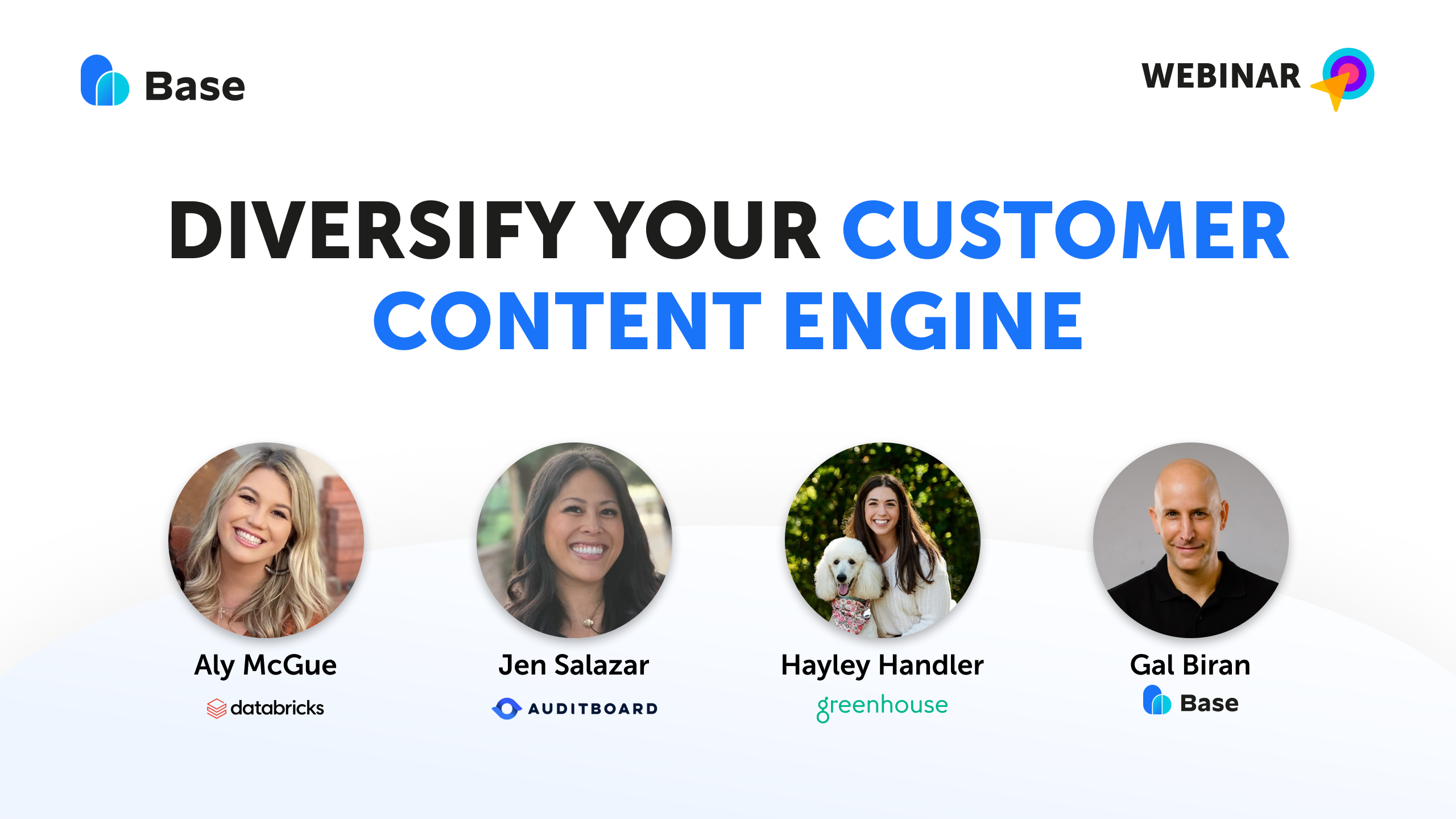
Customer content is evolving rapidly, and today’s B2B buyers demand more than polished testimonials—they crave authentic, engaging, and versatile stories. In our recent webinar, Diversify Your Customer Content Engine, we brought together three customer marketing powerhouses: Hayley Handler (Greenhouse Software), Jen Salazar (Airtable), and Brad McGinity (6sense) to share their strategies for creating authentic, impactful customer content at scale. Their insights form a comprehensive roadmap for modernizing your customer content engine.
1. Develop a Persona-Driven Content Strategy
The foundation of a strong customer content engine is a deep understanding of your audience. Jen Salazar from Airtable emphasized the importance of tailoring content to specific personas and use cases. At Airtable, where customers span industries and job functions, they use a product-driven approach, creating content for their key solutions, such as Marketing and Product Development. By aligning content with persona needs, Airtable ensures that every story resonates with its target audience. “Having use case-specific stories makes your content feel personal and actionable,” Jen explained.
Pro Tip: Focus on creating a mix of formats—testimonials, video interviews, technical use cases—that align with how your audience prefers to consume content. This is especially important given that 73% of B2B buyers now want personalized experiences similar to B2C, but only 22% say their recent experience was truly personalized. For a deeper perspective on operationalizing this, see our post on turning survey answers into audiences.
2. Focus on Cross-Functional Collaboration
Creating diverse customer content requires collaboration across teams. Hayley Handler shared how Greenhouse aligns with product marketing, customer advocacy, and corporate communications to maximize the value of their customer content. “Tight alignment with internal teams ensures we’re not duplicating efforts or missing opportunities,” Hayley noted. This unified approach allows them to connect their advocacy initiatives directly to broader marketing campaigns, amplifying the impact of their customer stories.
Actionable Tip: Establish regular touchpoints with cross-functional stakeholders to align on key customer content priorities. Base’s Team Dashboards are built to give Sales, CS, and Marketing a single view of the customer so the right ask goes to the right person at the right time.
3. Repurpose Content for Maximum Reach
Both Greenhouse and Airtable highlighted the importance of repurposing content to extend its lifecycle and reach. At Greenhouse, a single customer story can spark a case study, video, and event presentation—each tailored to a specific audience. Jen from Airtable added, “Repurposing content is a game-changer. It allows us to get creative and deliver value in multiple formats without starting from scratch.”
The ROI of this approach compounds when paired with event-based programs. Brad McGinity at 6sense shared how their customer advisory board (CAB) creates a reliable pipeline of content. From keynote recordings to panel insights, CABs provide a rich source of authentic narratives. “Customer advisory boards are a goldmine for content. You get direct, relevant insights that resonate across multiple channels,” Brad explained.
4. Leverage Social Media and Amplification
Once content is created, amplification is key. Hayley shared Greenhouse’s strategy of including social shares in every launch plan. Whether it’s a case study or a thought leadership piece, pairing content with a coordinated social push ensures it reaches a wider audience. Her advice: “Start small and be consistent. Even a single LinkedIn post can create momentum over time.”
Pro Tip: Encourage employees and customers alike to share your content. Authentic voices drive engagement and build credibility—90% of B2B buyers say social proof heavily influences shortlist decisions (Gartner Digital Markets, 2025), so peer amplification is one of the highest-leverage things customer marketers can do.
5. Embrace AI for Efficiency
AI tools are transforming how teams create and manage customer content. Jen shared how Airtable leverages AI for tasks like transcribing interviews, drafting social posts, and summarizing long-form content. “AI helps us unlock new possibilities. It’s not about replacing human creativity but enhancing it,” she said.
The adoption data is striking. 91% of marketing professionals now use AI tools in their daily work (Salesforce, 2026), and 92% of marketers say AI has already impacted their roles (HubSpot, 2025), with content creation (35%) as the single biggest AI use case. Base is leaning into this directly with the Ask Creation AI Agent, which builds ready-to-activate campaigns from plain-language intent.
Actionable Tip: Use AI for time-consuming tasks like creating transcripts or summarizing customer interviews. This allows your team to focus on strategy and storytelling.
6. Event-Based Content Creation
Events are another powerful avenue for generating customer content. Hayley highlighted Greenhouse’s success with their annual TalentMakers event, where customer speakers deliver breakout sessions. These sessions can later be repurposed into webinars, blogs, and other assets. “It’s about capitalizing on the momentum of live events to create a steady stream of content,” Hayley shared. Brad McGinity from 6sense echoed this, noting that their CAB events produce a wealth of content that continues to fuel campaigns long after the event ends.
7. Measure and Optimize
Finally, measuring the impact of your content is crucial. Brad emphasized the importance of tracking engagement, shares, and downstream metrics like lead generation and conversions. “Understanding what works helps you refine your strategy and make smarter decisions about where to invest.”
Pro Tip: Use analytics tools to track which types of content resonate most with your audience. Pair those insights with Engagement Score to connect content performance to actual customer behavior.
Conclusion: Diversify to Thrive
As customer content expectations evolve, so must our strategies. By embracing persona-driven approaches, repurposing effectively, leveraging AI, and measuring impact, customer marketers can create content engines that are not only diverse but also impactful. As Hayley aptly put it, “It’s about meeting your audience where they are and delivering stories that truly resonate.” With the combined wisdom of Hayley, Jen, and Brad, it’s clear that the future of customer content lies in authenticity, adaptability, and innovation—key ingredients for thriving in today’s competitive markets.
Ready to elevate your content strategy? Take inspiration from these experts and start building a customer content engine that’s authentic, scalable, and aligned with your goals.
Frequently asked questions
How do I build a diversified customer content engine?
Start with a persona-driven content strategy. Identify your top 2–3 personas or use cases, map the formats each prefers (case studies, short videos, technical deep-dives, peer quotes), and build a small content mix per persona. Layer in cross-functional collaboration and repurposing to scale.
What role does AI play in customer content?
AI now handles the time-intensive parts of the content pipeline — transcription, summarization, first drafts, repurposing — so human teams can focus on strategy, customer relationships, and storytelling. 91% of marketers use AI in daily work (Salesforce, 2026); content creation is the top use case (HubSpot, 2025).
How do customer advisory boards generate content?
CABs are a goldmine because they bring senior customers together in one place sharing candid perspectives. Every session can yield keynote recordings, panel quotes, blog summaries, social clips, and case-study source material — a single event can fuel months of content.
How should I measure customer content impact?
Track both engagement (views, shares, dwell time) and downstream business metrics (pipeline influenced, deals accelerated, reviews generated). Pair content analytics with Base’s Engagement Score to connect content performance to actual customer behavior inside the lifecycle.
Want More Insights?
For updates on upcoming sessions, browse our events and webinars or follow us on LinkedIn.