Half of our discovery calls end with the same sentence. “We are just going to build this with Claude.”
We get the instinct. Every enterprise has a smart engineer who can wire up a workflow. The APIs are cheap. The demos are magical. What is stopping you.
Here is what is stopping you.
The AI Customer Growth Platform is not a prompt, not a workflow, and not a wrapper on your existing CSP. It is a five-layer system for running every post-sale motion on one data plane, with agents on top, and the compounded program knowledge of 500+ customer programs running across 150+ enterprises. Building the workflow was never the hard part. Keeping it accurate, connected, and worth trusting twelve months later is.
We wrote this post for the CCO, VP of Customer Success, or CMO staring at a build-vs-buy slide and hoping to save money. Read the row-by-row comparison first, then the argument beneath it. If you want to see the same programs running on your data, book a walkthrough.
The row-by-row comparison
We do not run a marketing framework here. We run a real product. What follows is the actual gap between the version your team would build in-house and the version already running for Vidyard, ZoomInfo, Okta, SAP, Broadcom, and 150+ other enterprises on Base.
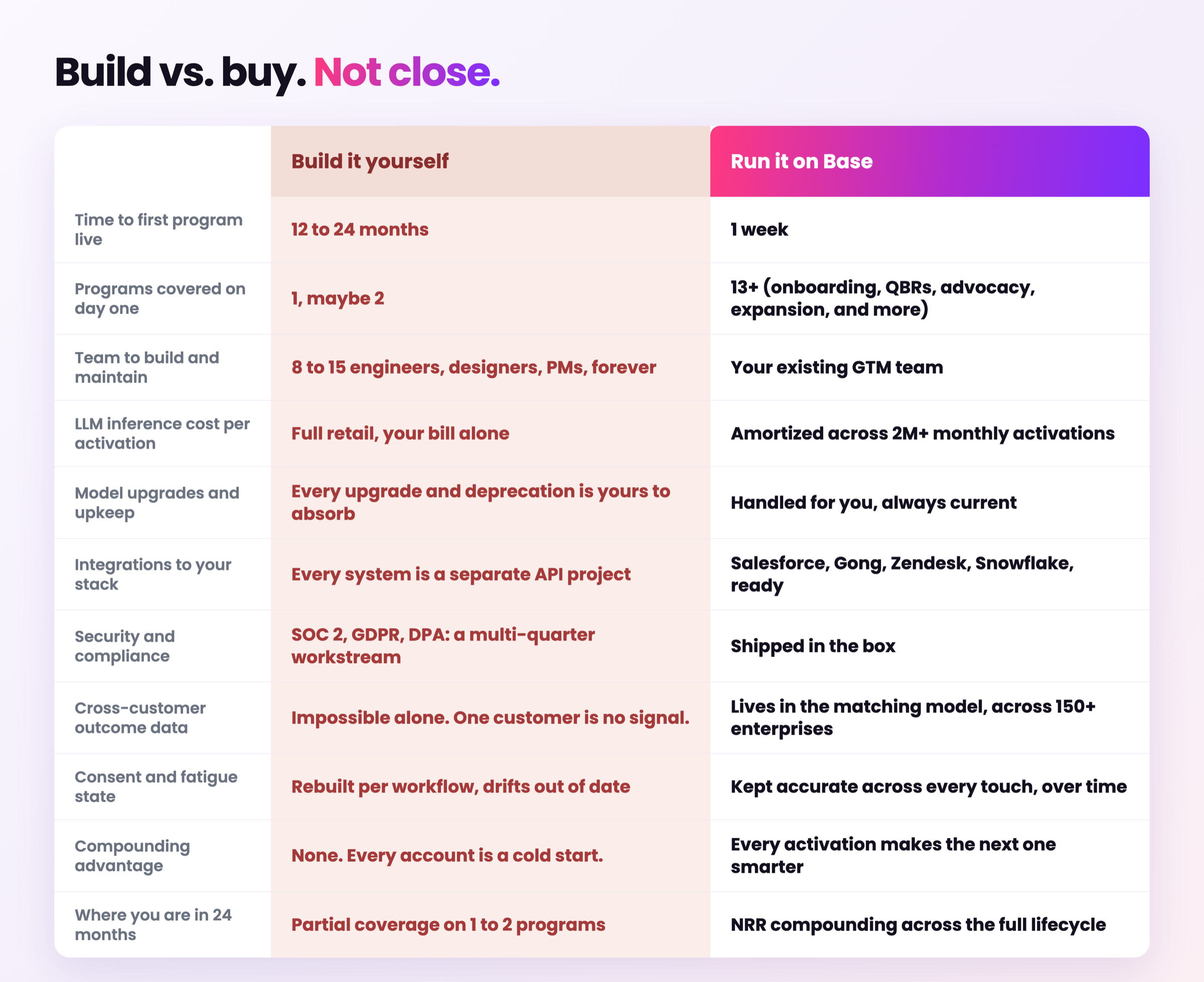
The row-by-row comparison. Every row is a workstream a build team has to fund and ship, and the bottom rows are the parts that never become buildable alone.
None of those rows are opinions. Each is a workstream a build team has to fund, staff, and ship before their first customer sees value. Base ships all of them in the box, connected in days, running on top of the CRM, product analytics, warehouse, and support system you already have.
The rest of this post walks through the five layers underneath, why each one is a multi-quarter workstream, and the numbers customers get when they let us run it instead.
Layer 1: Customer Intelligence. The context is the moat.
The model is not the moat. The context is.
An AI agent is only as good as the data it sits on. Point Claude at a Slack thread and it will draft a coherent onboarding email. Point Claude at the full picture of a customer, product usage from Snowflake, CRM state from Salesforce, sentiment from Gong, support history from Zendesk, community activity, last QBR notes, and it will draft one that lands.
The catch is that “the full picture” does not exist by default in most post-sale orgs. It lives in eight tools. That is the layer nobody has time to build. And it is exactly what Base’s Customer Intelligence layer is for. One live layer, connected to every system that touches your customer, resolved into a current view every agent can read from.
The compounding kicker: Base’s AI does not just work off your data. It designs each experience from what it learns across all of your accounts and, at the platform level, across every account on Base. Which onboarding paths reach value fastest. Which QBRs get opened. Which asks convert. Your best program becomes every customer’s starting point. That is a starting condition a DIY build cannot replicate from a cold start.
When a team says “we will build this with Claude,” they almost always mean one workflow. Usually onboarding. Sometimes reference matching. The AI Customer Growth Platform runs 13+ program types, all on the same shared context layer.
Each of those is its own agent, with its own logic, its own guardrails, its own success signals, and its own integration into your existing stack. Each one is what a normal product team would call a full product. Not a workflow. A product.
Now do the math. Multiply “one CS eng team of ten people” by “thirteen products to ship before the CCO sees value on all of them.” Then add the ongoing maintenance load as every GTM team asks for a new variant. Then add the roadmap cost of every LLM upgrade, every model deprecation, every prompt regression. Then subtract the platform team you never actually got hired for.
This is why “we will build it with Claude” understates the job. Claude is a model. The AI Customer Growth Platform is a system built on top of one. The model writes the email. Everything that decides which customer gets it, whether they have already heard from you this week, and whether it worked, is the part you would still have to build and keep running.
Base runs the thirteen as one product because it was built as one product for five years. You can see the full agent stack on the platform page, or book a walkthrough and we will run the ones most relevant to your motion against your data.
Layer 3: Journey Builder. The customer sees the interface, not the LLM.
Here is what your customer never sees. Your model choice. Your prompt template. Your RAG pipeline. Your evaluation harness.
Here is what your customer sees. Their onboarding hub. Their success plan. Their QBR. Their reference request. Their document.
Layer 3 is the layer between the two. Base’s Vibe-code Studio lets a marketer describe what they want the customer to experience, and the platform builds it, personalized per account and persona, on-brand, live inside a customer hub. No design tickets. No engineering tickets. Describe, publish, iterate.
This is the layer that gets skipped hardest in a build-your-own conversation. Building the LLM part is fun. Building the customer-facing part is not. It is design systems, brand tokens, personalization logic, responsive layouts, accessibility, localization, and the emotional labor of making it look like a product a human made.
Base has spent five years shipping that layer. Every hub, every journey, every document is on-brand out of the box, personalized per account, and rendered in seconds because the platform already knows the components. A DIY build starts from a blank Figma. Your customers can tell.
Layer 4: Customer Experiences. What customers actually get.
This is where the numbers start.
Vidyard replaced traditional onboarding with an always-on customer hub built on Base. Onboarding compressed from around 2 months to around 1 week. That is 8x faster time to value. Same content. Personalized, self-serve, per account. Their team also went from personalized QBRs reserved for top accounts to 100% QBR coverage across their entire customer base, every quarter. In their own words, “QBR has been a game changer for us.”
ZoomInfo moved onboarding to 100% self-service, with kickoffs 2x faster and implementation cut from weeks to days. CS headcount got reallocated to higher-value work. Beyond onboarding, their programs on Base have influenced $50M+ in pipeline, generated 260 AI-created reviews, and produced 100+ AI-built customer stories.
“We unlocked scale by shifting human effort to where it matters most.” Nate, Manager of CX Operations, ZoomInfo
Okta built autonomous success plans for thousands of self-service customers. Capture goals, sync into CRM, read live product usage, generate a personalized plan, auto-check tasks as customers complete them, unlock advanced setup at each threshold. The result: 3x feature adoption among self-serve accounts a CSM would never have time to touch.
These are not proof-of-concept demos. These are programs running in production against real customer bases every day. That is Layer 4 doing its job. Book a walkthrough and we will show you the equivalent version running against your customer base. More customer stories on the site.
Layer 5: Integrations and security. The boring parts that block DIY.
Here is an exercise for your build team. Write down every system that touches your customer. CRM. Product analytics. Warehouse. Support ticketing. Community platform. LMS. Gong. Marketing automation. Data lake. Now add up the number of API integrations you will need to build, maintain, and re-authenticate whenever any of those systems changes. Then add SOC 2, GDPR, DPA reviews, IT security review, a data processing addendum, and the right-to-be-forgotten flows that have to work across every one of the above systems.
That is not the fun part of building AI. It is not the LinkedIn part of building AI. It is the part that determines whether your program ever ships past a security review.
Base ships Salesforce, Snowflake, BigQuery, Databricks, Gong, Zendesk, community, and warehouse integrations in the box. SOC 2 is in the box. GDPR is in the box. DPA is in the box. The right-to-be-forgotten flows are in the box. Nothing gets ripped out of your existing stack. Nothing new needs a security review that has not already happened at 150+ other enterprises before you.
“Works with your stack, replaces nothing. Connected in days.” That is not a marketing line. That is Layer 5 doing the work no build team wants to do.
That sentence describes the compounding effect that turns any single program on Base into a system that gets smarter every quarter. Every activation improves the next recommendation for every other customer. The platform learns which onboarding paths reach value fastest, which QBR content moves adoption, which advocate profiles convert to reference calls that close deals.
A DIY build starts at zero. It stays at zero, alone, forever. There is no cross-customer learning because there is only one customer. There is no benchmarking because there is nothing to benchmark against. There is no compounding because compounding requires scale.
This is the moat that gets left off every build-vs-buy spreadsheet. It should be at the top of yours. See the flywheel running end to end in our AI-First Customer Org recap, and the operating model behind it in NRR requires one operating model.
The cost curve gets worse, not better
Here is the trap every “build with Claude” plan walks into. In a demo, LLM cost per activation is a rounding error. At production scale, LLM cost per activation is your problem.
Every onboarding email, every QBR generation, every reference match, every next-best-action call is an inference call. Multiply that by every customer, every touchpoint, every day. That number gets big fast. And it gets bigger every time you add a program or a customer, because inference cost scales linearly with activations and you have no leverage to negotiate against.
Base processes 2M+ B2B customer activations every month, across 150+ enterprises, driving 600k+ AI actions. That aggregate volume is what lets us amortize inference cost across the platform and reinvest it in better models, better retrieval, and better program design. Your DIY build has no such volume. Every activation is a full-price inference call. Every new program compounds the bill.
Six months in, the “cheaper to build” math flips. Twelve months in, it is embarrassing. Twenty-four months in, you are running less coverage than Base at higher unit cost, and your competition is compounding NRR while you are still on the roadmap.
Three moves to start on Monday
1. Do the row-by-row comparison against your own plan
Print the comparison above. Fill in your team’s real numbers for each row. Bring it to your next planning meeting. If your build plan matches Base in fewer than half the rows, the conversation is over.
2. Run the audit before you write a spec
Every existing tool that touches your customer. Every existing signal you already collect. Every existing program surface. Base sits on top of that. A build tears it up. If you are not clear on what you already have, you cannot compare fairly against either path.
3. See it running on your data
Book a walkthrough. Bring one of your top ten accounts. We will build a live version of your onboarding, QBR, or reference program on your data in the session. If you can build the same thing in the same time on your own, keep going. If not, stop building.
Building it with Claude understates the job. Claude is a model. The AI Customer Growth Platform is a system built on top of one. The model is the easy part. The data it runs on, the consent it respects, and the results it learns from are not.
Five layers, each a multi-quarter workstream. Customer Intelligence, AI Agents, Journey Builder, Customer Experiences, Integrations and Security. Not one prompt, not one workflow.
The customers running this on Base get real numbers. Vidyard: 8x faster onboarding, 100% QBR coverage. ZoomInfo: 100% self-serve onboarding, $50M+ pipeline influenced. Okta: 3x feature adoption on autonomous success plans.
The compounding flywheel is the moat a DIY build never gets. Every activation on Base makes the next one smarter for every other customer. Cold-start builds stay cold, forever.
The cost curve gets worse, not better. Inference cost per activation scales linearly and you have no leverage. Base amortizes across 2M+ monthly activations across 150+ enterprises.
Frequently asked questions
When should you build vs buy enterprise software?
Build when the capability is your actual differentiator and you will keep funding it for years. Buy when it is table stakes a vendor already runs at scale. Post-sale engagement is the second case for almost everyone: it is thirteen program types sitting on one shared data layer, and none of them are what your customers pay you for.
Can you build a customer engagement platform with Claude or GPT?
You can build a workflow. You cannot build the system. The AI Engagement OS is five layers: customer intelligence, AI agents, journey builder, customer experiences, and integrations with security. The model is one input to the second layer. Building the system with the model is like saying you will build your own AWS because you have Linux.
How long does it take to build your own post-sale AI platform?
Twelve to twenty-four months before a first program goes live, against roughly a week on a platform that already exists. The gap is not engineering talent. It is the five layers underneath, plus SOC 2, GDPR, and the integrations into Salesforce, Snowflake, Gong, and Zendesk that all have to work before anything reaches a customer.
What does it cost to run AI across thousands of customers?
Every activation is an inference call, so the bill scales linearly with customers and programs. A platform amortizes that cost across millions of monthly activations and reinvests it in better models and retrieval. A single-company build pays full retail on every call, and its cost per activation gets worse as coverage grows, not better.
Give us a try, easy peasy.
Building and scaling your advocacy program is easy when you can manage campaigns, rewards, track, and report - all within one AI platform.