The Industry Leaders Program: How to Turn Advocacy Into a Revenue Building Tool
Adi Gorelik
-
Base AI
4
min read
Customer advocacy has become a crowded market. Your customers get asked for case studies, reference calls, reviews, testimonials, and speaking slots. Often by several vendors in the same quarter.
The companies that stand out will not add another request to that list. They will offer something customers cannot easily build on their own.
Instead of asking customers to promote your brand, help them build the one asset that outlasts any vendor relationship: a visible professional reputation. Do that and you get stronger advocacy. You also get an engagement signal that Sales and Customer Success can act on the same week it fires.
That is the core of the Industry Leaders Program model. It works because it solves a problem your customers already have.
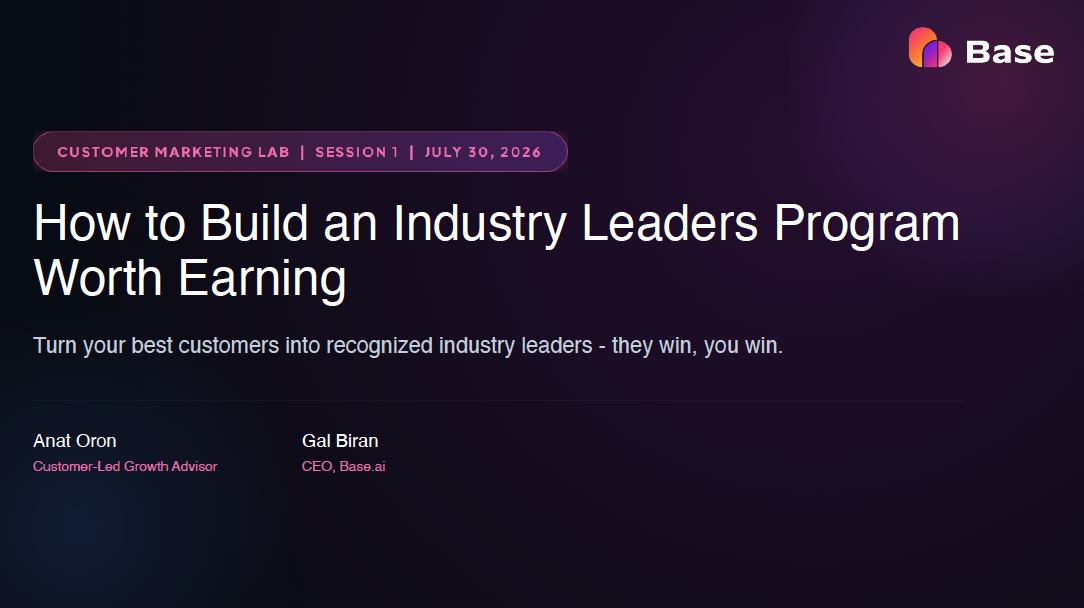
In the first session of our Customer Marketing Lab, Anat Oron (Customer Marketing and Customer-Led Growth Advisor) and Gal Biran (CEO and Co-founder of Base) walked through how the model runs in practice. Here is the framework, step by step.
Why this works right now
Only about 1% of professionals with an active LinkedIn presence publish content consistently.
The gap is not expertise. It is friction. People do not know whether they have earned the right to publish. They worry about being judged. They are not sure their employer will be thrilled about it. So they say nothing.
Meanwhile, reputation has become the one asset that survives career disruption. Careers are no longer a ladder inside one company. People move into consulting, start companies, switch industries. Roughly 40% of core professional skills are projected to shift within four years. What does not shift is what someone is known for.
Then there is the trust problem. Feeds are full of AI-generated content and corporate messaging that reads as hollow. People trust people, not brands. A personal brand built on real expertise is one of the few things that still earns attention in that environment.
The opportunity for customer marketing sits exactly there. Your customers do not need more motivation to write. They need someone to remove the friction for them.
The method
1. Identify your signal, not a generic list
Do not build the program around your whole customer base. Define what qualifies someone as a candidate, and make the criteria yours. Engagement score. Points in your advocacy program. Participation in case studies or video testimonials. Community activity. Peer review contributions.
Start narrow. A cohort of your most engaged customers, filtered by a real threshold, beats an open invitation every time.
Scarcity is part of the design. If everyone qualifies, nobody wants it.
2. Run a structured survey, not a generic questionnaire
The entry point is a short survey that captures expertise, background, and voice. What makes them credible in their field. How long they have worked in it. What they want to be known for.
This does two jobs at once. It becomes the raw material for their profile page. And it becomes contact and account level data you can segment and campaign against later.
3. Build one template, personalize every page
Every leader gets a personalized profile page. Bio, expertise, awards, speaking history, plus any video or quote content you already hold.
The template stays consistent across every leader. The content is entirely theirs. Build the page with SEO and answer engine optimization in mind, meaning real metadata and structured descriptions, so the page is findable by search engines and by LLMs, not only by the people already looking for it.
4. Package it as a credential, not a mention
The output is not a paragraph buried in a case study. It is a badge for LinkedIn and email signatures. A standalone page that functions as a professional credential. And a direct line into your revenue motion once sales gets involved.
Watch the full session
The four steps above are the setup. The next four are where the revenue shows up, and the session covers both end to end with a live look at how the workflow comes together.
5. Amplify on both sides
Promote the new leaders through your own community and social channels. Put a banner on your support site.
This does two things. It gives the leader visibility beyond their own network. And it creates aspiration across your broader customer base, which drives more people to want in. Run properly, the program generates its own momentum.
6. Loop in sales and log everything in the CRM
This is where most programs stop short.
The moment a profile goes live, notify the account team. Every milestone, profile published, badge accepted, gets logged against the contact and the account. If it is not in the CRM, it does not exist for the business.
This cohort becomes your first call for references, speaker requests, referrals, and executive engagement. Include these touches in your attribution model the same way you would credit a webinar or a product intent signal. This is not a branding exercise. Treat it as a pipeline and expansion motion. It is the same argument we made for running CS and customer marketing as one operating model.
7. Close the loop with a follow-up ask
A few weeks after launch, survey the leaders again. Ask what changed. New followers. Inbound interest. Feedback they received.
That gives you outcome data to report internally, and it signals to the leader that the relationship continues past the initial recognition.
8. Layer in tiering if you already have a loyalty structure
If you run points or badges elsewhere in your advocacy program, this cohort plugs into a dedicated tier. A VIP status or a distinct badge reinforces that this group sits a step above standard participation. Sonia Starova used a version of this to scale Temenos from zero to 1,000 advocates, which we covered in three plays worth stealing from Obsession 2025.
What used to take months now takes hours
Built manually, this program is a slog. A separate survey tool. A CMS for the pages. Manual coordination across marketing, CS, and sales. Months to stand up, and hard to repeat at scale.
Built on a system that connects survey data, workflow automation, AI-driven candidate selection, and page generation in one place, the same program compresses to days or hours. Still iterative. No longer a multi-month manual build.
That consolidation is the whole argument for running post-sale on one platform rather than stitching six tools together, which we broke down in build vs. buy the AI Engagement OS. If you want to see the Industry Leaders workflow running against your own customer data, book a walkthrough.
Recognition is a revenue motion
The mechanics are replicable regardless of what stack you use. The principle is the part to hold onto.
A program that gives customers something they want independent of your product, wired into your CRM and sales motion from day one, is not a branding exercise. It is a revenue building tool that happens to run through recognition instead of a discount. Done consistently, it shows up in net revenue retention, not just in engagement dashboards.
The future of customer advocacy is not asking customers to promote your brand. It is helping customers build their own professional reputation. When you create value for the customer first, advocacy and revenue become natural outcomes. That is customer-led growth in one program.
Three moves to start on Monday
1. Write your qualification rule
One sentence. What makes someone eligible. Pick a threshold you can query today, not one you wish you tracked. If the first cohort is twelve people, that is the right size.
2. Draft the survey before you design the page
Eight questions maximum. Expertise, tenure, what they want to be known for, proudest work, where they already speak or write. The survey defines the page. Not the other way around.
3. Wire the CRM handoff before you launch
Decide now which field logs the milestone, which alert fires to the account team, and how the touch shows up in attribution. Programs that skip this step stay branding exercises forever. If you want help mapping it against your own lifecycle automation, book 30 minutes.
Key Takeaways
Advocacy is crowded. Recognition is not. Every vendor asks for case studies and reference calls. Almost none help the customer build something they keep when they change jobs.
The barrier is friction, not expertise. Only about 1% of professionals with an active LinkedIn presence publish consistently. Your job is to remove the friction, not add motivation.
Start narrow and make it scarce. Define a real qualification threshold. If everyone qualifies, nobody wants it.
If it is not in the CRM, it does not exist. Log every milestone against the contact and the account, notify the account team the day a profile goes live, and put the touch in your attribution model.
This is a pipeline motion, not a branding exercise. The cohort becomes your first call for references, speakers, and executive engagement, and it shows up in net revenue retention.
Frequently asked questions
What is an Industry Leaders Program?
An advocacy program built around recognition instead of extraction. Rather than asking customers for another case study, you help them build a visible professional reputation they keep even when they change jobs.
Why does recognition work better than a standard advocacy ask?
Because it gives the customer something they cannot build alone. Every vendor asks for reference calls and case studies. Almost none help the advocate build personal credibility, which is why the recognition ask converts where the extraction ask stalls.
Who should qualify for the program?
Fewer people than you think. Define a real qualification threshold and hold it. If everyone qualifies, nobody wants it, and the credential stops being worth accepting.
How do you connect the program to revenue?
Log every participant, every asset, and every follow-up ask in the CRM. If it is not in the CRM it does not exist at budget time, and recognition programs are easy to dismiss as brand work when the attribution is missing.
Give us a try, easy peasy.
Building and scaling your advocacy program is easy when you can manage campaigns, rewards, track, and report - all within one AI platform.