Post-sale teams are being asked to move faster with AI while protecting the relationship that makes retention, expansion, advocacy, and renewal possible.
That is a hard operating problem. A customer who receives a perfectly timed adoption nudge may feel supported. The same customer can receive an automated message after a difficult support interaction and feel unseen. The difference is not the model. It is the context, the decision rules, and the team behind the action.
AI agents make that difference more visible because they turn customer data into customer-facing decisions. They can recommend a next step, draft an outreach message, flag an account, or guide an onboarding journey. Once they act in the post-sale relationship, trust stops being a brand aspiration and becomes an operating discipline.
TL;DR
Trust operations are the context, governance, transparency, and human escalation practices that make AI-driven customer engagement feel relevant and accountable.
Post-sale agents need a connected view of customer signals before they recommend or execute a next best action.
Teams should define what an agent can do independently, what requires review, and what evidence must support each action.
The long-term advantage is not more automated outreach. It is customer engagement that compounds context instead of resetting it.
Why trust becomes operational when AI acts on customers
For years, customer teams could treat trust as something shaped by brand, executive relationships, and the quality of a CSM conversation. Those still matter. But an AI agent changes the surface area of trust.
An agent can engage hundreds of accounts before a leader has time to inspect the pattern. It may trigger an onboarding reminder, prepare a renewal plan, identify a reference candidate, or suggest a campaign. Each action can be useful. Each can also be wrong if it relies on a partial view of the customer.
That is why the central question is no longer, “Should we use AI in customer engagement?” Most teams already are. The better question is, “What must be true before an AI agent can calculate a customer-specific next best action?”
Salesforce’s State of the AI Connected Customer places trust alongside changing customer expectations in the age of AI and agents. In customer communities, Higher Logic similarly points to the need to preserve authenticity, value, and human connection as AI scales engagement. The lesson for post-sale leaders is practical: speed has to be earned with relevance.
The hidden failure mode: fast action from partial truth
A customer relationship rarely lives in one system. Product usage may suggest healthy adoption while support history shows unresolved friction. A renewal date may be close while a sponsor has gone quiet. A customer may be a strong advocate in one program and an inappropriate reference for a specific deal.
When those signals are separated, an agent can create a confident but awkward interaction. It might congratulate an account that is escalating a support issue. It might ask a disengaged executive for a review. It might send a generic adoption message when the account needs a human check-in.
This is not an argument against automation. It is an argument against automating from a thin slice of the customer story.
Base AI’s Customer Context Graph describes the missing foundation: a customer context layer that connects information and lets AI reason from grounded knowledge. The broader Base AI platform describes the lifecycle signals that matter, from product and support activity to customer engagement, advocacy, reviews, referrals, and milestones.
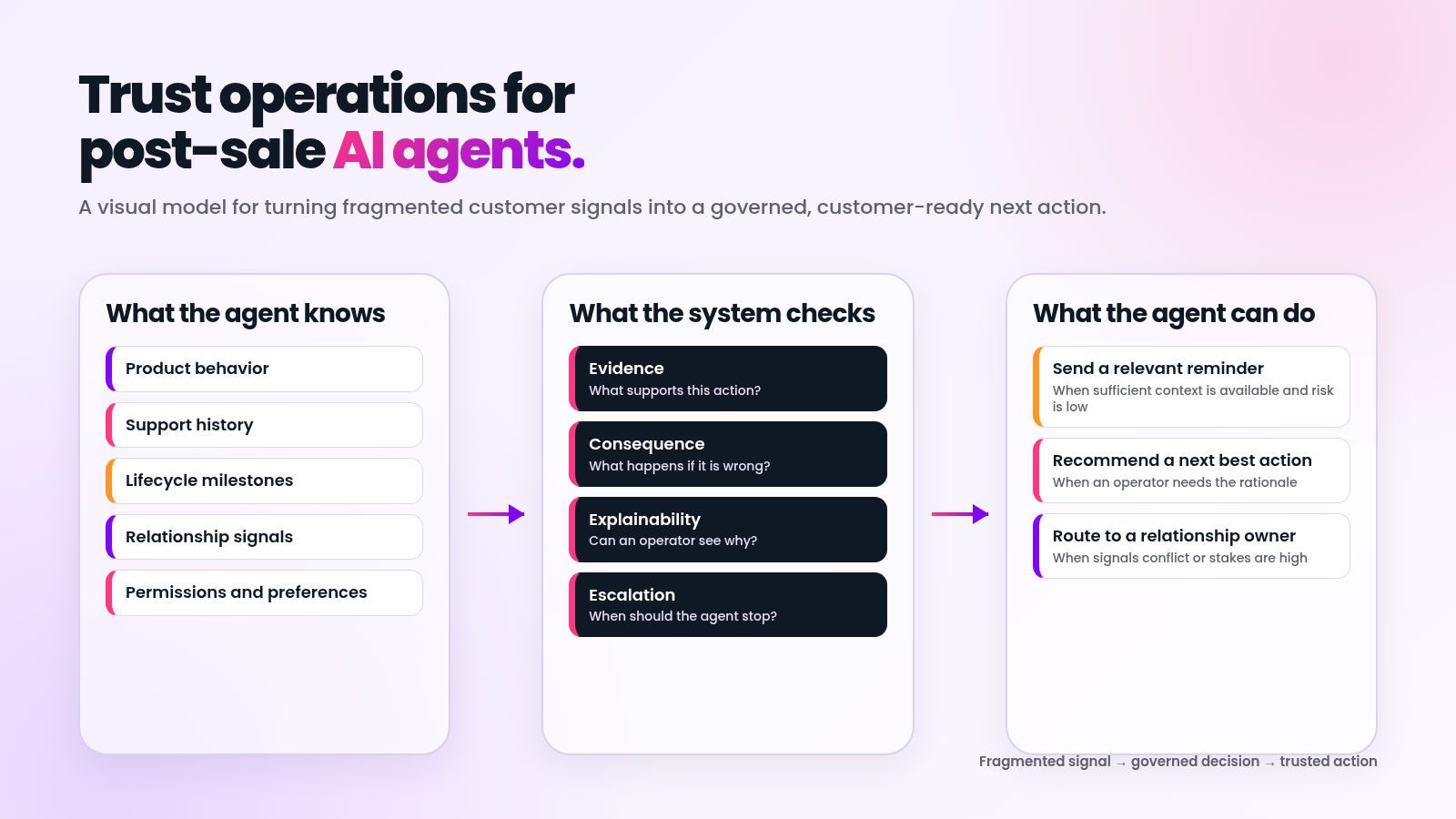
In practical terms, trusted AI starts with a question every operator understands: What evidence supports this next best action, and what relevant evidence could contradict it?
Context before action
What AI trust operations looks like
AI trust operations is not a committee that approves every message. It is a repeatable way to make automated engagement safe, useful, and explainable at the speed customer teams need.
It has four parts.
1. Build a shared customer truth
An agent should not have to guess whether an account is onboarded, at risk, ready for expansion, or willing to advocate. Those answers should be grounded in the customer context available across the lifecycle.
For a VP Customer Success, that may mean combining onboarding progress, usage patterns, success-plan milestones, support history, and executive engagement before an agent recommends outreach. For a CMO or customer-marketing leader, it may mean pairing advocacy history with relationship health, permissions, and account context before a customer receives an ask.
The goal is not a perfect record. Customer data will always be incomplete. The goal is to make incompleteness visible so an agent can choose a lower-risk action, gather more context, or route the decision to a person.
2. Match autonomy to consequence
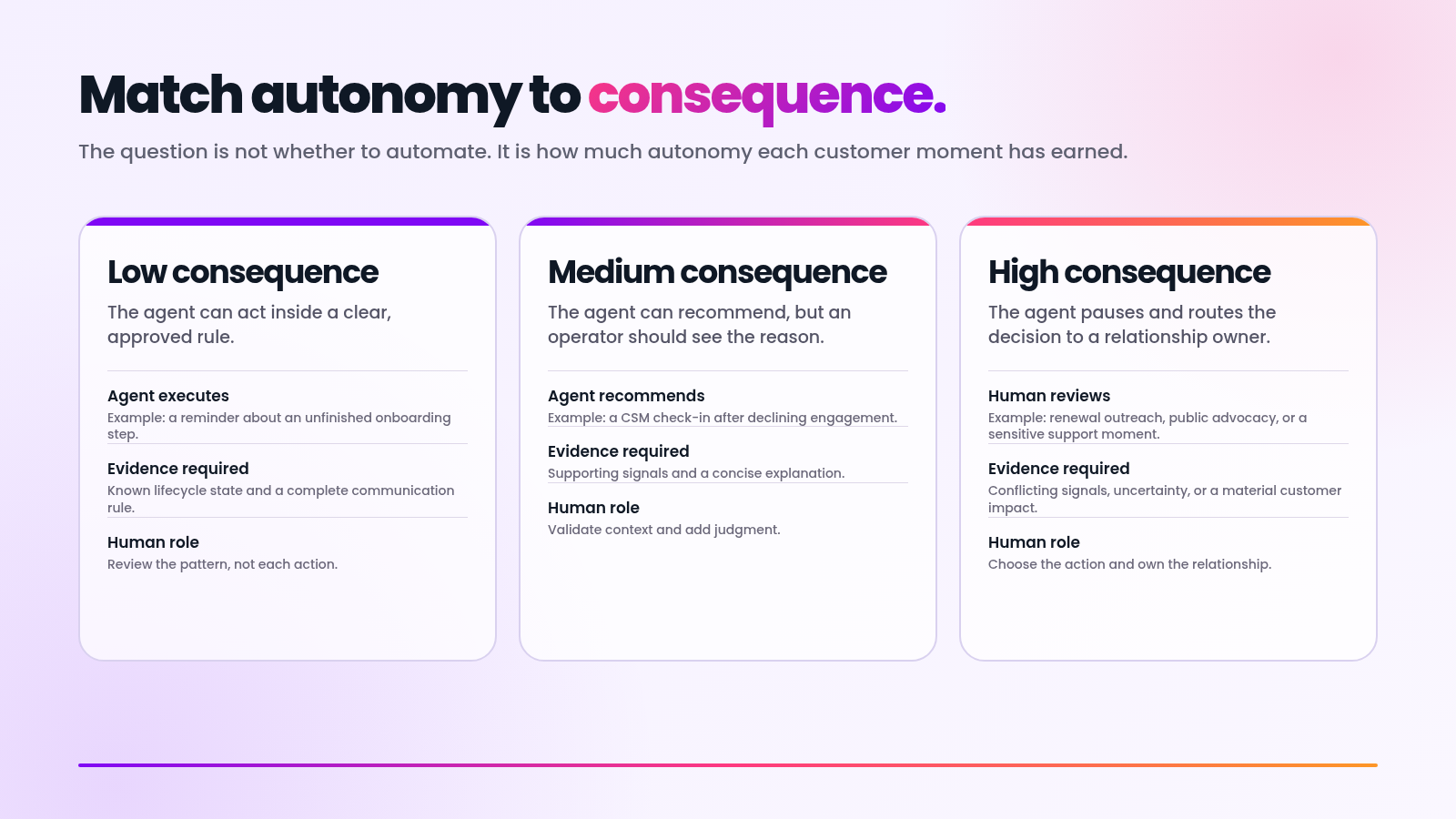
Not every action deserves the same level of automation. A simple reminder about an unfinished onboarding step has a different downside than a renewal outreach message or a request for public advocacy.
Define action tiers before the agent operates:
Low consequence: prepare a draft, surface a signal, or deliver a customer-facing reminder that follows an approved rule.
Medium consequence: recommend an action with a concise explanation of the customer signals behind it.
High consequence: require human review for actions that affect executive relationships, commercial conversations, public proof, sensitive support situations, or customer permissions.
This does not slow a team down. It prevents the expensive kind of speed, where an automation creates cleanup work for the CSM, the customer marketer, and the customer.
Match autonomy to consequence
3. Make the next best action understandable
An agent does not need to expose every underlying data point to be trustworthy. It does need to give operators a clear reason for its recommendation.
A useful explanation might say: “Recommend a CSM check-in because product engagement fell after the last support interaction, the success-plan milestone is overdue, and the executive sponsor has not engaged recently.” That gives the human a way to validate the action and add judgment that the system cannot hold.
Explanations are also how teams improve the operating model. If agents repeatedly recommend actions based on weak signals, RevOps and customer leaders can change the rule, improve the data, or add a review gate. Without this feedback loop, automation becomes difficult to audit and even harder to trust.
4. Keep a human relationship in the loop
Human escalation is not the failure case of AI. It is part of good AI engagement design.
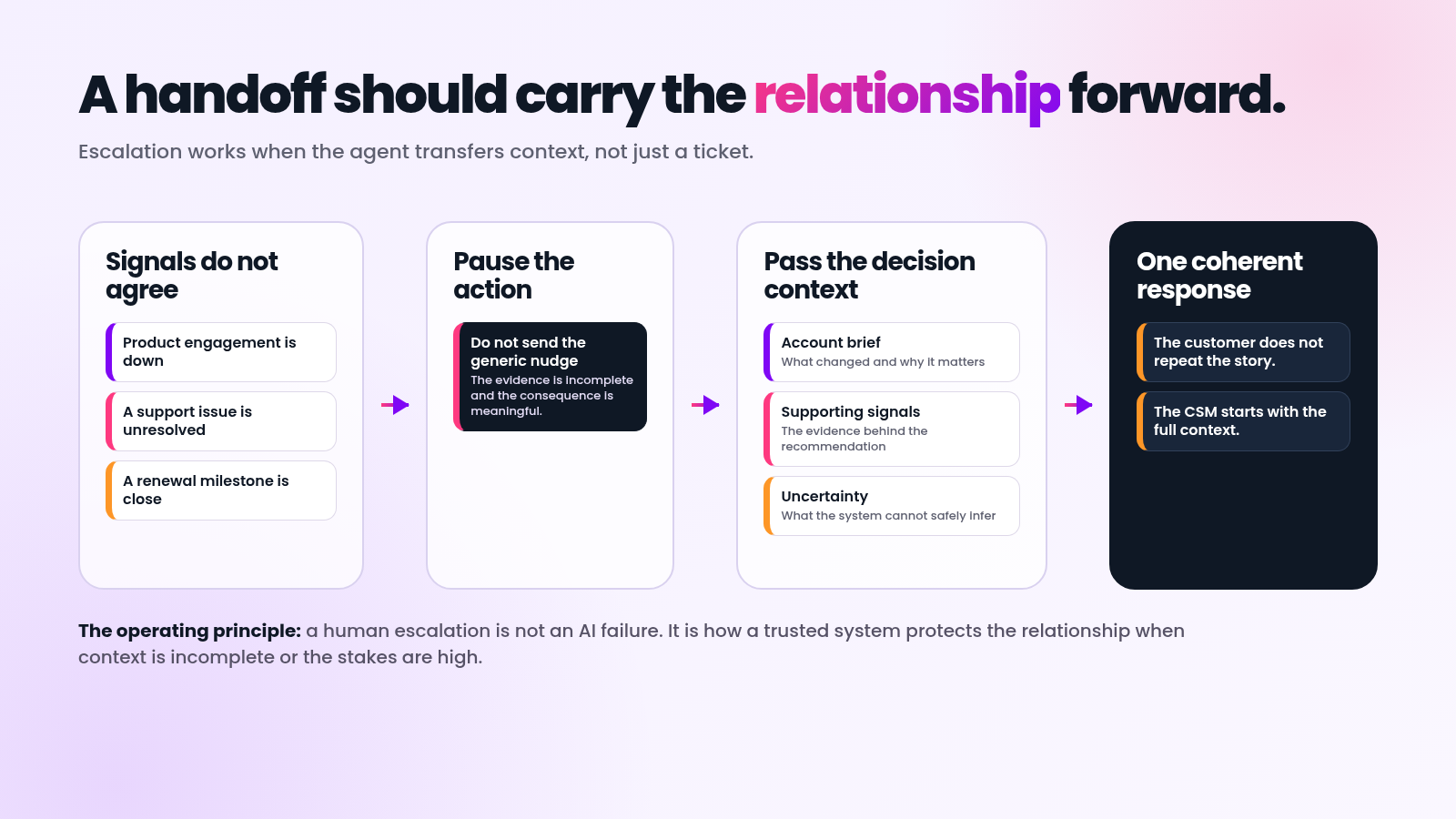
A trusted post-sale agent should know when to stop. It should route the account to a person when signals conflict, the customer expresses frustration, a commercial decision is involved, or the context is too thin to support a safe recommendation.
That handoff has to preserve the context the agent used. Otherwise, the customer repeats themselves and the operator starts from zero. The better pattern is to pass forward a short account brief, the supporting signals, the proposed action, and the uncertainty that triggered escalation.
A handoff should carry the relationship forward
Trust is a customer-led growth capability
Customer-led growth depends on more than engagement volume. It depends on customers receiving relevant help, being invited into the right programs, and feeling that their relationship history is remembered.
That makes trust operations a shared responsibility. Customer Success owns relationship quality and lifecycle judgment. Customer Marketing owns thoughtful asks and value exchange. RevOps owns data discipline and workflow design. Sales benefits when customer proof and reference engagement are timely and appropriate. The customer experiences one relationship, even when internal teams are organized differently.
This is the logic behind an AI Engagement OS: one customer context layer, experiences that make progress clear, and agents that calculate a customer-specific next best action. Base AI customer stories show the range of post-sale growth motions that can be connected through a common operating model. The important point is not to automate every motion. It is to ensure each motion has the context and guardrails to earn customer trust.
A practical starting point for customer leaders
Leaders do not need a multi-year program to begin. Choose one recurring post-sale moment where the cost of poor context is visible.
It could be onboarding nudges, stalled success-plan milestones, advocacy outreach, renewal preparation, or expansion signal review. Then answer five questions:
What customer signals should the agent consider before acting?
What signals should prevent or pause the action?
Which actions can the agent take, draft, or only recommend?
How will a human understand the reason behind the recommendation?
What outcome will show that the engagement was helpful, not merely sent?
Run that motion with a defined review loop. Listen to CSMs and customer marketers when they override the agent. Review the customer responses. Improve the context and rules before widening autonomy.
If your team is mapping how connected customer context and agents can support post-sale growth, book a conversation with Base AI. The best starting point is usually a real customer workflow, not an abstract AI roadmap.
Key Takeaways
Trust operations connect customer context, governance, transparency, and human escalation for AI-driven engagement.
Post-sale agents need a connected view of customer signals before they recommend or execute an action.
Teams should match agent autonomy to action consequence and require evidence for each action.
The long-term advantage is customer engagement that compounds context instead of resetting it.
Frequently asked questions
What are AI trust operations?
AI trust operations are the practices that make AI-driven customer engagement reliable and accountable: connected customer context, action guardrails, clear recommendations, human escalation, and feedback loops that improve how the system acts.
Why do post-sale AI agents need customer context?
Post-sale actions depend on relationship history, lifecycle stage, product and support signals, permissions, and business priorities. Without that context, an agent can act quickly from incomplete information and create an irrelevant or poorly timed customer interaction.
How can B2B teams make AI-driven customer engagement more trusted?
Start with one defined workflow, connect the customer signals that support the decision, set action tiers based on consequence, require explanations for recommendations, and route ambiguous or sensitive situations to a human owner.
Does trusted AI mean humans must approve every action?
No. It means autonomy should match the consequence of the action. Low-risk, well-defined actions can be automated. Higher-impact, ambiguous, or sensitive actions should be reviewed or escalated with the relevant context.
Where should a team begin?
Begin with a post-sale moment where fragmented context creates visible friction, such as onboarding, renewal preparation, advocacy outreach, or expansion review. If you want to evaluate the operating model for that workflow, talk with the Base AI team.
Give us a try, easy peasy.
Building and scaling your advocacy program is easy when you can manage campaigns, rewards, track, and report - all within one AI platform.