Direct Revenue Attribution in CS: Moving Beyond Reactive Churn
Adi Gorelik
-
Base AI
5
min read
Customer success teams cannot secure budget by showing executives how many badges users collected in a community portal.
Executive boards measure post-sale performance by net revenue retention and expansion. Gamified advocacy hubs treat customer relationships like an arcade game, and that disconnects high-value references from the closed-won revenue they actually generate.
The fix is not another engagement metric. Post-sale teams need references, referrals, and expansion unified into a single AI-driven platform with direct CRM revenue attribution.
Gamified community hubs drain operator bandwidth
Legacy platforms require constant manual challenge creation. Customer marketing managers spend hours writing trivia questions and assigning point values just to keep users logging in.
That drains operator bandwidth and it produces advocate fatigue. Customers want to share their expertise and network with peers. They do not want to grind for digital gift cards.
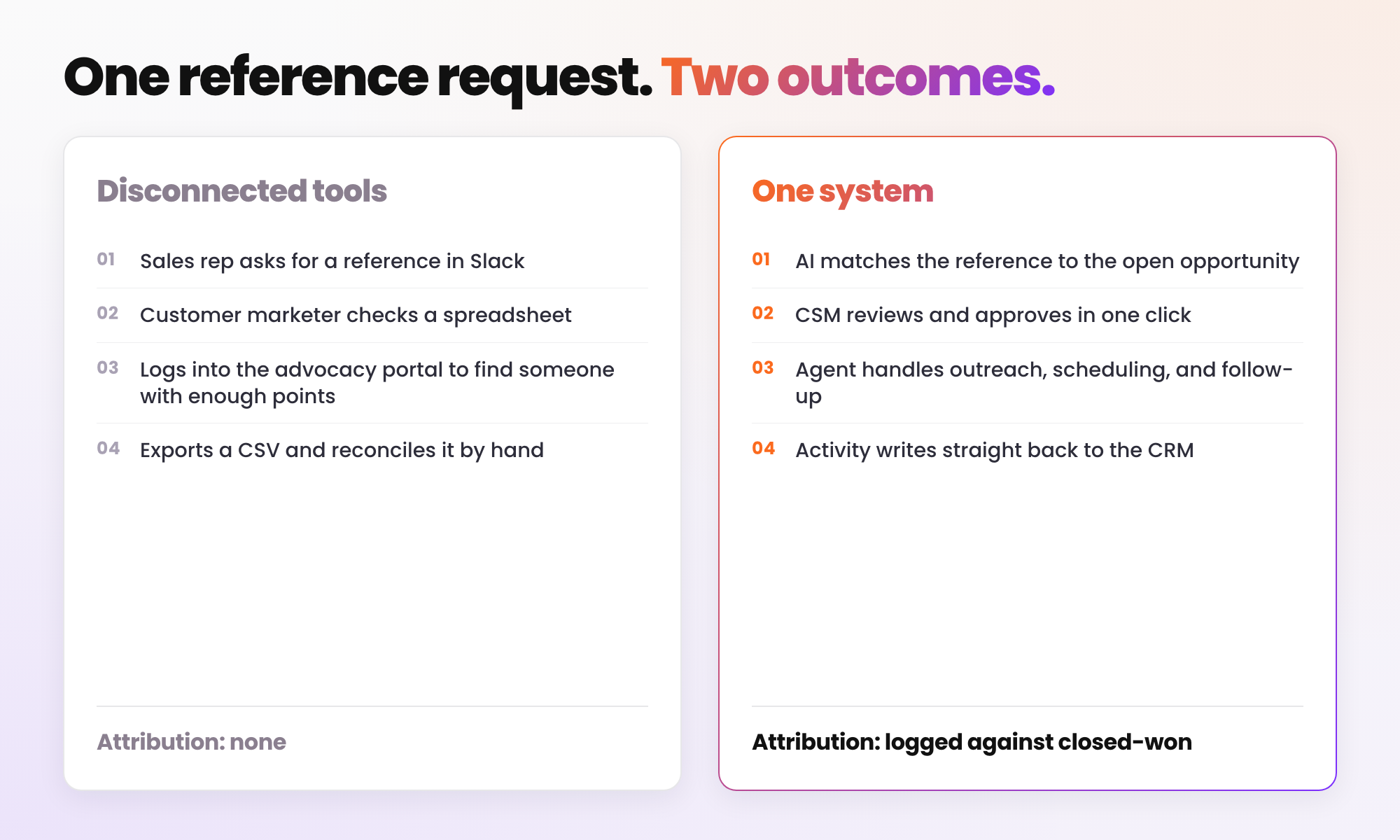
When sales needs a reference, pulling from a disconnected gamified hub delays the deal cycle. The rep asks in Slack. The customer marketer checks a spreadsheet, then logs into the advocacy portal to find someone with enough points. That manual routing breaks the chain of revenue attribution before it ever reaches the CRM.
Same request. The difference is whether the activity ever reaches the CRM.
Customer advocacy software has to tie directly to the CRM to prove financial impact. If a customer spends thirty minutes on a reference call that helps close a six-figure deal, the system should log that contribution automatically. Point-based reward systems obscure that value and push operators into managing the community instead of driving adoption and expansion. If you want to see that logging happen against your own pipeline, book a walkthrough.
Traditional customer reference management focuses on building isolated advocate pools. You can see the pattern in legacy models like Influitive’s reference management. The separation means customer marketing cannot trace a fulfilled reference request back to a closed-won opportunity in Salesforce.
Without real CRM integration depth, post-sale teams calculate their own impact by hand. They export CSVs from the advocacy tool and reconcile them against opportunity records. It is slow, and it is wrong often enough that nobody trusts the number.
Direct revenue attribution requires the reference activity to live in the same system where the revenue is booked. If the data does not flow back to the CRM automatically, customer success gets zero credit for the assist.
This is also why sales and CS argue about attribution. A rep closes a deal and takes full credit. The customer marketer knows a specific reference call pushed the prospect over the line. Neither can prove it, because their systems do not talk. A unified digital customer success platform removes the argument by making one record the source of truth.
Unifying post-sale programs proves direct expansion
Run onboarding, QBRs, and references in one white-labeled portal and every customer relationship gets consistent attention. Advocacy software has to grow up from a standalone marketing tool into a full post-sale system. Scattered point solutions force your customers to learn several interfaces just to interact with one brand.
AI agents can match references to prospects by industry and use case, which removes the spreadsheet bottleneck entirely. When a customer finishes a strong QBR, the system flags them as a candidate for specific product lines. The CSM reviews the suggestion and approves with one click. The agent handles outreach, scheduling, and follow-up.
That turns routine interactions into measurable expansion. A customer who finishes onboarding on time is more likely to become a strong advocate. Track the whole lifecycle in one place and you can see the exact moment an account is ready to give a reference or upgrade. That is what a predictable customer-led growth engine looks like, and it is the same operating-model argument we made in NRR requires one operating model.
Engagement tools versus revenue-accountable platforms
Some platforms focus purely on generating marketing assets, a point raised in UserEvidence’s roundup of Influitive alternatives. Others, like Deeto, focus on prospect-to-customer matching but stop short of full lifecycle onboarding and QBR automation.
A revenue-accountable platform writes reference activity, referral data, and QBR outcomes directly into the CRM. That proves exact revenue influence with no manual data entry. Instead of guessing which reference call helped close a deal, you get an audit trail.
Asset generation and prospect matching are useful. They are not a substitute for a unified post-sale system. If your tools cannot follow a customer from their first onboarding task to their third reference call, you are leaving revenue unclaimed.
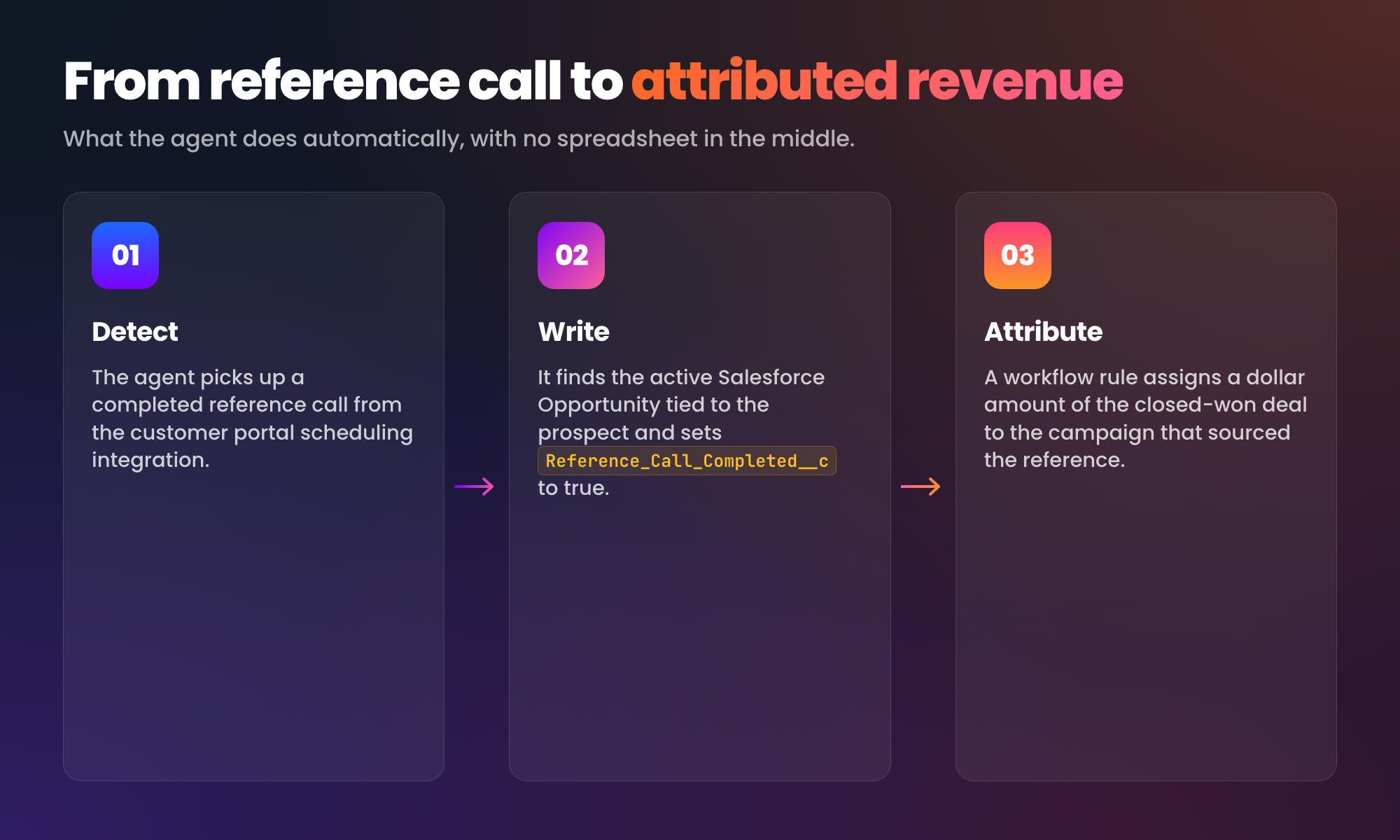
Here is what the handoff looks like when an agent logs a completed reference call against a Salesforce Opportunity.
Detect, write, attribute. No spreadsheet in the middle.
Replacing manual community management with AI engagement
Software review hubs show growing demand for platforms that scale without adding headcount. It shows up in the alternatives people browse on Gartner and G2. Hiring more community managers to run point-based reward systems is not a growth model.
The better shape is a B2B customer portal both the customer and the CSM live in. Customers open their onboarding checklist, read their latest QBR, and accept reference requests in one place. The CSM runs the whole relationship from the same interface.
Replace scattered tools with one portal and operator bandwidth stops being the constraint. Customer marketing managers are not jumping between a survey tool, a reference spreadsheet, and a gamified hub. They work on the programs that move revenue while agents handle matching, scheduling, and logging. We made the full build-it-yourself case in build vs. buy the AI Engagement OS, and the recognition-driven version of this motion in the Industry Leaders Program.
Tying every post-sale action to the bottom line
Treating customer success as a growth engine means abandoning disconnected tools and unmeasurable reward systems. Deploy agents to run onboarding, references, and expansion at scale and CS can finally show its financial impact in the same currency the board uses.
The days of defending budget with engagement metrics are over. Agents automate reference matching. CSMs keep control of approvals. Every post-sale action ties back to a number someone in finance recognises.
When references, referrals, and QBRs run through a single revenue-accountable system, customer success stops being a cost line and becomes the most predictable revenue driver in the company. The context layer underneath it is what makes the attribution trustworthy.
Three moves to start on Monday
1. Find the last five deals a reference touched
Pull them up and try to prove it in the CRM. If the reference call is not on the opportunity record, you have found your attribution gap, and you now know its size in dollars.
2. Kill one gamification mechanic
Pick the challenge your team spends the most time authoring and the customers engage with least. Delete it. Redirect those hours to advocacy work that has a revenue line attached.
3. Write the one field you are missing
Decide today which CRM field logs a completed reference, who writes to it, and which report reads it. Everything else in this post depends on that field existing. If you want it wired against your own customer programs, book 30 minutes and we will show you the working version.
Key Takeaways
Badges are not a budget argument. Boards measure post-sale performance in net revenue retention and expansion, not daily active users in a standalone portal.
Gamification costs operator bandwidth. Manual challenge creation burns customer marketing hours and produces advocate fatigue, not advocacy.
Attribution breaks at the handoff. Slack request to spreadsheet to advocacy portal to CSV export means the reference never reaches the opportunity record.
The reference has to live where the revenue is booked. If activity does not write back to the CRM automatically, customer success gets zero credit for the assist.
Agents match, CSMs approve. AI handles matching, scheduling, and logging. Humans keep control of who gets asked, and every action lands on a revenue line.
Frequently asked questions
What is revenue attribution?
Connecting a specific activity to the revenue it influenced. In post-sale that means logging which reference, referral, or expansion play touched which opportunity, so the program can be credited on the same terms as any other revenue investment.
How can customer success prove direct revenue attribution?
Put the reference where the revenue is booked. If a reference call is logged against the opportunity record, reference-influenced pipeline and closed-won revenue become a standing report rather than a quarterly reconstruction.
Why do gamified community hubs fail to prove ROI?
Because boards measure post-sale performance in net revenue retention and expansion, not daily active users in a standalone portal. Manual challenge creation also burns customer marketing hours and produces advocate fatigue rather than advocacy.
Where does reference attribution usually break?
At the handoff. A Slack request becomes a spreadsheet row, becomes an advocacy portal entry, becomes a CSV export, and the reference never reaches the opportunity record. Every hop is a place the revenue link is lost.
Give us a try, easy peasy.
Building and scaling your advocacy program is easy when you can manage campaigns, rewards, track, and report - all within one AI platform.