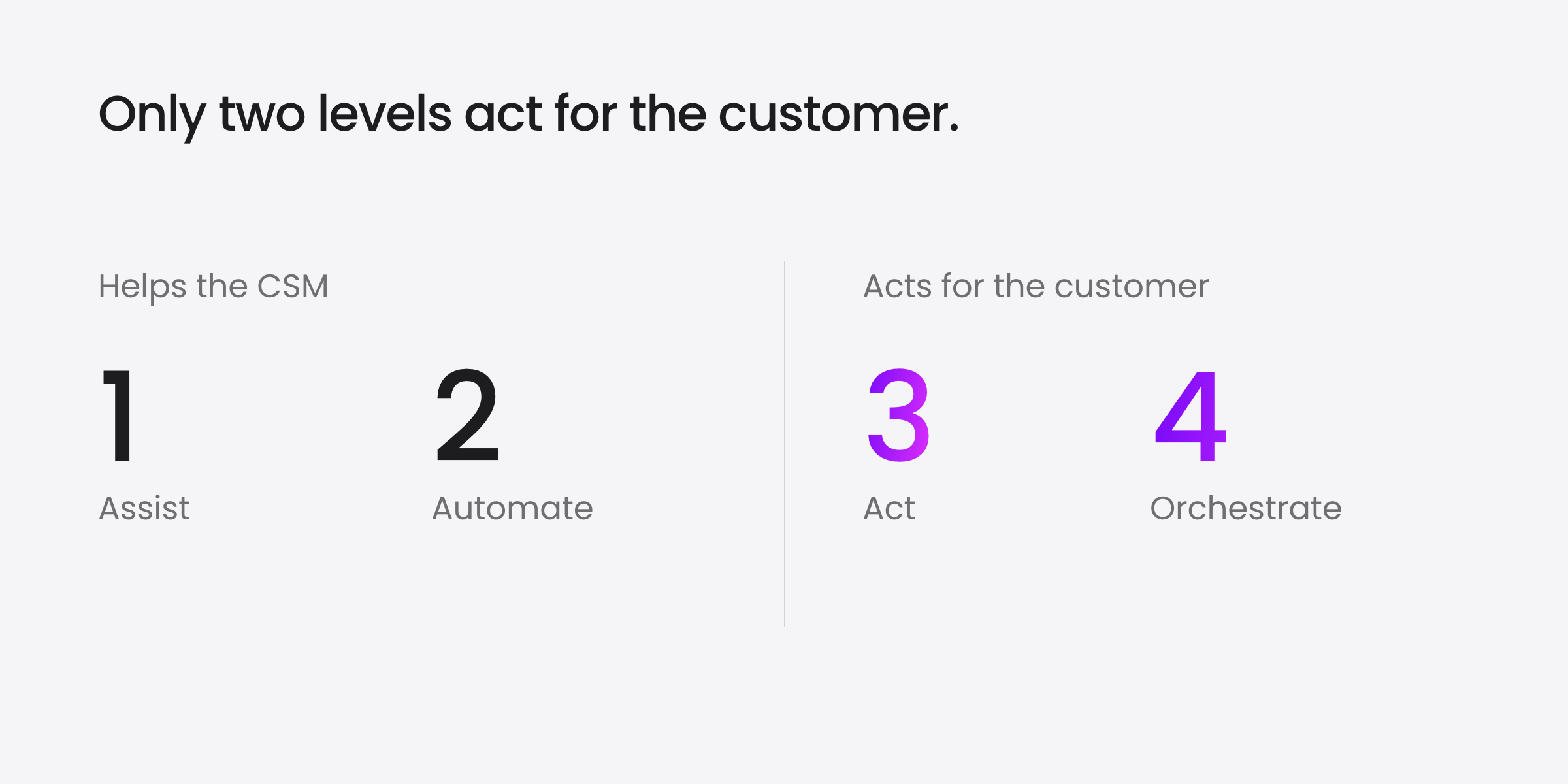
We map AI for customer success on four maturity levels: Assist, Automate, Act and Orchestrate. On our reading of the survey data, most teams sit at Level 1 or 2, where AI mostly makes the CSM faster.
The fix is not a bigger rollout. It is one program, moved up one level. Eight yes or no questions below show you where to start.
What is AI for customer success?
AI for customer success is software that watches customer data, prepares the work and acts across the post-sale lifecycle: onboarding, adoption, retention, advocacy and expansion. Most of what teams call AI today is narrower. It points at the CSM's inbox, not at the customer's lifecycle, where renewals are decided.
Most tools stop at watching and preparing. That is useful, and it is why the customer often notices nothing. A faster CSM is still one CSM.
Our four levels of AI
At each level, ask two things: who acts, and what does the customer see?
Assist. AI helps a person with a task. The customer sees a better-prepared CSM.
Automate. Signals trigger tasks and drafts, and a person approves every touch. The customer sees timely, mostly templated outreach.
Act. AI runs one customer-facing program inside guardrails you set. The customer sees a program that responds to them.
Orchestrate. Programs share one customer record and hand accounts to each other. The customer sees one lifecycle instead of five teams.
Levels 1 and 2 make the CSM faster. Levels 3 and 4 act for the customer.
Forrester's Laura Ramos draws a similar line in her November 2025 note: conservative starting points like briefs and drafted business reviews, then bolder moves like assistants for CSMs and customers.
Where do most teams sit?
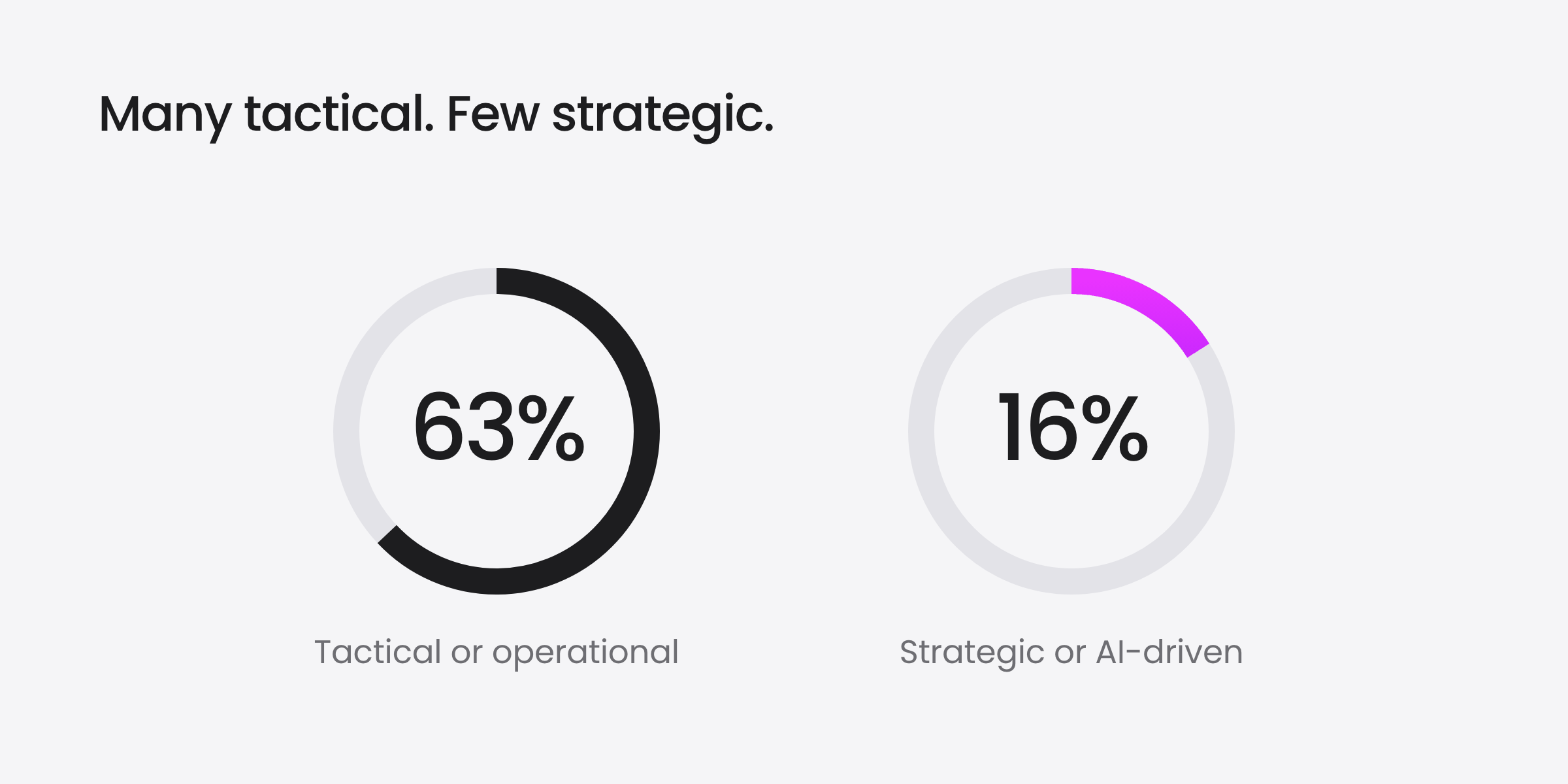
Most customer success and revenue leaders surveyed place their teams at Level 1 or 2, if you map their labels onto this model, and that mapping is ours. In ChurnZero's 2026 Customer Revenue Leadership Study, 63% of 580 customer success and revenue leaders rated their AI maturity tactical or operational.
ChurnZero 2026, 580 leaders, self-reported. The release doesn't place the other 21%.
Those same leaders aren't short of AI: 81% said it has reduced time spent on manual tasks.
In Velaris's State of AI in Customer Success 2026, only 3% of 394 CS professionals said their teams had deployed AI "that can operate with full autonomy". Velaris and ChurnZero both sell CS software, so treat both as vendor research.
Neither study measures how much reaches the customer. Our read is that little does, because AI at these levels works through a person.
Why Level 2 AI hits a ceiling
Levels 1 and 2 multiply the CSM. That is their ceiling. AI that works through a person only reaches the accounts that person already touches.
Take an illustrative team, with invented numbers: 8 CSMs, 160 named accounts and 600 pooled accounts nobody owns by name.
Level 1 makes the 8 CSMs faster. Level 2 sends the pooled alerts to a shared queue nobody clears. Those 600 customers see no change. Level 3 is the first level where they get something new.
The second reason is the approval queue. Base AI's glossary entry on human-in-the-loop AI names the failure: when review queues pile up, teams stop using the system or approve everything unreviewed.
What does Level 3 look like?
Level 3 of AI for customer success is AI that takes the next step with the customer directly, inside rules a person wrote, without approval of each touch. The program lives where the customer opens it, and people handle the exceptions. Vendors call this customer success AI agents.
Frontify, a Base AI customer, is one narrow example. Its CSMs relied on static content and disconnected tools, and its QBRs were slide decks that took heavy preparation. The team built one AI-powered customer hub in AI Studio, with no product or design resources.
Resources and updates are surfaced by relevance, not a fixed monthly list
QBRs run on live data in the hub
Frontify reports a +90% engagement rate on the hub and fewer support tickets
John Gaspar, Frontify's Director of Scale Customer Success, named the problem: "We have thousands of accounts, so we don't know what's relevant to who."
The story doesn't describe written guardrails, or AI sending outreach on its own. To widen autonomy that far, write down what the AI does alone, what it asks first and what it only suggests, per task and per segment. Base AI's AI teammates are set that way. Trust operations covers the review.
Level 4 AI is a data problem
At Level 4, several programs run on one customer record, and each hands the account to the next with context attached. Onboarding finishes and adoption picks up. A red health signal pauses the advocacy ask and opens a retention plan. A usage milestone triggers a reference request.
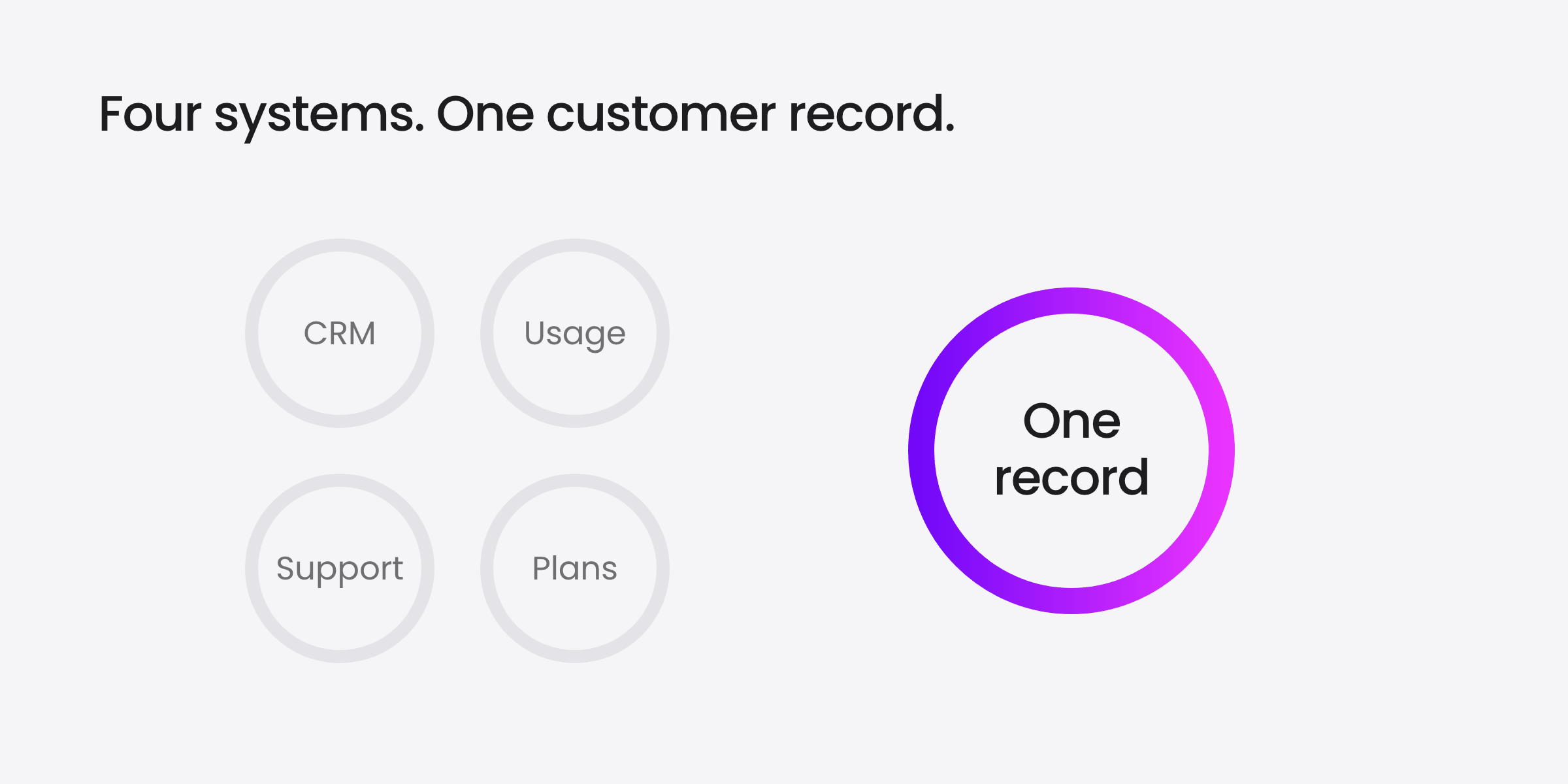
That takes CRM, usage, support and success-plan data on one record the AI can read. Many teams own all four, in four systems.
Level 4 starts when these four sources sit on one record the AI can read.
Base AI covers part of this. Its platform page says customer success and customer marketing "run their programs on the same record and roll up to the same number: NRR." Retention is the clearest test: success plans are only as good as what they can read from onboarding.
Which level is your team at?
A customer success team's AI maturity level comes from eight yes or no questions, two per level. Your level is the highest pair where both answers are yes, with every pair below it also yes. Your next move is the first pair with a no. It takes about ten minutes with your CS ops lead.
Assist. Do most CSMs use AI at least weekly for prep, summaries or drafts? Can you say where the saved time went?
Automate. Do usage or health signals create a task without anyone pulling a report? Do you measure time from signal to customer touch?
Act. In one program, does AI send, answer or adapt without per-touch approval, inside written guardrails? Does your strongest customer-facing program report customer behavior, not hours saved?
Orchestrate. Do CRM, usage, support and success-plan data land on one record the AI can read? Does the next program pick up an account without anyone re-entering context?
If either Assist answer is no, you are at Level 0: individuals use AI and the team can't say what it bought.
You may land a level lower than you would rate yourself. ChurnZero's 63% is self-rated, and this check asks for proof.
How do you climb one level?
Climb one level of AI maturity in customer success by moving one program up one level in a quarter, and proving it with one metric before you touch the next. Maturity models fail when they become a two-year transformation plan. One program keeps the scope small enough to finish.
Pick the program with the most accounts and the least CSM coverage. For most teams that is onboarding for the pooled segment.
Write the guardrails first, task by task. Start narrow.
Connect only the data that program needs. Check your stack against the platform integrations.
Keep a holdout group on the old process.
Decide at 90 days: widen autonomy, hold or roll back.
The metric changes with the level:
Level 1: hours saved, and where they went
Level 2: time from signal to touch
Level 3: customer completion or self-serve rate
Level 4: NRR for the cohort against the holdout
Run the eight questions with your CS leads this week. Write the answer next to one program name.
Key Takeaways
Four levels. Assist, Automate, Act and Orchestrate differ in who acts and what customers see.
Levels 1 and 2. AI through a person only reaches accounts that person already touches.
Level 3. The first level customers notice: one program, acting inside written guardrails.
Climb one program. Pick the biggest uncovered program, keep a holdout, decide at 90 days.
Frequently asked questions
What is AI for customer success?
AI for customer success is software that watches customer data, prepares the work and acts across the post-sale lifecycle: onboarding, adoption, retention, advocacy and expansion. Most AI in customer success today is narrower. It drafts emails and summarizes calls for the CSM, which saves time but, on our reading, often doesn't change what the customer sees. Customers notice a difference once AI acts for them inside guardrails a person sets.
What is a customer success AI maturity model?
A customer success AI maturity model ranks how far AI has moved from helping the CSM to acting for the customer. Base AI's four-level model runs from Assist (AI helps a CSM with a task) to Automate (signals trigger tasks and drafts, a person approves every touch), Act (AI runs one customer-facing program inside written guardrails) and Orchestrate (programs share one customer record and hand accounts on).
What are the latest statistics on AI in customer success?
Most customer success leaders report time savings from AI, but few let it act alone. In ChurnZero's 2026 study of 580 customer success and revenue leaders, 81% said AI has reduced time spent on manual tasks, yet 63% rated their AI maturity tactical or operational and 16% strategic or AI-driven. In Velaris's 2026 survey of 394 CS professionals, only 3% reported AI that can operate with full autonomy.
How do you assess your team's AI maturity in customer success?
Answer eight yes/no questions, two per level, with your CS ops lead in about ten minutes. Your level is the highest pair where both answers are yes, with every pair below it also yes. Your next move is the first pair with a no. You may land a level lower than you would rate yourself, because the check asks for proof rather than a self-rating.
What is AI in customer lifecycle management?
AI in customer lifecycle management means several customer programs run on one customer record, so each hands the account to the next with context attached. Onboarding finishes and adoption picks the account up. A red health signal pauses the advocacy ask and opens a retention plan. It needs CRM, product usage, support and success-plan data in one place the AI can read.
How do you move up a level of AI maturity in customer success?
Move one program up one level, not the whole team. Pick the program with the most accounts and the least CSM coverage, often onboarding for the pooled segment. Write the guardrails first: what AI does on its own, asks first or only suggests. Connect only the data that program needs, choose the metric for the target level, keep a holdout group and decide at 90 days.
Customer experiences that drive NRR.
Building and scaling your advocacy program is easy when you can manage campaigns, rewards, track, and report - all within one AI platform.