A customer success AI agent is software that, inside limits you set, reads each account's live data, picks an action nobody scripted, carries it out with the customer, and stops for a person when it should. Software that only drafts for a CSM, or replays steps someone wrote, is not an agent.
Five demo questions tell you which one you are looking at. Send them before the call, and run them in order.
What is agent washing?
Agent washing, in Gartner's June 2025 definition, is "the rebranding of existing products, such as AI assistants, robotic process automation (RPA) and chatbots, without substantial agentic capabilities." In the same release, Gartner estimated that only about 130 of the thousands of agentic AI vendors were real.
Gartner also predicts that "over 40% of agentic AI projects will be canceled by the end of 2027, due to escalating costs, unclear business value or inadequate risk controls." Both figures are cross-industry, but customer success is not exempt. In our reading, the tests below check for each cause.
Picture minute four of a demo. A health score drops on screen, the agent flags the account, and a tidy check-in email goes to the champion. Your side of the call nods. Nobody can tell yet whether the agent chose that email or replayed a rule somebody wrote two years ago.
Workflow, copilot or AI agent
Three different products get demoed under one word:
Workflow. A person wrote every step in advance. Much of what teams already run as customer success automation looks like this.
Copilot. It works when someone asks. Useful work, all of it bounded by the CSM's calendar. An account nobody opens never gets touched.
Agent. It starts from account data, not a request. It picks the step, takes it and checks what the customer did.
None of the three is a bad purchase. The costly mistake is paying for an agent and getting a workflow.
Five tests for a 45-minute demo
This is our script, so keep the order. Send the questions ahead, ask for a tenant with enough accounts to pick look-alikes from, and bring a CSM who knows real accounts. Skip the slides.
Our script for a 45-minute slot, after five minutes of introductions.
Decide. "Let my CSM pick two accounts in the same segment with the same renewal date. Show me the step the agent chose for each, and the data it used to choose." A pass is two different steps, with a reason that isn't a date or a threshold.
Act. "Show me the last ten actions the agent took without a person pressing send." A pass is a log with timestamps, account names, channels and what the customer did next.
Dial. "Show me the setting for one task in one segment, then change it while I watch." A pass is three positions per task and segment, plus a defined path for an unanswered approval.
Hand off. "Trigger a handoff now, on a test account. Show me exactly what the CSM receives, and where." A pass is one message your CSM can act on without opening another tool.
Report. "Which number on my board deck will this agent move, and how will you separate the agent's effect from my CSMs'?" A pass is a named metric, such as gross and net retention, a set of accounts, a comparison group and a time window.
One trap on Decide: per-account output isn't a per-account decision. Okta's digital success plans, built on Base, the publisher of this blog, place each account on Okta's maturity model from live usage. Okta's story calls that experience automated, and it is: Okta's team designed the model behind every plan.
The agent question is whether the software chooses among actions nobody sequenced for it.
A dial, not a switch
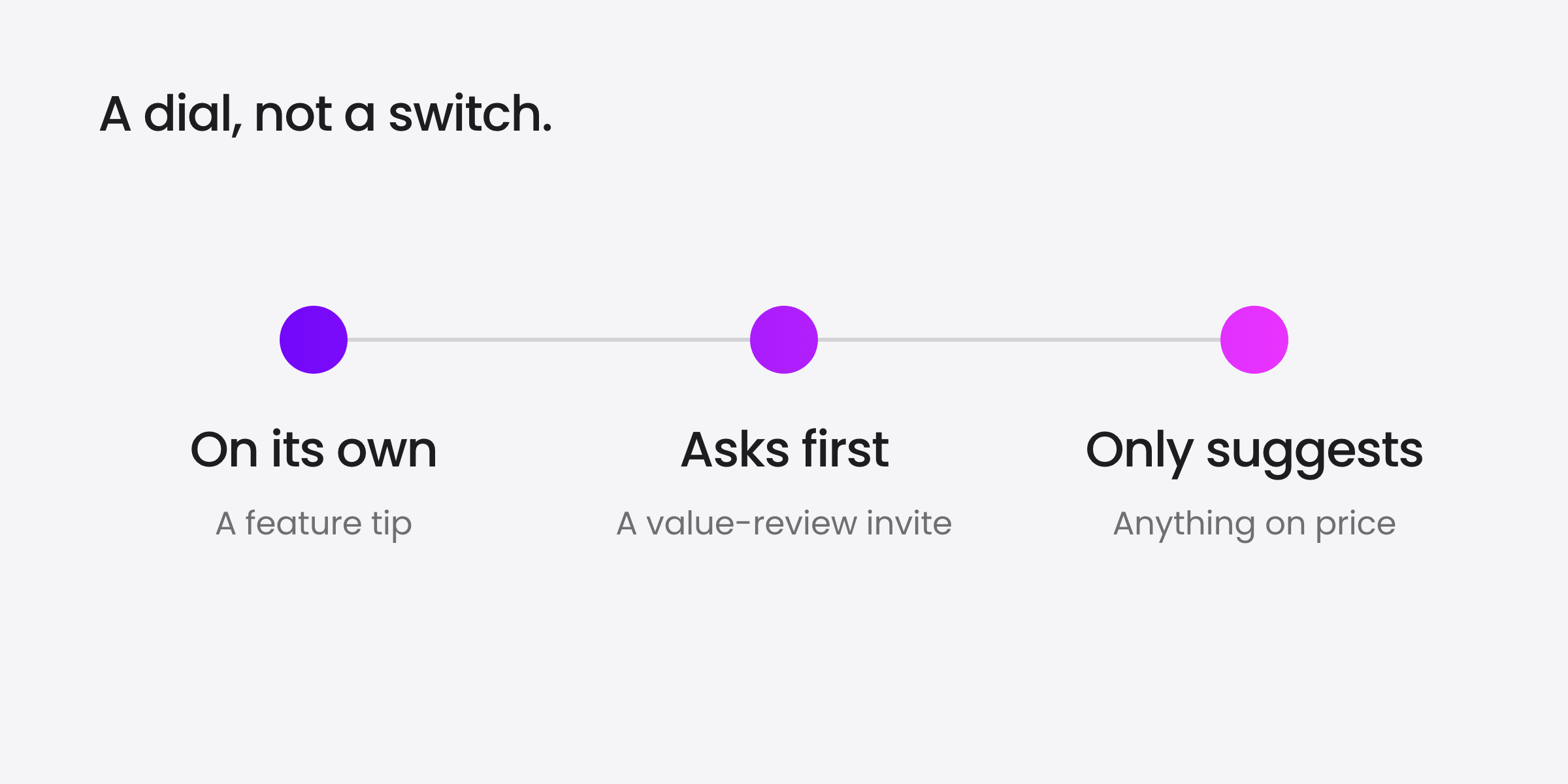
An agent that acts needs a dial. Switched on globally, it can do anything to anyone. Switched off, you bought a reporting tool. Here is an illustration of the three positions:
An illustration. Set yours per task and per segment.
Base AI builds the dial at that grain. Its homepage says "Choose what it does on its own, what it asks first and what it only suggests," and its AI Customer Growth platform page applies the setting "per task and per segment." Ask every vendor to change it live, us included.
Score a customer success AI agent demo by running the five tests in order and stopping at the first fail. Fail Decide and you have a workflow. Fail Act and you have a copilot. Fail Dial or Hand off and you have an ungoverned agent. Fail only Report and it is unproven.
Pass all five and it is worth a pilot. Order matters because a product that can't decide has nothing to dial, and one that never acts has nothing to hand off.
Listen for relabeled answers along the way. These are our composites, not vendor quotes:
"At 60 days out, the agent sends the renewal sequence." That is a rule.
"Your CSM reviews and sends with one click." That puts a person back in the middle.
"AI is switched on for this workspace." That has no dial.
"The CSM gets a notification and can click through to the account." Click through to what?
Which AI agent is best for customer success?
The best AI agent for customer success is the one that passes all five tests on the specific job you plan to hand it, using your own account data. Pick the job first, then invite vendors and run the demo script on that job only.
Each job stretches a different test:
Onboarding: stretch Act. Does the nudge reach the customer?
We have not run these tests on any vendor, so run them yourself, us included. Our definition echoes how Base describes its own product, so give us the hardest demo.
Run a blind test before you sign
The script runs on a demo tenant. Before a contract, compare the agent's decisions with your team's, blind, on your own data. This is our working method, not an industry benchmark, and it takes about four weeks.
Our working method, not an industry benchmark.
Pick 30 accounts on one job, in one segment, mixing ones you worry about with ones you trust.
Have the agent and two of your CSMs each choose the next step for every account, without seeing each other's answers.
Have a CS leader rate the steps unlabeled, and count where the agent matched or beat your team.
Shadow for two weeks in suggest-only mode on live accounts.
Promote task by task where the agent matched or beat your team: "asks first," then low-risk tasks to "on its own."
The output is a map of which tasks this agent should own, propose or never touch. That map is what you negotiate the contract around.
Before you start, cover the plumbing: data access and security. If you would rather build, see our build vs. buy guide. Add one demand: an audit trail of every action, the bar Base sets on its security and privacy page.
Start with one email
Paste the five questions into the calendar invite. A vendor with a real agent will build the demo around them. One with a relabeled workflow will steer back to the slides, and you will know by minute 15.
If Base AI is on your shortlist, send us the same invite. The script doesn't care who publishes the blog.
Key Takeaways
Run your script, not theirs. Send five questions ahead and run them in order.
Ask to see it happen. An action log, a live dial change, a real handoff.
Stop at the first fail. Fail Decide and you have a workflow, not an agent.
Sign after a blind test. Compare the agent's choices with two CSMs' on 30 accounts.
Frequently asked questions
What is a customer success AI agent?
A customer success AI agent is software that, inside limits you set, reads each account's live data, picks an action nobody scripted, carries it out with the customer, and stops for a person when it should. Software that only drafts for a CSM is a copilot. Software that replays steps someone wrote is a workflow.
What questions should you ask in a customer success AI agent demo?
In a customer success AI agent demo, ask five questions, one per agent test, and send them before the call. Test 1: show the step chosen for two look-alike accounts and the data behind each. Test 2: show the last ten actions taken without a person pressing send. Test 3: change one task's setting while I watch. Test 4: trigger a handoff. Test 5: name the board metric it moves.
How do you score a customer success AI agent demo?
Score a customer success AI agent demo by running the five agent tests in order and stopping at the first fail. A product that fails Decide is a workflow, and one that fails Act is a copilot. Failing Dial or Hand off means an ungoverned agent, and failing only Report means an unproven one. Pass all five: worth a pilot.
What is agent washing?
Agent washing is Gartner's term for "the rebranding of existing products, such as AI assistants, robotic process automation (RPA) and chatbots, without substantial agentic capabilities." In its June 2025 release, Gartner estimates only about 130 of the thousands of agentic AI vendors are real. The figure is cross-industry, not specific to customer success, so test each product in the demo.
What is the best AI agent for customer success automation?
The best AI agent for customer success automation is the one that passes all five agent tests (decide, act, dial, hand off, report) on the specific job you plan to hand it, using your own account data. No general list settles that. Pick the job first, such as onboarding, adoption, renewal or expansion, then run the demo script on that job only.
How do you test a customer success AI agent before you buy it?
After the demo, run a blind test of about four weeks on your own data. Pick 30 accounts on one job. The agent and two CSMs each choose the next step without seeing each other's answers, and a CS leader rates them unlabeled. Then shadow the agent for two weeks in suggest-only mode and promote only the tasks where it matched or beat your team.
Customer experiences that drive NRR.
Building and scaling your advocacy program is easy when you can manage campaigns, rewards, track, and report - all within one AI platform.