Customer success AI saves time, but few teams can say what the time bought. In ChurnZero's 2026 Customer Revenue Leadership Study of 580 customer success and revenue leaders, only 21% of the CS leaders tied their AI measurement to revenue outcomes.
In the same study, teams unable to measure AI's impact were four times more likely to require human approval of every recommendation, a correlation in self-reported data. We call that the AI babysitting tax.
The way out is a four-rung ladder, a random holdout and a one-page report. Together they give one AI program a revenue forecast in 90 days, confirmed at first renewal.
Saved time alone doesn't move NRR, on our reasoning. Most customer success AI is pointed at CSM tasks: summaries, drafts, follow-ups. NRR moves when customers behave differently, by onboarding faster, adopting more and renewing. Few teams measure that middle step, so saved hours rarely connect to retained revenue.
ChurnZero 2026, self-reported. The 81% covers all 580 leaders, the 21% covers CS leaders only.
In the same study, 81% of all leaders said AI reduced time spent on manual tasks. NRR has been flat since 2024, yet 65% of the most AI-mature teams reported NRR of 100% or higher. The data is self-reported and ChurnZero sells CS software, so treat it as vendor research that doesn't prove cause.
The AI babysitting tax
The 4x is a correlation, not proof of cause. Our read of the loop behind it:
The team can't show what the AI changed for customers.
So leaders don't trust it, and a person approves every recommendation.
Approval caps volume and keeps the AI on low-stakes work.
Low-stakes work moves no outcome, so there is still nothing to measure.
The tax is easy to estimate. An illustrative team whose AI proposes 300 next steps a week, each reviewed in about 90 seconds, spends 7.5 hours of a senior person's week checking messages it mostly sends unchanged.
Approval itself isn't the problem. On executive outreach or an at-risk escalation, it is good judgment. The problem is approval used instead of measurement.
How do you measure customer success AI ROI?
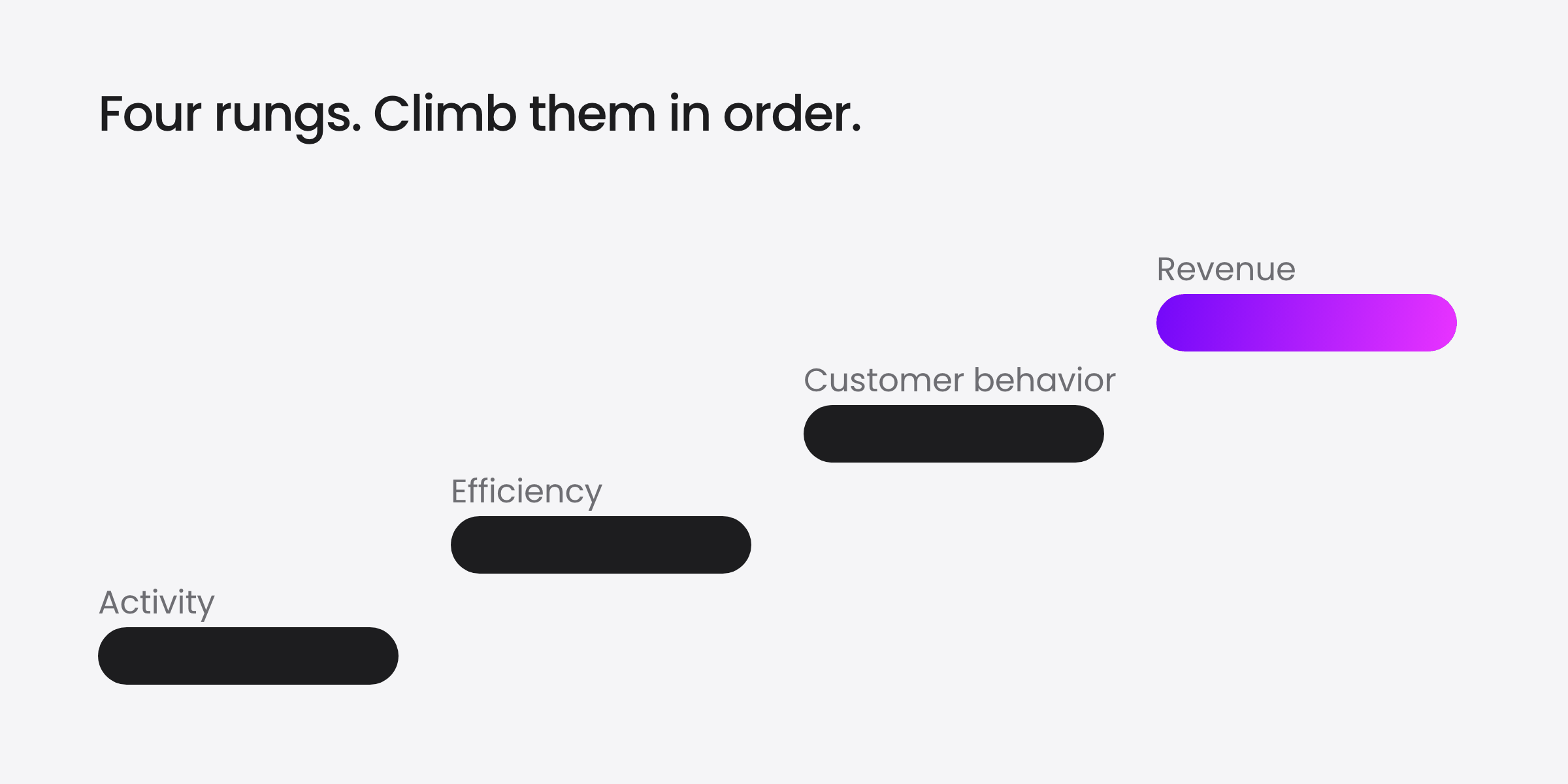
Measure customer success AI ROI on four rungs, with one metric each: activity, efficiency, customer behavior and revenue. Compare every rung against a holdout group, and claim ROI only up to the highest rung you have proven, net of program cost.
One metric per rung, each compared against a holdout.
Activity. What did the AI do? Example: share of accounts with a relevant touch every week.
Efficiency. What did it cost per account? Example: CSM hours per account in the program.
Customer behavior. What did customers do differently? Example: share reaching first value by a fixed day.
Revenue. What did it do to ARR? Example: renewal rate against the holdout, or a forecast from your own history.
Pick each metric before launch. Picked afterwards, you report whatever moved.
Don't stop at hours. TSIA's State of Customer Success 2026 lists what executive teams now focus on: acquisition cost, cost-to-serve, customer lifetime value and NRR. Hours saved isn't there. TSIA is a Base AI customer.
Behavior is the missing rung. Frontify's Base AI customer story reports "a +90% engagement rate on the hub." The page gives no baseline, so read it as direction. Notice its type: what customers did, not what the CSM saved. Customer-facing success plans can work the same way, if you track milestone completion.
A worked example, in illustrative numbers
Every number here is illustrative. It shows the method, not a customer result.
A mid-market CS team onboards 240 accounts in a quarter, at $30,000 average ARR, and launches an AI onboarding journey. Before launch, 48 random accounts stay on the current process. The other 192 get the journey. Ninety days later:
Activity. 97% got a relevant touch every week, against 64% in the holdout.
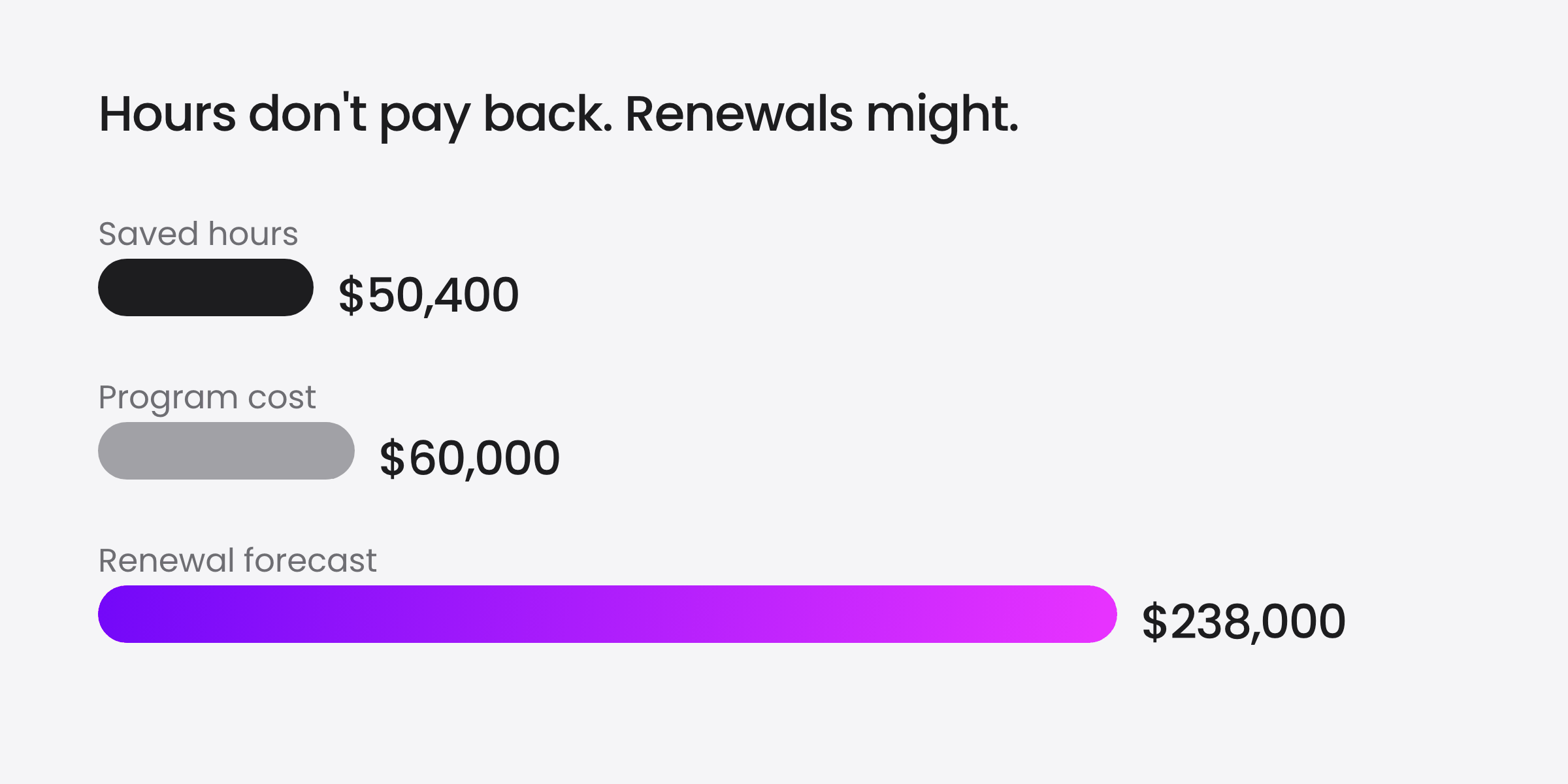
Efficiency. CSM time fell from 5.0 to 1.5 hours per account. At $75 an hour, that is about $50,400 across the 192.
Customer behavior. 81% reached first value by day 45, against 58%.
Revenue forecast. Past cohorts renewed at 92% if they reached first value by day 45, and 74% if not. That predicts 88.6% against 84.4%, or about $238,000 more renewing on $5.76 million of ARR.
Illustrative numbers. The revenue line stays a forecast until the cohort's first renewal.
Add an illustrative program cost of $60,000. Hours alone don't pay back. The forecast does: ($238,000 - $60,000) / $60,000 is a net return of about 3x, in ARR before margin, if renewals confirm it.
It stays a forecast because 90 days is too short to see a renewal. Some of the historical gap is account health, not onboarding speed, so treat it as a ceiling until the holdout's own renewals come in.
What is a holdout group?
A holdout group is a random 10 to 20 percent of a segment's accounts that keeps your current process while the rest get the AI program. Because chance decides who is in it, the gap between the groups at a date fixed in advance is the program's effect plus chance.
It is the cheapest proof you can run. Before-and-after comparisons make you argue away every other change that quarter. A holdout needs a random number and discipline.
Pick one program and one segment.
Sort accounts by a random number and take the bottom 10 to 20 percent.
Give the holdout your current process, not nothing.
Write down the four metrics and the read date before launch.
Keep the groups apart, and read the result on the date you set.
Size matters. As a rule of thumb, with about 50 accounts in the holdout and 200 in the program, a gap needs to be about 15 percentage points or more on a completion rate before you can be confident it isn't chance.
When can AI run without approval?
AI can run without approval once a play's numbers hold: reviewers stop changing its output, and its behavior metric beats the holdout. The Base AI platform describes three modes for an AI teammate: it acts, asks first or suggests. Move one play at a time.
A promotion rule we'd use, per play. The thresholds are ours, not a benchmark.
Suggests to asks first: a defined trigger and audience, live for a holdout test.
Full review to sampled review: reviewers sent at least 95% of the first 200 recommendations unchanged.
Sampled review to acts alone: behavior beats the holdout, and no negative customer signal rose.
Back down a level: the sample shows errors, or behavior stops beating the holdout.
Four rung lines: metric, AI group, holdout, gap. Mark revenue "forecast" until renewals are in.
Program cost: licence, setup and review hours
Approval hours this quarter, and the plays that moved to sampling
The decision: scale, hold or stop, with the next read date
This gets easier when results roll up without a spreadsheet. On the Base AI Customer Growth platform, adoption, references, renewals and expansion are attributed to revenue in one dashboard.
Whatever you use, ask which rung its reporting reaches without an export.
Start with one AI program this week
Bain's December 2025 advice to CS leaders is blunt: "Pick two or three processes to deliver the greatest impact." For measurement, start with one. Choose the AI program closest to a customer outcome, usually onboarding or adoption. Write its four metrics and read date on one page. Draw a random holdout before Monday.
In 90 days you will join the roughly one in five CS leaders who tie AI measurement to revenue, with a forecast and the date it gets confirmed.
To see how Base AI reports on a program, book a demo and bring that one.
Key Takeaways
Time isn't ROI. ChurnZero 2026: only 21% of CS leaders tied AI measurement to revenue.
Babysat AI. Teams that can't measure were 4x likelier to require approval every time, a correlation.
Climb four rungs. Activity, efficiency, customer behavior, revenue: one metric each, chosen before launch.
Keep a holdout. A random 10 to 20 percent of accounts is the cheapest proof.
Frequently asked questions
How do you measure the ROI of AI in customer success?
Measure it on four rungs, with one metric each chosen before launch: activity (what the AI did), efficiency (cost or time per account), customer behavior (what customers did differently) and revenue (retained or expanded ARR). Compare every rung against a random holdout group at a date set in advance, and claim ROI only up to the highest rung proven, net of program cost.
Does customer success AI improve NRR?
Saving time alone is unlikely to, on our reasoning. Most customer success AI is pointed at CSM tasks such as call summaries, drafts and follow-ups, so it saves time without changing what customers do. NRR moves only when customers onboard faster, adopt more and renew. Few teams measure that middle step: in ChurnZero's self-reported 2026 study, only 21% of CS leaders connected their AI measurement to revenue outcomes, while 65% of the most AI-mature teams reported NRR of 100% or higher, which doesn't prove cause.
What are the risks of letting AI act on its own in customer success?
The main risk of letting customer success AI act alone is a wrong or badly timed message reaching a customer unchecked. The opposite risk is an approval queue so long that teams stop using the AI or approve everything unreviewed. Promote one play at a time: full review, then sampled review once reviewers send at least 95% of 200 recommendations unchanged, and step back when errors appear.
What is a holdout group in customer success?
A holdout group is a random 10 to 20 percent of a segment's accounts that keeps the current process while the rest get an AI program. Because chance decides who is in it, the gap between the groups at a date fixed in advance shows the program's effect plus chance. It needs a random number and discipline, not an attribution model or a data science team.
Is hours saved a good metric for AI ROI in customer success?
Hours saved is an input, not a return. A CFO asks whether headcount cost went down and, if not, what the hours produced. Hours count only when converted into a lower cost to serve per account (hours saved times a loaded hourly cost) or given to a named program whose customer outcome you measure. Hours that went to neither were simply absorbed.
How long does it take to see AI ROI in customer success?
Activity, efficiency and customer-behavior results against a holdout can be read within about 90 days. Revenue takes longer, because 90 days is too short to observe a new account's renewal. Until then the revenue line is a forecast built from your own renewal history, treated as a ceiling, and confirmed or replaced by actual rates at the cohort's first renewal.
Customer experiences that drive NRR.
Building and scaling your advocacy program is easy when you can manage campaigns, rewards, track, and report - all within one AI platform.