Will AI Replace Customer Success Managers? Not Yet
Adi Gorelik
-
Base AI
7
min read
-
Published
November 14, 2026
The short answer
Will AI replace customer success managers? Not yet, and not as a whole job. In Velaris's 2026 survey of 394 customer success professionals, 83% reported no CSM workforce reductions at their company due to AI, and 49% reported their role becoming more strategic after using AI.
The harder finding sits next to that number. Leaders report headcount moves their teams may not see.
Will AI replace customer success managers?
AI will not replace customer success managers on the 2026 evidence, but it is taking on tasks like call summaries, QBR prep and first drafts. The role is shifting toward value management. The survey data describes what has happened so far, which says little about next year's plan.
Three cautions on the 83%:
It counts people, not companies. Read it as 83% of CS professionals, never 83% of CS teams.
It reports the past. Velaris titled the finding "The robots aren't coming for you (yet)."
It is vendor research. Velaris and ChurnZero, the other survey here, both sell CS platforms. Both are self-reported, and the samples can't be added.
Leaders report cuts CSMs may miss
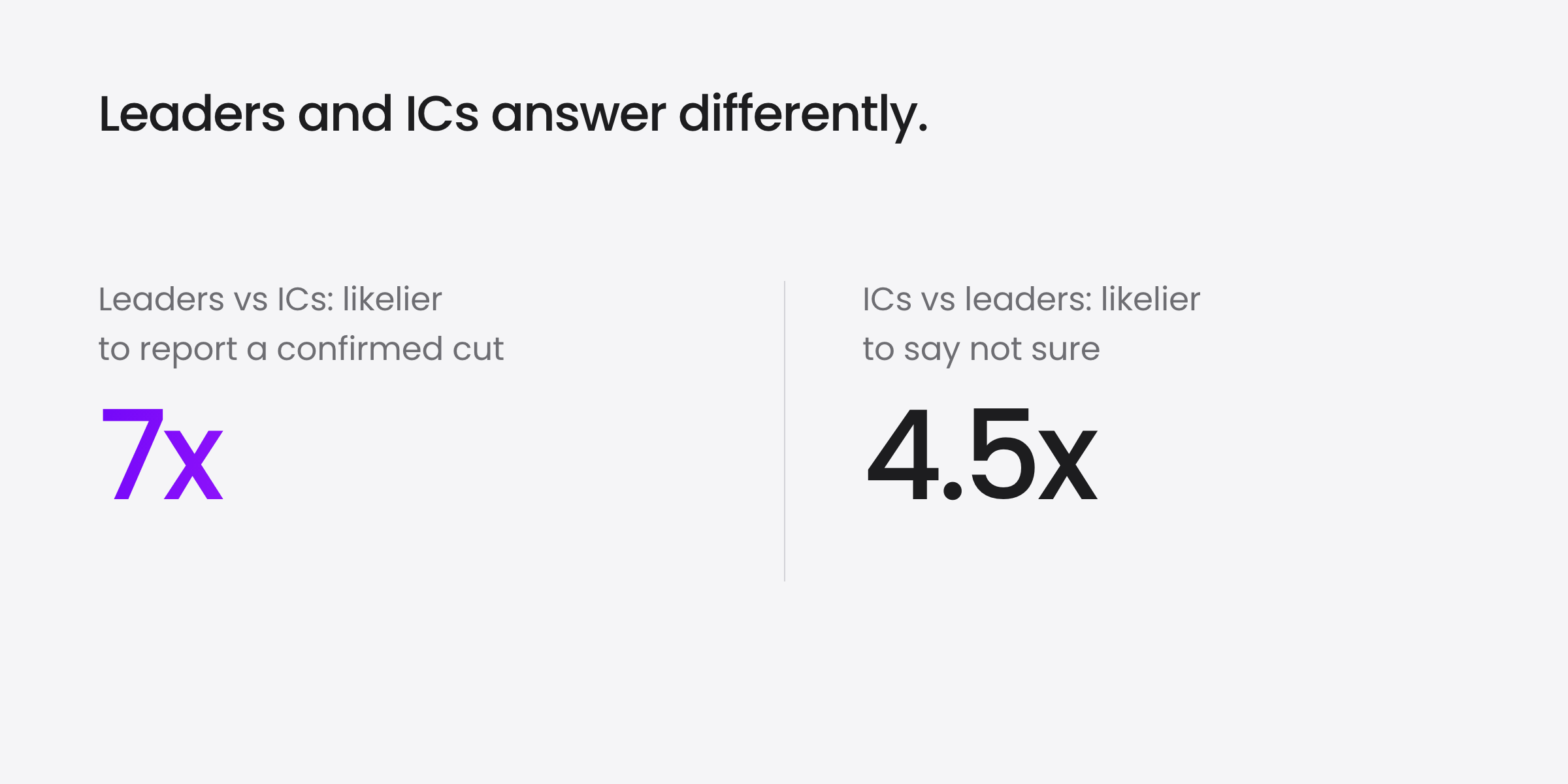
In Velaris's survey, senior leaders were 7x more likely than individual contributors to report a confirmed headcount reduction at their company. ICs were 4.5x more likely to answer "not sure".
Velaris 2026, 394 CS professionals. The cause of the cuts isn't stated, and base rates aren't published.
Be careful with the 7x. The public summary doesn't say those reductions were caused by AI, and Velaris doesn't publish the base rates. Velaris's own reading is that ICs may not see headcount decisions made above them.
That fits how CS orgs work. A VP sees the plan and the requisition that was quietly closed. A CSM sees their own book.
The gap has a cost. Every pessimistic response about the future of CS came from individual contributors.
So if you lead CS, don't assume your team reads the 83% the way you do. Silence about headcount doesn't read as reassurance to someone who already answered "not sure". It reads as confirmation.
AI is already in the headcount plan
In ChurnZero's 2026 Customer Revenue Leadership Study of 580 leaders of customer success, sales or both, 61% said AI has factored into how they plan headcount. The release doesn't say which way. Fewer hires, frozen backfills and cuts could all be in that number.
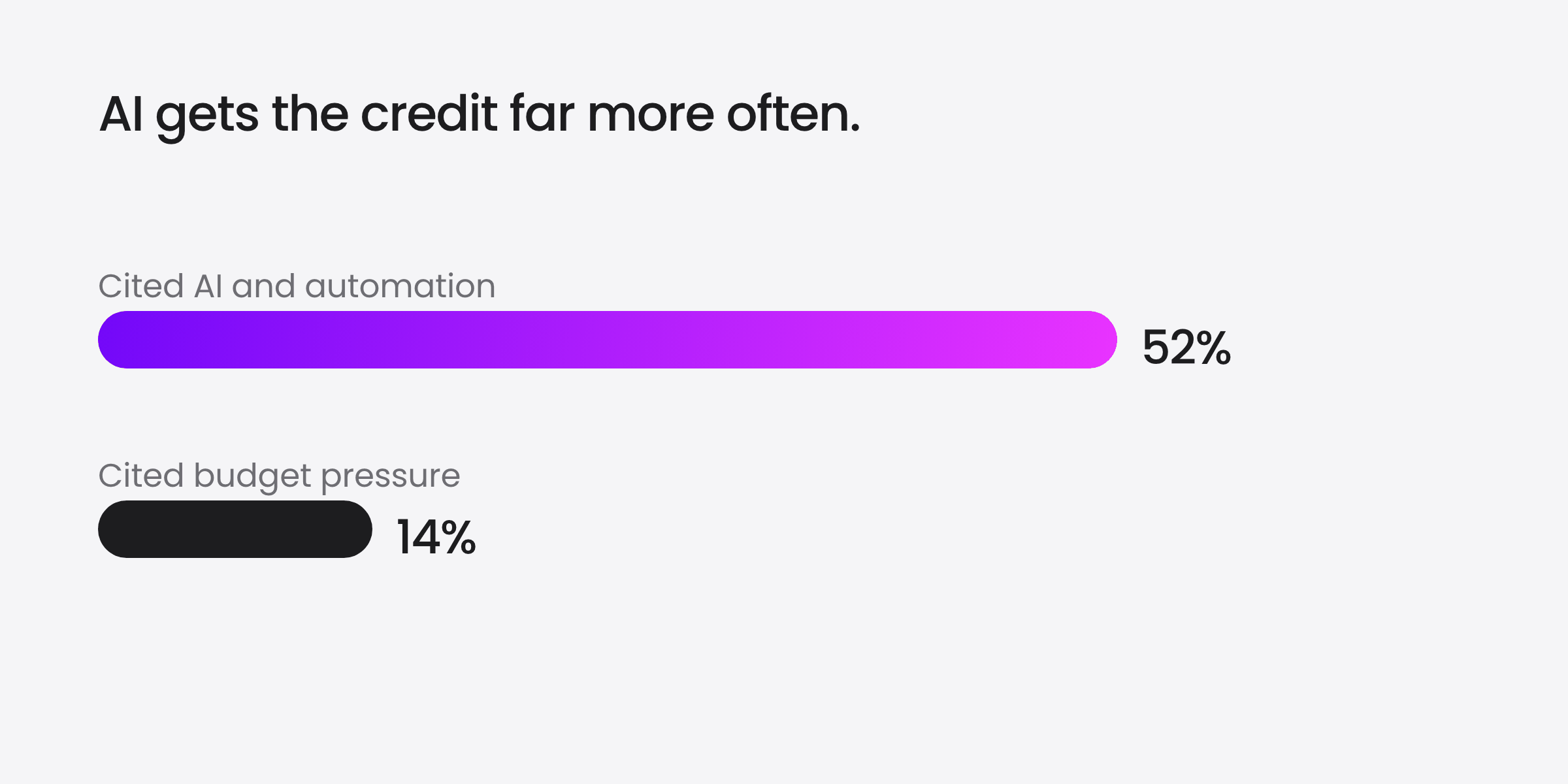
The same study asks why teams cut. Among respondents whose teams reduced roles, 52% cited AI and automation absorbing the work. Only 14% cited budget pressure.
ChurnZero 2026, leaders whose teams reduced roles. The size of that subgroup isn't published.
A second finding shows which line moves first. When budgets shrink, 59% of ChurnZero's respondents cut headcount, while 27% reduce AI spending.
Our read: the pressure shows up in planning before layoffs. If your company cuts CS roles this year, expect the cut to be credited to AI whether or not AI is doing that work yet. Your defense is knowing, account by account, what AI actually does today.
The same release predicts that by 2027, half of the companies that attributed customer service headcount reductions to AI will rehire staff to perform similar functions, but under different job titles.
Gartner's Emily Potosky said AI "isn't mature enough to fully replace the expertise, empathy, and judgment" that human service agents provide.
The work differs. A service agent resolves a ticket. A CSM answers for whether the customer renews and grows. The lesson still carries: cutting before the AI works can cost you twice. You lose the people and their account knowledge, and Gartner expects half of those companies to rehire.
What is an AI customer success manager?
An AI customer success manager is software that does part of a CSM's job without being asked each time. It reads the account's data, prepares briefs, sends routine follow-ups and passes the account to a person when judgment is needed. In 2026 it takes over tasks inside a book, not the book itself.
Forrester's Shari Srebnick described the split in her October 2025 post: AI agents summarize meetings, monitor adoption and flag risk signals, which frees CSMs for strategic guidance.
At Base AI, every program comes staffed. Each AI teammate owns one program, decides the next step for each account, takes it, and brings your people in when an account needs a person. On the AI Customer Growth platform, you choose per task whether it acts, asks first or only suggests.
If AI takes the summaries, the monitoring and the chasing, what's left is a different job. TSIA's State of Customer Success 2026 puts it in one line: "The modern CSM is a value manager." TSIA is a Base AI customer. TSIA and Forrester point to the first two jobs below. The third, program designer, is our addition.
Our synthesis. Value and commercial draw on TSIA and Forrester; program designer is our own.
Value manager. Owns the customer's stated outcome and the evidence for it. Success plans and QBRs built from live data make that proof a standing asset. At Frontify, self-serve experiences replaced one-off communications, "freeing CSMs for higher-value, strategic conversations", per its Base AI customer story.
Commercial owner. Carries the renewal and expansion conversation. Software can flag a signal. A budget holder still wants a person who understands their business case.
Program designer. Decides the journeys and where each AI teammate acts, asks first or suggests. AI Studio lets post-sale teams build customer-facing experiences "without engineers".
A quick check: open last month's calendar for one CSM. If more hours went to prep, notes and chasing than to these three jobs, the risk to that role isn't AI. It's that the role still looks like the tasks AI is taking.
If you're the CSM reading this, the 2026 evidence says most CSM roles aren't going yet. Your tasks are. Pick the job closest to what you already do well, and ask your manager to make it part of your goals this half.
What should you tell your team and board?
Tell your team what you know about headcount before rumor does, and give your board the AI plan as programs and outcomes. ICs are the ones answering "not sure" in Velaris's survey, while 61% of ChurnZero's leaders already factor AI into headcount plans. Five moves for this quarter:
Say what you know, on a schedule. Where headcount stands, what is planned, what is not decided.
Write the workforce plan first. Gartner, as reported by iTnews Asia, told customer service leaders to write their own phased, data-led workforce reduction strategy or risk being handed one. Do the same in CS.
Separate credit from cause. If a role closes, write down which work AI took and who owns the judgment calls.
Rewrite one job description. Start with the role you will hire next, built around the three jobs.
The 83% describes the past. The 61% describes how next year's headcount gets decided. Most of your CSMs can't see into that decision, and that is the gap to close first.
Send this monthly, in your own words:
"Here is where headcount stands today."
"Here is what is decided, and what is not decided yet."
"Here is the work AI is taking off your plate, and the work that stays yours."
"If your role changes, you will hear it from me first."
Not yet. In Velaris's 2026 survey, 83% of CS professionals reported no AI-driven CSM cuts.
A visibility gap. Leaders were 7x likelier than ICs to report confirmed cuts, cause unstated.
AI is in the plan. In ChurnZero's 2026 study, 61% of leaders factor AI into headcount.
The job shifts. Our read: CSMs move toward value, commercial and program work.
Frequently asked questions
Will customer success be replaced by AI?
Not on the 2026 evidence. In Velaris's 2026 survey of 394 customer success professionals, 83% reported no CSM workforce reductions at their company due to AI, and 49% reported their role becoming more strategic after using AI. AI is taking on tasks such as meeting summaries, QBR prep and first drafts, while the CSM role shifts toward value management.
What is an AI customer success manager?
An AI customer success manager is software that does part of a CSM's job without being asked each time: it reads account data, prepares briefs and summaries, sends routine follow-ups and nudges, and hands the account to a person when judgment is needed. The same title is also used for a human CSM who leads customers' AI adoption. In 2026 the software takes tasks, not the book of business.
Why do CS leaders and CSMs disagree about AI job cuts?
CS leaders and CSMs see different parts of the picture. In Velaris's 2026 survey, senior leaders were 7x more likely than individual contributors to report a confirmed headcount reduction at their company, cause unstated, and ICs were 4.5x more likely to answer "not sure". Velaris reads this as ICs not seeing decisions made above them. Every pessimistic answer about CS came from ICs.
How is AI changing the customer success manager role?
AI takes the meeting summaries, adoption monitoring, risk flags and follow-ups, and the CSM job shifts in three directions. TSIA writes that "The modern CSM is a value manager" who owns the customer's outcome. TSIA is a Base AI customer. CSMs also carry renewal and expansion conversations, and design the programs AI runs, including where it acts alone and where it hands off to a person.
Should CS leaders cut CSM headcount because of AI?
Not before the AI does the work. Customer service is the warning: Gartner predicts that by 2027, half of the companies that attributed customer service headcount reductions to AI will rehire staff for similar functions under different job titles. Write your own phased workforce plan, guided by data, and tie each step to work AI already does rather than work a vendor promises.
How can a CSM avoid being replaced by AI?
CSMs stay ahead of AI by moving their week away from the tasks it takes. The contest is less AI against CSMs than CSMs who use AI against CSMs who don't. Check last month's calendar: if prep, notes and chasing outweighed value, commercial and program work, shift it. Pick the job closest to your strengths and ask your manager to make it a goal.
Customer experiences that drive NRR.
Building and scaling your advocacy program is easy when you can manage campaigns, rewards, track, and report - all within one AI platform.