How to use AI in customer success comes down to evidence. We graded 15 use cases, from onboarding to expansion, on the proof behind each one. One earns an A, nine a B and five a C. The only A was borrowed from support agents.
Base AI's own customer stories sit on the same scale, and every one is a C. Pick two or three use cases, and run each grade differently.
How do you use AI in customer success?
To use AI in customer success, pick two or three use cases where analyst or independent support already exists, such as account briefs, health scores and QBR drafts. Then run one customer-facing use case as a measured experiment with a comparison group. Grade every candidate on its evidence before you buy.
Why grade at all? A July 2026 Gartner analysis of 432 AI use cases in customer service, as reported by CX Dive, found about one in four produced a return. Another one in four lost money. In 42% of cases, support leaders didn't know what value they got.
Each use case gets one grade, based on the strongest public evidence for the use case itself, not for any product.
A: independent, measured. Researchers with no product to sell measured a result against a comparison group.
B: analyst or practitioner research. An analyst says leading teams use it, with no published figures. Eight of our nine Bs rest on one Forrester post.
C: vendor claims only. Results come only from companies that sell it. Ours included.
Public sources checked on 2 November 2026. The one A is borrowed from support.
A C doesn't mean a use case fails. It means nobody independent has shown in public that it works. Customer stories are a C by default, because the vendor picks the customer and writes the story.
AI onboarding: vivid proof, weak evidence
Workspace built from the contract: C. TSIA's partner success team assembles one of roughly 500 journeys within three minutes of contract close, per a Base AI story with no exact results published. To test it, generate workspaces for half of new accounts and compare days to the first completed task.
Weekly nudge from an AI agent: C. The same story's headline metric, 0 manual reminders, measures effort, not speed. If you switch on automated onboarding reminders, split new accounts in two and compare on-time completion after 30 days.
Kickoff brief from the sales handoff: B. Forrester's Laura Ramos (November 2025) lists AI-built account briefs among starting points that bring "measurable benefits quickly". Baseline prep time for a month, then count the facts each CSM corrects.
Adoption: the only A is borrowed
Spot accounts ready for an unused feature: B. Forrester lists signals that "spot accounts ready to try out a new feature". Flag accounts for a month, then send tips to half and compare activation at 30 days.
Suggest answers to the CSM mid-question: A, borrowed from support. The study is below.
Assistant in front of the customer: B. Forrester puts these with advanced adopters. Launch on one hub section, for example with AI Studio AI Experts, and compare tickets per account with the quarter before.
The A comes from an NBER working paper by Brynjolfsson, Li and Raymond, covering an AI assistant rolled out to 5,179 customer support agents. Issues resolved per hour rose 14% on average and 34% for novice and low-skilled agents, with minimal impact on experienced agents.
NBER 2023, 5,179 customer support agents, not CSMs. Issues resolved per hour.
Those were support agents, not CSMs. So start with newer CSMs or a pooled team, and keep a person sending every reply. The A doesn't transfer to a customer-facing assistant, because it measured a person with an assistant.
Retention: one analyst backs the signals
Health score from more than usage: B. Forrester names AI-generated health scores "that help them prioritize which accounts to focus on". Score last year's churned and renewed accounts blind.
Catch the account that went quiet: B. Forrester's starting points include signals that "detect potential risks". Back-test one rule, such as red health and 30 quiet days, before you add a model.
QBR drafted from live data: B. Forrester lists AI that helps "draft quarterly business reviews". Our retention page calls this running QBRs without the prep work. Time prep for a month, then switch on drafts.
Base AI's clearest quiet-account example isn't AI. At Phenom, the story credits analytics dashboards that show which companies have gone quiet. Like every customer story here, it is a C.
Advocacy and expansion: half rest on vendors
In advocacy, two of three use cases have only vendor numbers:
Find customers ready to be asked: C. Our advocacy page describes it, and we found no independent test. Split asks between AI-picked and CSM-picked advocates.
Mine calls and tickets for stories: B. Forrester calls customer experiences and service cases "some of the richest sources of material". Count usable quotes per hour of review.
Match references to live deals: C. Our references page says programs on Base AI "convert 60% more asks into completed references", with no published method or baseline. Split requests and compare completed references.
In expansion, signals have analyst backing and automated campaigns do not:
Flag accounts ready to upgrade: B. Forrester's signals name accounts ready to "upgrade to a new product." Flag for a quarter without acting, then compare upgrade rates.
Draft the expansion plan: B, borrowed from account briefs and growth signals. Draft plans for half of your top 40 accounts and compare commercial conversations after 90 days.
Trigger upsell campaigns from usage: C. Our expansion page describes it and our homepage cites 78% conversion, with no published definition or baseline. Hold back a random tenth of eligible accounts.
Which AI uses have the strongest evidence?
The strongest evidence for AI in customer success is for AI that helps a person. In an independent study of 5,179 support agents (NBER, 2023), those given an AI assistant resolved 14% more issues per hour. Forrester lists preparation work as bringing measurable benefits quickly. No independent controlled study we found measures customer-facing or automated uses in customer success.
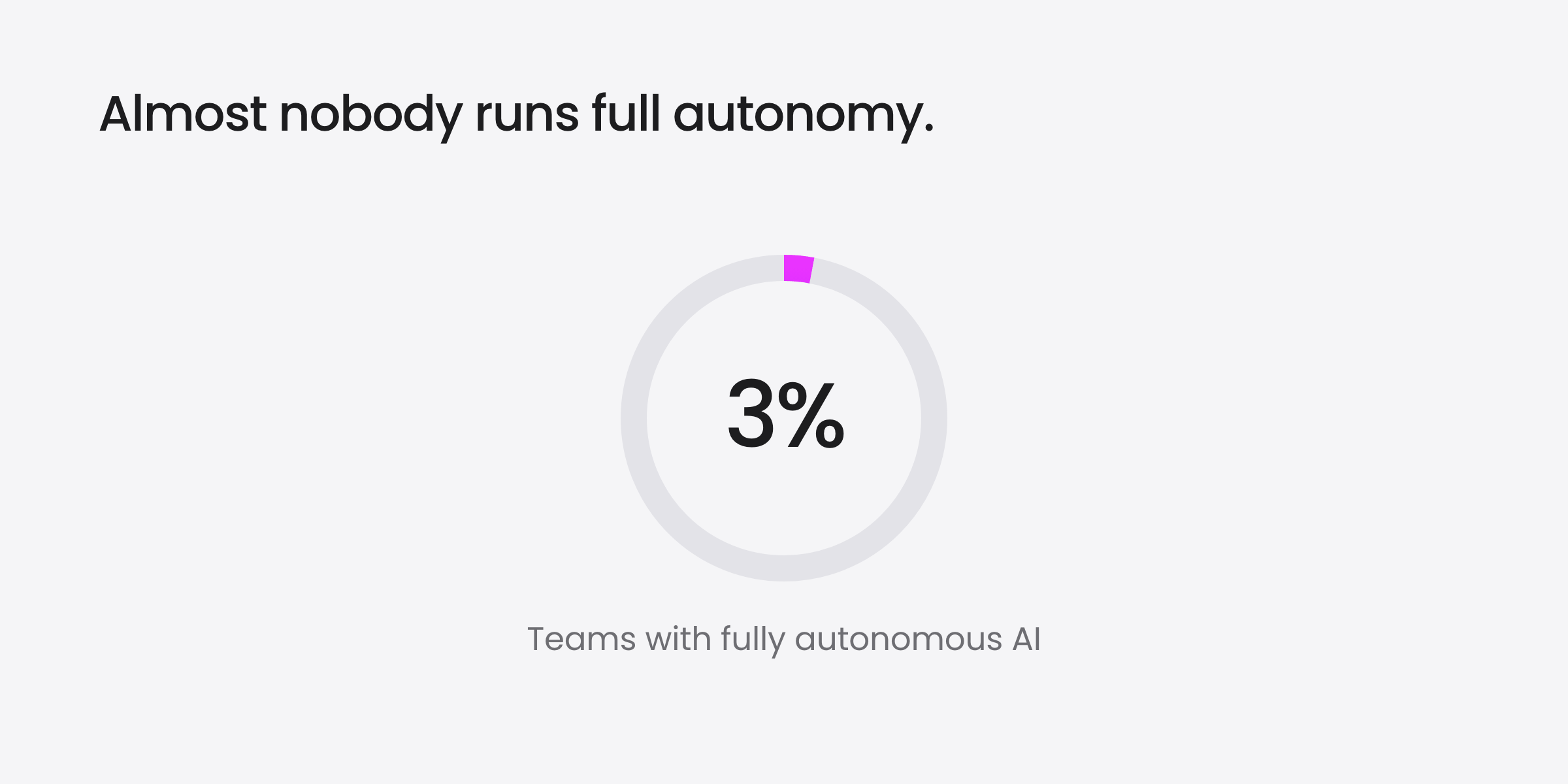
Autonomy has little evidence, and one likely reason is that few teams run it. Velaris, which sells a CS platform, surveyed 394 CS professionals for its 2026 report and found: "Only 3% of teams report having deployed AI that can operate with full autonomy".
Velaris 2026, 394 CS professionals. Velaris sells a CS platform.
Here is the uncomfortable part. Prep work saves CSM time, and saved time doesn't reach a customer by itself. You can't avoid customer-facing uses. You can stop treating them as proven.
Pick two or three AI uses
Bain's December 2025 report is blunt: "Pick two or three processes to deliver the greatest impact." The grade tells you how to run each pick.
A: adopt and measure lightly. One before-and-after metric is enough. Check that your team resembles the study's.
B: pilot against a baseline. Record the metric for a month before you switch it on.
C: run an experiment. Set up a holdout group, choose one customer outcome and set a kill date.
A sensible first mix: one B that gives time back, like kickoff briefs, and one C that touches customers, like onboarding nudges, with a holdout. The B buys the time. The C produces the evidence.
Every C here is a program Base AI runs, which is why we graded our own stories as hard as anyone's. On the AI Customer Growth platform, every program comes staffed: an AI teammate decides the next step for each account and takes it. Run it with a holdout, and grade it yourself.
Key Takeaways
Grade first. Of 15 use cases, one earns an A, nine a B, five a C.
The A is borrowed. NBER: AI-assisted support agents resolved 14% more issues per hour.
Vendor claims are a C. Automated uses rest on vendor numbers, Base AI's own included.
Run each grade differently. Measure an A lightly, baseline a B, hold out a C.
Frequently asked questions
How can AI be used in customer success?
AI can be used at every stage of the customer lifecycle: onboarding workspaces built from the contract, weekly task nudges and kickoff briefs; adoption signals, suggested answers and customer-facing assistants; health scores, quiet-account alerts and QBR drafts; advocate readiness, story mining and reference matching; and upgrade signals, expansion plan drafts and usage-triggered upsell campaigns.
Does AI actually improve customer success results?
Independent proof is thin. The only measured result with a comparison group comes from customer support: in an NBER study of 5,179 agents, an AI assistant raised issues resolved per hour by 14%, and by 34% for novices, with minimal impact on experienced agents. One Forrester post supports preparation and signal use cases, without published figures. For automated uses such as nudges and upsell campaigns, only vendors publish numbers.
How can AI agents help customer success teams?
AI agents can take the action after a signal: sending weekly task nudges, building onboarding workspaces from the contract or launching upsell campaigns when usage crosses a threshold. The evidence for these automated uses comes only from vendors. Velaris, which sells a CS platform, surveyed 394 CS professionals and found only 3% of teams report deploying AI with full autonomy.
Where should a customer success team start with AI?
Start with two or three use cases, as Bain advises in its December 2025 report on customer success. A sensible first mix sits in one lifecycle stage: one analyst-backed use case that gives CSMs time back, such as kickoff briefs, and one customer-facing use case, such as onboarding nudges, run against a holdout group so it produces your own evidence.
Can AI predict customer churn?
AI health scores that combine usage, ticket text and call sentiment have analyst backing as a way to decide which accounts to focus on. The sources behind that backing publish no figures on how well they predict churn. Test one before trusting it: score last year's churned and renewed accounts blind, and check whether the churned ones land in the bottom quartile.
How do you test an AI use case in customer success before rolling it out?
Match the test to the use case's evidence grade. For a use case with independent proof, one before-and-after metric is enough. For one with analyst backing, record the metric for a month before switching it on. For one backed only by vendor claims, hold out a comparison group, pick one customer outcome metric and set a kill date. Name the 90-day number first.
Customer experiences that drive NRR.
Building and scaling your advocacy program is easy when you can manage campaigns, rewards, track, and report - all within one AI platform.